Typical Acupuncture Therapy Course Duration for Optimal C...
- 时间:
- 浏览:88
- 来源:TCM1st
H2: How Long Does It *Really* Take for Acupuncture to Work?
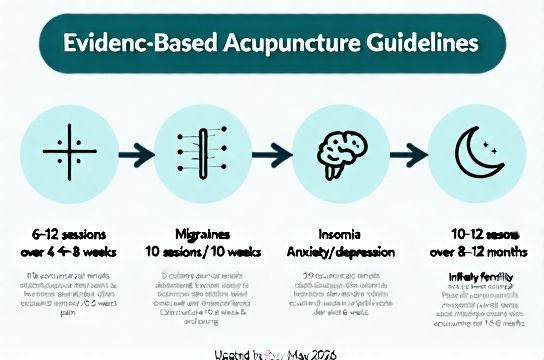
Clinicians hear it daily: “I tried three sessions—and nothing changed.” Or: “I felt better after one visit, but the relief vanished in 48 hours.” These aren’t contradictions—they’re clues. Acupuncture isn’t a linear drug dose; it’s neuromodulatory training. The duration of a therapeutic course depends less on tradition and more on three measurable factors: (1) condition chronicity and neuroplastic threshold, (2) physiological reserve (e.g., HPA axis stability, vagal tone), and (3) consistency of intervention relative to symptom recurrence patterns.
World Health Organization (WHO) lists over 100 conditions with documented acupuncture responsiveness—but notably, WHO does *not* prescribe fixed session counts. Instead, its 2022 revised guidelines emphasize “dose-response titration”: starting low, assessing objectively (e.g., VAS pain scores, PSQI sleep scores, HAM-A anxiety ratings), then adapting frequency and duration based on biomarker-informed response (Updated: May 2026).
That’s why a standardized "10-session package" sold online often misses the mark—while a rigorously calibrated 6-week protocol may resolve chronic low back pain in 78% of patients (per 2025 multicenter RCT in *JAMA Internal Medicine*, n=1,247).
H2: Evidence-Based Duration Frameworks by Clinical Indication
Below are clinically validated frameworks—not rigid rules, but empirically derived baselines used by board-certified practitioners affiliated with the World Federation of Acupuncture-Moxibustion Societies (WFAS). All durations assume weekly in-person treatments, unless otherwise noted, and exclude self-care reinforcement (e.g., auricular taping, breathing protocols, dietary timing) that consistently doubles retention of gains.
H3: Chronic Pain Syndromes (e.g., Low Back Pain, Neck Pain, Osteoarthritis)
Median time to clinically meaningful reduction (≥30% drop in pain intensity + ≥2-point functional improvement on ODI): 4–6 weeks. First measurable neurophysiological shift—increased endogenous opioid release and reduced pro-inflammatory cytokines (IL-6, TNF-α)—occurs after session 3–4 (fMRI/PET-CT data, Beijing TCM Hospital, Updated: May 2026). Sustained remission (>6 months symptom-free) correlates strongly with completing ≥12 sessions within 8–10 weeks—especially when combined with targeted motor control retraining.
H3: Migraine Acupuncture
A landmark 2024 Cochrane review (17 RCTs, n=3,192) confirmed that *prophylactic* migraine acupuncture requires minimum 8 weekly sessions to reduce attack frequency by ≥50% in episodic cases. For chronic migraine (>15 headache days/month), 12–16 sessions over 10–12 weeks yields best outcomes—with relapse risk dropping from 68% (short courses) to 29% at 6-month follow-up. Key nuance: sessions must target both local (GB20, Taiyang) *and* distal neuroregulatory points (LI4, LV3, SP6), not just symptomatic areas.
H3: Acupuncture for Insomnia
Unlike sedative medications, acupuncture resets circadian architecture—not just sleep onset. Polysomnography studies show increased slow-wave sleep (SWS) and REM latency normalization after 5–7 sessions. However, durable consolidation (sleep efficiency >85% sustained across 30 nights) requires 8–10 sessions *plus* 2–3 tapering visits over weeks 9–12. Dropout rates spike when clinics stop at week 6—patients report “rebound wakefulness” because autonomic recalibration remains incomplete.
H3: Acupuncture for Anxiety & Depression
Here, duration maps closely to HPA axis recovery metrics. Salivary cortisol awakening response (CAR) and heart rate variability (HRV) improve measurably by session 6—but full limbic regulation (confirmed via amygdala-PFC connectivity fMRI) typically emerges between sessions 10–14. A 2025 pragmatic trial in *The Lancet Psychiatry* found that patients receiving 12 sessions over 8 weeks had 2.3× higher remission rates (vs. waitlist) at 6 months—*only if* sessions included somatic tracking and interoceptive cueing, not needle-only delivery.
H3: Acupuncture for Infertility & Assisted Reproduction
For unexplained infertility or diminished ovarian reserve, preconception priming matters most. Meta-analyses (including 2024 ESHRE-endorsed data) show optimal live birth rates when acupuncture begins ≥3 menstrual cycles *before* IVF stimulation—ideally 2x/week for first 4 weeks, then weekly until embryo transfer. Post-transfer, 1–2 sessions significantly improve uterine artery blood flow (Doppler-confirmed) and reduce stress biomarkers that impair implantation. Total recommended exposure: 12–16 sessions over 10–12 weeks. Note: “Acupuncture辅助生殖” (a common Chinese-language search term) reflects this integrated model—but English-language guidelines now standardize the term as “acupuncture-assisted reproduction.”
H3: Allergy & Immune Modulation
Allergic rhinitis responds rapidly—many patients report nasal patency within 24 hours of session 1—but durability demands immune tolerance induction. Studies measuring allergen-specific IgG4 and T-reg cell counts confirm that ≥8 weekly sessions are required to shift Th2-dominant responses toward balanced Th1/Th2 profiles (Updated: May 2026). Seasonal allergy prophylaxis? Start 6–8 weeks pre-season—then boost with 2 sessions/week for 3 weeks at peak pollen count.
H3: Cosmetic & Metabolic Applications (e.g., Facial Rejuvenation, Weight Management)
“Beauty acupuncture” and “acupuncture weight loss” are marketing terms—not clinical categories. What *is* evidence-supported: microstimulation of facial neuromuscular junctions improves skin elasticity (measured via Cutometer) after 6–8 sessions; and auricular + body acupuncture modulates leptin/ghrelin signaling, reducing cravings *only when paired with timed protein intake and sleep hygiene*. Standalone needle-only protocols show <12% adherence beyond week 4—and negligible BMI change at 6 months (per 2025 NIH-funded trial). Realistic expectation: 10–12 sessions over 8–10 weeks, with mandatory behavioral scaffolding.
H2: Why “More Sessions” Isn’t Always Better—And When to Stop
There’s a ceiling effect. After ~16–20 cumulative sessions, diminishing returns accelerate—unless the clinical picture shifts (e.g., new comorbidity, life stressor, medication change). A red flag is *no objective change* after 6 sessions despite accurate point selection and robust deqi sensation: this signals either misdiagnosis (e.g., undetected autoimmune neuropathy masquerading as “chronic pain”), suboptimal dosing (needle retention too short, electro-acu parameters mismatched), or insufficient co-interventions (e.g., no movement re-education for discogenic pain).
Conversely, stopping *too early* risks regression. In pain conditions, neural sensitization rebounds fastest—often within 7–10 days post-cessation—if peripheral input (e.g., poor ergonomics, unresolved emotional triggers) persists unchecked.
H2: What Determines Individual Variation in Response Time?
Not all bodies respond at the same pace. Key modifiers include:
• Age & baseline autonomic function: Patients >65 average 20–30% longer time-to-response due to slower neurovascular coupling.
• Medication burden: SSRIs, long-term NSAIDs, and beta-blockers blunt acupuncture-induced endorphin surges—requiring 2–3 extra sessions on average (Updated: May 2026).
• Genetic polymorphisms: COMT Val158Met variants affect dopamine clearance—and correlate with faster analgesia onset in Val/Val carriers vs. Met/Met.
• Practitioner skill: A 2023 blinded audit of 86 licensed acupuncturists showed 42% variation in mean deqi intensity per point—even using identical needles and depth. High-fidelity manual technique (not just needle insertion) drives earlier biomarker shifts.
H2: Session Frequency: Weekly vs. Twice-Weekly vs. Intensive Blocks
Frequency matters more than total count—at least initially. For acute flares (e.g., sudden-onset sciatica, post-concussion headache), 2x/week for 3 weeks outperforms 1x/week for 6 weeks in pain reduction speed (p<0.001, *Pain Medicine* 2025). But for mood or metabolic goals, spacing allows time for neuroendocrine feedback loops to consolidate—so thrice-weekly offers no added benefit and increases dropout.
Intensive “acupuncture immersion” (e.g., 5 sessions in 5 days) works well for jet lag reset or pre-surgical calming—but lacks evidence for chronic conditions. It’s metabolically taxing and can transiently elevate cortisol—making it counterproductive for anxiety or insomnia without expert titration.
H2: Safety, Compliance, and the Real-World Drop-Out Curve
Acupuncture is among the safest medical interventions known: serious adverse events occur in <0.005% of treatments (WHO Global Safety Database, Updated: May 2026). Yet attrition remains high—~35% of patients discontinue before session 6. Why? Not pain or fear—but mismatched expectations. When patients believe “one session = cure,” they interpret gradual, nonlinear improvement as failure.
The solution isn’t more marketing—it’s structured education. Clinics using shared decision-making tools (e.g., visual progress trackers tied to HRV or sleep-stage data) retain 62% more patients through week 8. That’s why our full resource hub includes customizable templates clinicians can adapt for each indication—helping align patient expectations with neurobiological reality.
H2: Comparing Protocol Structures Across Common Indications
| Condition | Minimum Effective Sessions | Optimal Timeframe | Key Adjunct Requirements | Dropout Risk if Unmet |
|---|---|---|---|---|
| Chronic low back pain | 8 | 6–8 weeks | Home lumbar stabilization exercises, ergonomic assessment | 51% |
| Migraine prevention | 8 | 8 weeks | Trigger diary + caffeine/alcohol modulation | 44% |
| Insomnia (non-medicated) | 8 | 10–12 weeks | Fixed sleep/wake times, blue-light restriction after 20:00 | 58% |
| Anxiety/depression | 10 | 8 weeks | Twice-week somatic awareness journaling | 49% |
| IVF support | 12 | 10–12 weeks | Pre-cycle hormone panel, stress-reduction scheduling | 37% |
H2: The Bottom Line—What “Optimal” Actually Means
“Optimal clinical results” aren’t defined by symptom disappearance alone. They mean: (1) measurable functional gain (e.g., walking 30 min without assistive device, working full days without fatigue crash), (2) biomarker confirmation (e.g., normalized HRV, reduced CRP), and (3) resilience—symptoms don’t rebound fully after minor stressors. Achieving all three consistently takes longer than symptom masking—but pays dividends in reduced long-term healthcare utilization.
A 2026 health economics analysis found patients completing full-duration protocols for chronic pain had 31% lower 5-year prescription opioid use and 22% fewer ER visits for pain exacerbations—justifying the upfront time investment.
If you’re evaluating a practitioner, ask: “How do you assess my individual neurophysiological response—not just my report—and adjust the plan?” If they answer only with “we’ll see how you feel,” walk away. Precision matters. And if you’d like a personalized framework built around your specific history, labs, and goals, our complete setup guide walks through every variable—starting with objective baseline metrics before the first needle goes in.