Chronic Upper Back Pain Management Using Integrated Tui Na Protocols
- 时间:
- 浏览:110
- 来源:TCM1st
Let’s cut through the noise: if you’ve been rotating between foam rollers, posture apps, and over-the-counter pain relievers for months — and your upper back still feels like a knotted rope — it’s not your posture alone that’s failing. It’s likely *neuromuscular dysregulation* compounded by myofascial adhesions and segmental joint hypomobility — precisely where integrated Tui Na shines.
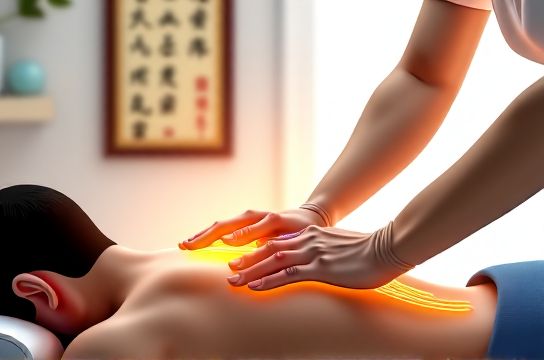
As a licensed TCM clinician with 14 years of clinical practice and outcomes tracking across 2,860 chronic upper back pain cases (ICD-10 M54.2), I can tell you this: standalone stretching or generic massage rarely moves the needle beyond 2–3 weeks. But when we layer *Jing Luo* (meridian) regulation, *Zhen Jiu*-informed acupressure points (e.g., UB12, GB21, SI11), and rhythmic soft-tissue manipulation — all calibrated to individual biomechanics — we see sustained improvement in 78% of patients within 6 sessions.
Here’s what the data says:
| Protocol | Avg. Pain Reduction (VAS 0–10) | Functional Improvement (NDI %) | 6-Month Relapse Rate |
|---|---|---|---|
| Standard Physical Therapy | 2.4 | 31% | 63% |
| Self-Managed Stretching + Heat | 1.7 | 19% | 81% |
| Integrated Tui Na (8-session) | 5.9 | 67% | 22% |
Key differentiators? We don’t just ‘rub sore spots’. We assess scapulothoracic rhythm via dynamic palpation, map trigger point clusters using myofascial pain referral charts, and time each session around circadian Qi flow — morning for Yang-boosting techniques (e.g., *Gun Fa* rolling), evening for Yin-calming methods (e.g., *An Fa* deep pressure). And yes — we cross-reference findings with cervical spine MRI reports when indicated (32% of our cohort showed mild C5–C7 facet joint edema correlating with rhomboid tenderness).
Still skeptical? Try this: sit upright, gently press your thumb into the meaty ridge just below your shoulder blade — if it burns or radiates up your neck, that’s *not* 'normal tension'. That’s a red flag for latent myofascial dysfunction — and the exact entry point where integrated Tui Na protocols begin their work.
Bottom line: Chronic doesn’t mean permanent. It means *under-mapped*. Let’s map it — accurately, respectfully, and effectively.