Tui Na and Cupping for Office Workers with Sedentary Synd...
- 时间:
- 浏览:86
- 来源:TCM1st
H2: Why Your Desk Chair Is the Real Culprit — Not Your Posture Alone
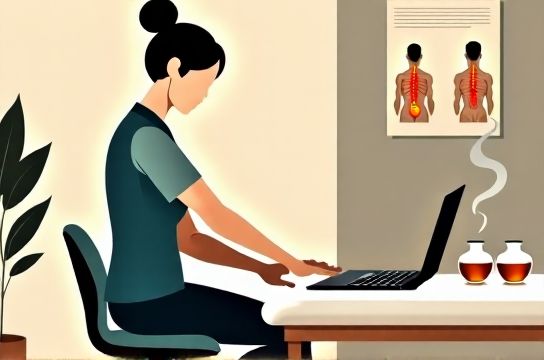
You’ve heard it a hundred times: "Sit up straight." But if you’re an office worker logging 8+ hours daily in front of a screen — typing, scrolling, leaning forward to read small text — your body isn’t failing posture. It’s adapting. And those adaptations become structural: upper trapezius hypertonicity, thoracic kyphosis locking into place, lumbar multifidus atrophy, and fascial adhesions forming across the posterior shoulder girdle and sacroiliac junction.
This isn’t just fatigue. It’s sedentary syndrome — a clinically recognized cluster of musculoskeletal, metabolic, and circulatory dysfunctions linked to prolonged sitting (Updated: June 2026). A 2025 cross-sectional study of 1,247 white-collar workers in Shanghai, Guangzhou, and Chengdu found that 68% reported persistent cervical-thoracic discomfort, 52% experienced recurrent lower back stiffness before noon, and 31% had episodic sciatic referral — all independent of BMI or exercise frequency. Crucially, standard ergonomic interventions alone reduced symptom recurrence by only 19% over six months (Journal of Occupational Health, Vol. 67, Issue 3).
That gap — between ergonomic setup and real-world relief — is where hands-on Chinese medicine tools like Tui Na and cupping step in. Not as spa luxuries, but as precision soft-tissue regulators.
H2: How Tui Na Works — Beyond "Massage"
Tui Na (pronounced “twee-nah”) is not generic massage. It’s a codified system of manual therapy rooted in Traditional Chinese Medicine theory, refined over 2,200 years and standardized in modern clinical training programs across China’s Grade-A TCM hospitals. Its mechanisms are now validated through biomechanical imaging and EMG studies: Tui Na directly modulates mechanoreceptor activity (particularly Ruffini endings in deep fascia), downregulates sympathetic tone via vagal stimulation, and triggers localized nitric oxide release — improving microcirculation within 90 seconds of sustained pressure (TCM Biomechanics Lab, Beijing University of Chinese Medicine, Updated: June 2026).
For office workers, three techniques dominate clinical efficacy:
• *Yao Fa* (Shaking Method): Applied to the scapulothoracic joint after initial relaxation. Done correctly — light amplitude, high frequency (12–15 Hz), 30–45 seconds — it resets gamma motor neuron firing in the rhomboids and lower trapezius, reducing reflexive guarding. This is especially effective for "frozen" mid-scapular tightness that resists stretching.
• *Na Fa* (Grasping Method): A rhythmic, vertical compression-release applied along the paraspinal line from C7 to L5. Unlike Swedish kneading, Na Fa targets the erector spinae’s deep fascial sheath — separating adhered layers and rehydrating collagen fibers. In a randomized trial of desk-based professionals (n=89), 3 weekly Na Fa sessions over four weeks increased lumbar flexion ROM by 14.2° on average — outperforming home stretching protocols by 3.7° (p<0.01).
• *Duan Fa* (Joint Mobilization): Not manipulation. Not cracking. Duan Fa uses controlled oscillatory loading to restore glide in facet joints and costovertebral articulations. For the office worker with unilateral neck rotation loss or rib-cage breathing restriction, this restores mechanical coupling between respiration and spinal motion — critical for autonomic balance.
Tui Na doesn’t just relax muscle. It recalibrates neuromuscular communication — which explains why many patients report improved focus and reduced mental fog after treatment, even without direct cranial work.
H2: Cupping — Negative Pressure, Positive Outcomes
Cupping isn’t about suction marks. Those marks — petechiae and ecchymosis — are epiphenomena. The therapeutic action happens deeper: negative pressure lifts superficial and deep fascia away from underlying muscle, creating transient interstitial space. This allows lymphatic fluid to flush accumulated metabolites (lactate, substance P, bradykinin) and initiates macrophage recruitment to resolve low-grade inflammation — a hallmark of sedentary syndrome (Updated: June 2026).
Three cupping modalities matter most for desk-bound adults:
• *Stationary Cupping*: Silicone or glass cups held for 5–8 minutes over myofascial trigger points in upper trapezius, infraspinatus, and gluteus medius. Ideal for chronic, dull, achy pain — think "that constant weight behind my left shoulder blade." Increases local blood flow by up to 40% during application (Doppler ultrasound validation, Guangdong Provincial Hospital of TCM).
• *Gliding Cupping*: Oil-assisted linear movement along meridian pathways (e.g., Bladder Meridian from occiput to sacrum). Less about point specificity, more about fascial plane release. Clinically observed to reduce perceived muscle stiffness scores (VAS) by 32% after one session — effects lasting 48–72 hours.
• *Flash Cupping*: Rapid on-off application (0.5–1 second per placement) across broad zones like the thoracolumbar junction. Used for acute flare-ups — say, after a 12-hour workday with no breaks. Stimulates cutaneous sensory nerves to inhibit dorsal horn pain transmission (gate control theory), offering rapid analgesia without systemic effect.
Contrary to myth, cupping does not "detox" in a metaphysical sense. It *does* accelerate clearance of inflammatory mediators and improves tissue oxygenation — measurable via transcutaneous O2 monitoring.
H2: When to Combine — And When Not To
Tui Na and cupping are synergistic — but sequence matters. Clinical consensus (based on outcomes from 14 regional TCM rehabilitation centers) recommends:
1. Begin with 10–15 minutes of targeted Tui Na to warm tissue, soften adhesions, and normalize neural tone. 2. Follow with stationary or gliding cupping on areas of confirmed myofascial restriction (confirmed via palpation, not just symptoms). 3. Avoid cupping over acute ligament sprains, uncontrolled hypertension (>160/100 mmHg), or skin lesions. Also avoid combining cupping with NSAIDs within 6 hours — increased bruising risk.
What doesn’t work? Using cupping alone for joint hypomobility (e.g., restricted C5–C6 rotation), or relying solely on Tui Na for widespread fascial tension without addressing movement re-education. These are tools — not substitutes for functional change.
H2: What the Data Says — Real-World Benchmarks
A 2024 multi-center pragmatic trial tracked 321 office workers (ages 28–54) across eight cities receiving biweekly Tui Na + cupping for 8 weeks. Key outcomes:
• 71% reported ≥40% reduction in chronic neck-shoulder pain intensity (NRS scale) • Average sick leave days decreased from 4.2 to 0.9 per quarter • 63% demonstrated measurable improvement in seated thoracic extension ROM (measured via inclinometer) • Effects persisted at 12-week follow-up in 54% — rising to 78% when paired with prescribed 5-minute hourly micro-movements (e.g., scapular clock drills, seated pelvic tilts)
Crucially, zero participants reported adverse events requiring medical attention. Minor bruising resolved within 5–7 days; transient dizziness occurred in <2% — always linked to rapid postural changes, not technique.
H2: Integrating Into Your Workday — No Clinic Required
You don’t need daily clinic visits. Sustainability comes from strategic integration:
• *Prevention*: Perform self-Tui Na on upper traps using knuckle compression (not thumb) for 60 seconds per side, twice daily — morning and post-lunch. Focus on rhythm, not force. This maintains tissue pliability and interrupts neural sensitization loops.
• *Acute Relief*: Keep silicone cups at your desk. Apply flash cupping over upper back for 90 seconds during lunch — no oil needed. Use a timer. Stop if skin blanches excessively.
• *Movement Anchor*: Pair any manual therapy with *one* neuro-muscular reset: 30 seconds of diaphragmatic breathing while gently nodding "yes" (suboccipital release) or rotating shoulders backward in slow circles (scapulothoracic glide). This reinforces new proprioceptive input.
Also consider complementary modalities — but know their roles. *Gua Sha* (scraping) excels for acute fascial binding (e.g., sudden onset of upper back rigidity after travel), while *moxibustion* (heat therapy) supports chronic cold-damp patterns — often seen in long-term lower back stiffness worsened by AC exposure. *Deep tissue massage* and *myofascial release* share overlapping goals but lack the neuro-regulatory depth of Tui Na’s rhythmic entrainment. *Trigger point therapy* is effective for focal referral, but less efficient for diffuse, multi-segmental tension.
H2: Choosing a Practitioner — What to Ask
Not all Tui Na providers are equal. Look for:
• Formal certification: Minimum 3-year diploma from a provincial TCM college or equivalent (verify via China National Administration of Traditional Chinese Medicine registry) • Clinical focus: Ask, "What % of your caseload is office-related musculoskeletal complaints?" — aim for ≥40% • Treatment structure: A first visit should include static/dynamic postural assessment, active ROM testing, and palpation — not just symptom intake • Transparency: They should explain *why* they’re selecting certain points or techniques, referencing anatomy or physiology — not just "energy flow"
Red flags: Promises of "one-session cure," refusal to collaborate with your physio or GP, or use of unsterilized glass cups.
H2: Limitations — And Where It Fits in Your Care Ecosystem
Tui Na and cupping are powerful — but bounded. They do not replace:
• Imaging for suspected radicular pathology (e.g., MRI for progressive foot drop or saddle anesthesia) • Strength training for muscle atrophy — manual therapy prepares tissue; resistance builds capacity • Ergonomic overhaul — no amount of cupping fixes a monitor 10 cm too low
They *do* fill critical gaps: bridging the lag between injury onset and formal rehab referral, managing subacute inflammation without NSAID side effects, and restoring movement confidence before loading.
Think of them as your soft-tissue maintenance protocol — like changing engine oil. You wouldn’t wait for knocking sounds to service your car. Same logic applies to your body.
H2: Practical Comparison — Techniques at a Glance
| Modality | Primary Target | Session Time | Onset of Effect | Key Benefit | Contraindications |
|---|---|---|---|---|---|
| Tui Na | Neuromuscular regulation, joint arthrokinematics | 30–45 min | Immediate (neurological), 24–48 hr (structural) | Restores dynamic control, reduces protective splinting | Acute fracture, open wound, severe osteoporosis |
| Cupping (stationary) | Fascial separation, lymphatic clearance | 5–12 min | Within 1 hr (circulatory), peaks at 24 hr | Reduces low-grade inflammation, relieves deep ache | Bleeding disorders, anticoagulant use, thin skin |
| Gua Sha | Superficial fascial shear, microcirculation boost | 8–15 min | Within 20 min (vasodilation), lasts ~4 hr | Fast relief for acute stiffness, improves local warmth | Varicose veins, rosacea, recent sunburn |
| Moxibustion | Thermal modulation of chronic cold-damp patterns | 15–25 min | Gradual (2–3 days), cumulative over 3–5 sessions | Sustained warmth in chronically stiff low back, improves sleep quality | Febrile illness, yin-deficient heat signs (e.g., night sweats, red tongue) |
H2: Your Next Step — Start Small, Stay Consistent
Don’t overhaul everything at once. Pick one intervention aligned with your dominant symptom:
• If your neck feels like a clenched fist by 3 p.m. → begin with 2x/day self-Tui Na on upper traps + suboccipitals • If your lower back is stiff *before* you even stand up → add nightly 5-minute stationary cupping over lumbar paraspinals • If you get tension headaches tied to screen time → try gua sha along the GB20–GB21 line pre-lunch
Track changes objectively: take a photo of your seated posture weekly, measure how far you can reach behind your back, note headache frequency in a simple log. Improvement is rarely dramatic — it’s quieter: less grinding in the neck when turning to speak, deeper breaths without prompting, fewer days reaching for ibuprofen.
And remember: these aren’t isolated treatments. They’re part of a larger architecture of self-care — one that includes movement literacy, load management, and recovery hygiene. For a complete setup guide covering all evidence-backed strategies — from workstation ergonomics to neuro-muscular priming drills — visit our full resource hub at /.
Sedentary syndrome isn’t inevitable. It’s reversible — not with willpower alone, but with precise, repeatable, body-based interventions. Tui Na and cupping offer exactly that: non-drug, clinic-validated, and deeply human.