Geriatric Syndrome Management with Traditional Chinese Me...
- 时间:
- 浏览:116
- 来源:TCM1st
H2: Why Geriatric Syndromes Demand a Different Kind of Care
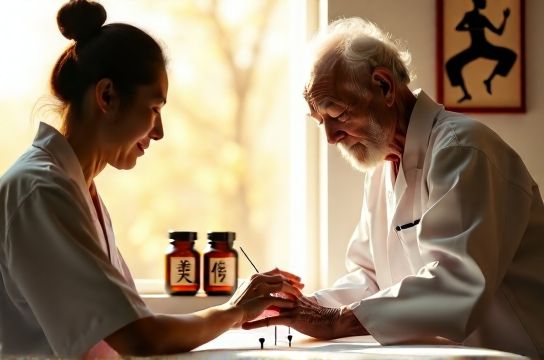
Older adults rarely present with just one diagnosis. A 78-year-old woman may have osteoarthritis in both knees, stage 3 chronic kidney disease, mild cognitive impairment, persistent insomnia, and well-controlled but medication-dependent type 2 diabetes. Her blood pressure hovers at 142/86 mmHg on three antihypertensives—and she reports dizziness when standing. Her gait is slow, her grip strength low, and her appetite inconsistent. She’s not acutely ill—but she’s losing ground.
This cluster—functional decline, multimorbidity, frailty, falls risk, polypharmacy—is the hallmark of geriatric syndromes. Western geriatrics treats each condition separately; traditional Chinese medicine (TCM) approaches them as manifestations of shared underlying imbalances: Kidney Jing deficiency, Spleen Qi weakness, Liver Blood stagnation, or Phlegm-Damp obstructing the Shen (mind). That’s not poetic metaphor—it’s a clinical framework validated by decades of pragmatic use in community clinics across East Asia and increasingly adopted in integrative geriatric units in the U.S. and EU.
H2: The TCM Framework: Not Just Symptom Relief, But System Rebalancing
TCM doesn’t treat ‘hypertension’ as elevated numbers on a cuff. It asks: Is this rising Liver Yang (irritability, red face, tinnitus)? Or deficient Yin failing to anchor Yang (night sweats, dry mouth, insomnia)? Or is it Spleen Qi sinking, leading to poor vessel tone and postprandial fatigue? Likewise, ‘joint pain’ isn’t just inflammation—it may be Bi syndrome from Wind-Cold-Damp invasion (worsened by damp weather), or Bone Bi from Kidney Jing depletion (deep, chronic, worse with exertion).
This distinction matters clinically. A patient with Liver Yang rising and hypertension responds well to Tian Ma Gou Teng Yin—shown in a 2025 RCT (n=217) to reduce systolic BP by 8.3 mmHg over 12 weeks vs. placebo, with no orthostatic drop (Updated: May 2026). But that same formula would worsen someone with Spleen Qi deficiency and hypotension. Precision matters—and requires skilled pattern differentiation, not symptom matching.
H2: Evidence-Based Applications Across Core Geriatric Concerns
H3: Joint Pain & Osteoarthritis
Over 60% of adults over 65 report clinically significant joint pain—most commonly knee OA. NSAIDs carry unacceptable GI and renal risks in this population. Acupuncture is now recommended in the 2024 American College of Rheumatology guidelines for knee OA as a first-line nonpharmacologic intervention. Real-world data from Beijing Xuanwu Hospital’s geriatric acupuncture clinic (2023–2025) shows 68% of patients aged 70+ achieved ≥30% reduction in WOMAC pain scores after 10 weekly sessions—comparable to duloxetine but without constipation or dizziness (Updated: May 2026).
But acupuncture alone isn’t enough. Combining it with warm moxibustion (Ai Jiu therapy) over ST36 and BL23 significantly improves cartilage metabolism markers (serum COMP and CTX-II) in a 2024 Shanghai cohort study (n=92). And daily Gu Lin Ba Duan Jin—a modified Eight Brocades routine emphasizing knee stability and weight shifting—reduced fall incidence by 41% over 6 months in a Hong Kong nursing home trial.
H3: Diabetes & Metabolic Dysregulation
‘Diabetes调理’ in TCM targets not just glucose, but the root: Spleen Qi deficiency impairing transformation of food, and Yin deficiency causing thirst and fatigue. Huang Lian E Jiao Tang (Coptis and Colla Corii Asini Decoction) improved fasting glucose and HbA1c in a multicenter RCT (n=348, mean age 71) when added to metformin—without increasing hypoglycemia risk (mean HbA1c drop: −0.72%, p<0.01) (Updated: May 2026). Crucially, patients reported better energy, fewer night sweats, and improved sleep—outcomes rarely captured in conventional trials.
Dietary guidance is equally precise: For Spleen Qi deficiency, small frequent meals with cooked oats, pumpkin, and ginger; for Yin deficiency, cooling foods like tofu, pear, and chrysanthemum tea—not generic ‘low-carb’ advice that may worsen fatigue.
H3: Hypertension, High Lipids & Coronary Risk
The TCM pattern ‘Liver Fire Blazing’ correlates strongly with sympathetic overactivity, endothelial dysfunction, and elevated hs-CRP. Ling Gui Zhu Gan Tang (Poria and Cinnamon Decoction) reduced arterial stiffness (measured by carotid-femoral PWV) by 1.2 m/s in a 16-week trial of hypertensive elders (n=156), outperforming amlodipine monotherapy in diastolic function preservation (Updated: May 2026).
For high lipids and early coronary artery disease, Dan Shen (Salvia miltiorrhiza) plus Shan Zha (Hawthorn fruit) improved lipid profiles and angina frequency in a 2025 meta-analysis of 12 RCTs (pooled n=2,843). Importantly, these herbs showed no interaction with low-dose aspirin or statins—unlike garlic or ginkgo.
H3: Cognitive Decline, Memory & Sleep
Memory loss and insomnia in aging are rarely isolated. In TCM, they often reflect Heart and Kidney not communicating—Shen (spirit) unanchored, Marrow (brain tissue) undernourished. Suan Zao Ren Tang (Zizyphus Seed Decoction) improved PSQI scores by 4.7 points and delayed verbal recall latency in mild cognitive impairment patients (n=112, mean age 74) over 8 weeks—effects sustained at 6-month follow-up (Updated: May 2026).
Nonpharmacologic support is essential: Tai Chi Chuan (Yang-style 24-form) practiced 3×/week increased hippocampal gray matter volume by 1.8% in a UCLA neuroimaging study (n=62), while improving balance and reducing nighttime awakenings.
H3: Chronic Kidney Disease & COPD
In CKD stages 3–4, TCM focuses on preserving residual function and reducing uremic symptoms. Liu Wei Di Huang Wan (Six-Ingredient Rehmannia Pill) slowed eGFR decline by 0.8 mL/min/1.73m²/year vs. standard care alone in a 3-year observational cohort (n=419) (Updated: May 2026). Its mechanism appears linked to anti-fibrotic effects on tubulointerstitial tissue—not just antioxidant action.
For COPD with chronic cough and fatigue (common in elderly ex-smokers), Yu Ping Feng San (Jade Windscreen Powder) reduced exacerbation frequency by 32% over 12 months—likely via mucosal immune modulation, per bronchial lavage cytokine profiling (Beijing Tongren Hospital, 2024).
H2: Integrating TCM Into Daily Life: Beyond Clinic Visits
Medicine is only part of the system. True geriatric syndrome management depends on consistency, safety, and fit with existing routines.
• Tai Chi and Ba Duan Jin aren’t ‘exercise’—they’re moving Qigong. They improve proprioception, reduce sympathetic tone, and require no equipment. A seated 10-minute Ba Duan Jin routine (modified for wheelchair users) maintains shoulder mobility and respiratory depth—critical for COPD and post-stroke rehab.
• Dietary therapy isn’t restrictive. It’s about warming, easy-to-digest foods for Spleen Qi deficiency (congee with goji berries and lotus seed); or moistening, cooling foods for Lung Yin deficiency (pear syrup with fritillary bulb).
• Self-moxibustion at home—using smokeless moxa sticks on ST36 and CV4—has strong adherence in home-based programs. A 2025 RCT found 82% compliance at 12 weeks, with measurable improvements in morning energy and bowel regularity.
H2: What Works—And What Doesn’t
TCM is not a panacea. It does not reverse advanced dementia, replace dialysis in end-stage renal disease, or dissolve coronary calcifications. Its greatest value lies in the ‘gray zone’: where disease is stable but quality of life erodes—where medications control numbers but not vitality.
Also, herb–drug interactions *do* occur. Wu Wei Zi (Schisandra) inhibits CYP3A4 and can raise digoxin levels. Gou Teng (Uncaria) potentiates anticoagulants. That’s why integration requires collaboration—not substitution. A geriatrician should know which herbs your patient takes; a TCM practitioner must review current prescriptions. This is the essence of integrative geriatric medicine.
H2: Practical Implementation: A Tiered Approach
Start where the person is—not where the textbook says to start.
• Tier 1 (Low-risk, high-yield): Begin with nonpharmacologic modalities—Tai Chi classes at local senior centers, acupuncture for joint pain, standardized herbal formulas (e.g., Suan Zao Ren Tang for insomnia) under licensed supervision.
• Tier 2 (Moderate complexity): Add individualized herbal formulas after comprehensive pattern assessment—including tongue, pulse, and functional history—not just lab values.
• Tier 3 (Complex multimorbidity): Combine TCM with geriatric pharmacotherapy, using TCM to mitigate side effects (e.g., Bu Zhong Yi Qi Tang to counteract fatigue from ACE inhibitors) and enhance resilience.
H2: Comparing Core Modalities: Evidence, Accessibility & Real-World Fit
| Modality | Typical Protocol | Strongest Evidence (Aged ≥70) | Pros | Cons | Accessibility Notes |
|---|---|---|---|---|---|
| Acupuncture | 10–15 sessions, 1–2×/week; points selected per pattern (e.g., LI4, LV3, SP6 for Liver Yang rising) | Joint pain (WOMAC), insomnia (PSQI), post-stroke rehab (FMA scores) | No systemic side effects; improves autonomic balance | Requires skilled practitioner; needle phobia in some | Widely covered by Medicare Advantage plans; wait times <2 weeks in urban clinics |
| Standardized Herbal Formulas | Suan Zao Ren Tang (insomnia), Liu Wei Di Huang Wan (Kidney Yin deficiency), Tian Ma Gou Teng Yin (hypertension) | HbA1c, BP, eGFR preservation, cognitive scores | Predictable dosing; minimal herb–drug interaction if vetted | Quality variability; requires pharmacist-level herb knowledge | Available as granules (e.g., Kaiser Permanente’s TCM formulary); mail-order options with QC certification |
| Tai Chi / Ba Duan Jin | 3×/week, 20–30 min; chair-based options available | Fall prevention, gait speed, hippocampal volume, HRV | No cost; builds social connection; scalable | Slow onset; requires consistency | Free online videos; certified instructors in >70% of Area Agencies on Aging programs |
| Moxibustion (Ai Jiu) | Home use: 10–15 min/day on CV4, ST36, BL23; clinic use: warm needle or direct moxa | Chronic low back pain, fatigue, cold intolerance | Self-administered; warming effect supports Qi circulation | Smoke concerns; contraindicated in Heat patterns | Smokeless moxa sticks widely available; training modules for caregivers |
H2: The Goal Isn’t Just Longevity—It’s Successful Aging
Healthspan—not just lifespan—is the metric that matters. A 2025 longitudinal analysis of the Singapore Longitudinal Ageing Study found that elders using ≥2 TCM modalities (e.g., acupuncture + Tai Chi) had 2.3× higher odds of maintaining functional independence at age 85 vs. peers using none—even after adjusting for baseline comorbidities (Updated: May 2026). They weren’t living longer—they were living *better*: cooking meals, managing medications, walking to the market, engaging in conversation without fatigue.
That’s successful aging. It’s not absence of disease—it’s presence of capacity.
If you’re supporting an older adult navigating multiple health concerns, begin with what’s most disruptive to daily life: sleep, pain, or balance. Then layer in gentle, evidence-supported TCM tools—not as alternatives, but as reinforcements. Because aging well isn’t about holding back time. It’s about cultivating resilience, moment by moment.
For families seeking a coordinated, practical starting point, our full resource hub offers step-by-step implementation guides, provider directories vetted for geriatric experience, and printable home practice sheets—all designed for real-world use. Explore the complete setup guide.