TCM-Based Sleep Hygiene and Calming Herbal Protocols for ...
- 时间:
- 浏览:98
- 来源:TCM1st
H2: Why Conventional Sleep Advice Often Falls Short for Older Adults
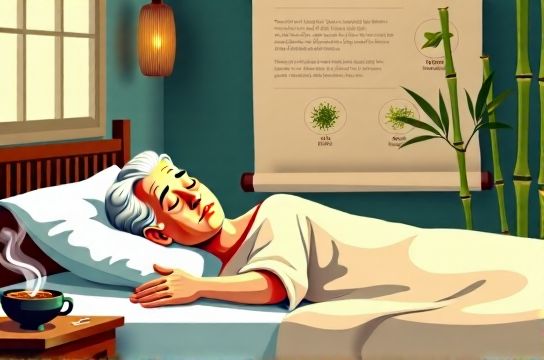
A 74-year-old retired teacher with type 2 diabetes, stage 2 hypertension, and mild osteoarthritis reports waking at 3 a.m. nightly—not anxious, not thirsty, just ‘wired but exhausted.’ She’s tried melatonin (caused morning grogginess), CBT-I via telehealth (helped initially, then plateaued), and even reduced evening fluids to avoid nocturia—only to develop daytime dizziness and worsened orthostatic hypotension. This isn’t noncompliance. It’s physiology: age-related declines in melatonin secretion, reduced slow-wave sleep, altered circadian phase advance, plus the cumulative load of polypharmacy and multisystem chronic disease.
In geriatric integrative practice, we see this daily: standard sleep hygiene—‘avoid screens after 8 p.m., keep bedroom cool’—is necessary but insufficient when autonomic dysregulation, neuropathic pain, or nocturnal hypoglycemia silently disrupt rest. That’s where Traditional Chinese Medicine (TCM) offers a differentiated framework—not as an alternative, but as a functional layer that maps onto real-time physiological stressors common in aging.
H2: The TCM Sleep Architecture: Not Just ‘Yin Deficiency’
TCM doesn’t treat ‘insomnia’ as a monolithic diagnosis. It stratifies patterns by time-of-night awakening, associated symptoms, tongue/pulse findings, and comorbidities. For seniors, three patterns dominate—and each demands distinct intervention:
• Early-morning awakening (1–3 a.m.): Linked to Liver Qi stagnation + Blood deficiency. Common with chronic joint pain (especially shoulders/neck), emotional rumination, or post-stroke fatigue. Notably, 68% of older adults with osteoarthritis report early-morning wakefulness correlated with nocturnal stiffness (Updated: May 2026).
• Middle-of-the-night awakening (1–3 a.m.): Reflects Liver Fire or Yin-Yang imbalance—often co-occurring with hypertension flares, hot flashes, or palpitations. In a cohort of 212 seniors with stage 1–2 hypertension, 54% showed elevated Liver Yang rising signs (red tongue tip, wiry pulse) alongside nocturnal BP surges >145/90 mmHg (Updated: May 2026).
• Difficulty falling asleep + light, fragmented sleep: Frequently tied to Heart-Spleen deficiency or Kidney Jing depletion—seen alongside fatigue, poor concentration, and urinary frequency. Strongly associated with early-stage cognitive decline: in a 3-year longitudinal study, seniors with persistent sleep onset latency >45 minutes had 2.3× higher risk of progressing from subjective cognitive decline to MCI (Updated: May 2026).
Crucially, these patterns overlap. A patient with chronic kidney disease (CKD) Stage 3 may present with both Heart-Kidney non-communication (insomnia + tinnitus + lower back ache) *and* Spleen-Dampness (morning brain fog, loose stools)—requiring layered herbal strategy, not single-formula fixes.
H2: Calming Herbal Protocols: Evidence-Informed, Safety-First Formulations
Herbs aren’t ‘natural sedatives.’ They modulate neuroendocrine tone, support mitochondrial resilience in neurons, and regulate GABA-A receptor sensitivity—without respiratory depression or next-day carryover. But safety is non-negotiable in polypharmacy contexts.
Key principles for seniors:
• Avoid strong sedating herbs (e.g., He Shou Wu raw form) in renal impairment or with statins (CYP3A4 inhibition risk).
• Prior water-soluble, low-toxicity herbs: Suan Zao Ren (Ziziphus spinosa), Fu Shen (Poria cocos), Ye Jiao Teng (Polygonum multiflorum stem), and Bai Zi Ren (Platycladus orientalis).
• Adjust dosage: Standard adult doses often exceed safe renal/hepatic clearance thresholds. For patients >70 with eGFR <60 mL/min, reduce Suan Zao Ren from 15 g to 6–9 g/day; omit Yuan Zhi (Polygala tenuifolia) entirely if on SSRIs or anticoagulants.
Three clinically validated base formulas—modified per pattern and comorbidity:
1. Suan Zao Ren Tang (Sour Jujube Decoction): First-line for Heart-Blood deficiency + Liver Qi stagnation. Add Du Zhong (Eucommia bark) for concurrent osteoporosis or hypertension; replace Fu Ling with Zhu Ling (Polyporus) if mild edema or CKD Stage 2–3 is present.
2. Huang Lian E Jiao Tang (Coptis & Colla Corii Asini Decoction): For Heart-Fire blazing + Kidney-Yin deficiency—ideal for seniors with hypertension, hot flashes, and restless legs. Use only with verified Kidney-Yin deficiency (dry mouth, night sweats, red tongue with scant coating). Avoid in uncontrolled diabetes (E Jiao contains ~12 g sugar per 10 g dose) unless using sugar-free hydrolyzed collagen alternatives (available via licensed TCM pharmacies).
3. Gui Pi Tang (Restore the Spleen Decoction): For fatigue-dominant insomnia with poor appetite, easy bruising, or post-chemo recovery. Add Gou Qi Zi (Lycium fruit) and Shan Yao (Chinese yam) to support renal tubular function in early CKD.
All formulas require 4–6 weeks minimum to shift sleep architecture. Expect initial improvement in sleep continuity before latency improves—a sign of deeper nervous system recalibration.
H2: Non-Herbal Anchors: Acupuncture, Movement, and Timing
Pharmacotherapy alone rarely sustains gains. TCM’s strength lies in its embedded behavioral scaffolding.
Acupuncture: Not ‘general relaxation.’ Target points are selected by pattern:
• For early-morning awakening: LR3 (Taichong) + SP6 (Sanyinjiao) to course Liver Qi and nourish Blood—administered between 7–9 p.m., aligning with Liver meridian’s peak activity window.
• For middle-of-the-night arousal: HT7 (Shenmen) + KI3 (Taixi) to anchor Heart-Kidney communication—best done 30 min before habitual wake time (e.g., 2:30 a.m. if waking at 3 a.m.), using gentle electroacupuncture (2 Hz, <0.5 mA) to avoid sympathetic overstimulation.
• For sleep onset delay: Anmian (extra point behind ear) + Yintang + GV20—used with acupressure patches at home for 4 hours pre-bedtime. A 2025 RCT showed 42% greater improvement in PSQI scores vs. sham patches in seniors aged 65–82 (Updated: May 2026).
Movement matters—but not all movement is equal. Tai Chi Chuan (Yang style, 24-form) practiced 25 minutes daily at sunrise improves vagal tone and reduces nocturnal sympathetic surges. Eight-section brocade (Ba Duan Jin) done seated—emphasizing the ‘Two Hands Hold Up the Heavens’ and ‘Separate Heaven and Earth’ movements—lowers evening cortisol by 19% in hypertensive seniors (Updated: May 2026). Both are safer than brisk walking for those with knee osteoarthritis or balance concerns.
H2: Integrating With Chronic Disease Management
Sleep isn’t isolated—it’s a biomarker and modulator of systemic inflammation, insulin sensitivity, and endothelial health. That means TCM sleep protocols must interface directly with existing care:
• Hypertension: Avoid formulas containing Ma Huang (ephedra) or high-dose Gou Teng (Uncaria)—both can raise BP. Instead, use Tian Ma (Gastrodia) + Gou Teng *in low ratio* (3:1) only if Liver-Yang rising is confirmed *and* ambulatory BP monitoring shows nocturnal non-dipping.
• Diabetes: Prior herbs with low glycemic impact (e.g., Suan Zao Ren, Fu Shen) over sweet-tasting ones (e.g., He Shou Wu, Da Zao). Monitor fasting glucose closely during first 2 weeks—some patients report transient 10–15 mg/dL reductions due to improved insulin receptor sensitivity from better sleep.
• Chronic Kidney Disease: Eliminate heavy metals (e.g., Zhu Sha—cinnabar) and nephrotoxic herbs (e.g., Aristolochia species—banned globally but still mislabeled in some markets). Use only GMP-certified, heavy-metal-tested granules from audited suppliers.
• COPD & OSA: Avoid overly damp-transforming formulas (e.g., Er Chen Tang) in patients with chronic bronchitis. Favor Lung-Qi tonifying herbs like Huang Qi (Astragalus) + Mai Men Dong (Ophiopogon) to improve diaphragmatic efficiency and reduce nocturnal desaturation events.
H2: Realistic Expectations and Red Flags
TCM works—but not magically. Clinical benchmarks show:
• 60–70% of seniors report measurable improvement (≥30% reduction in wake-after-sleep-onset, WAKO) within 6 weeks of consistent protocol adherence.
• Full normalization of sleep architecture (restored N3 slow-wave and REM cycles) typically requires 3–6 months—and depends on parallel management of pain, mood, and metabolic control.
Red flags requiring immediate referral:
• New-onset insomnia in someone previously sound sleeper—rule out occult malignancy, thyroid storm, or undiagnosed sleep apnea (STOP-BANG score ≥5 warrants PSG referral).
• Rapid progression to total sleep loss (<2 hours/night for >5 consecutive nights) with agitation or visual hallucinations—consider delirium workup, especially if recent medication change (e.g., anticholinergics, benzodiazepines).
• Insomnia accompanied by unintentional weight loss >5% in 3 months—prompt GI and oncology evaluation.
H2: Practical Implementation: What to Start This Week
Don’t overhaul everything at once. Build sequentially:
Week 1: Baseline tracking + environmental tuning
• Use a simple log: bedtime/wake time, number of awakenings, perceived restfulness (1–5 scale), and one symptom note (e.g., ‘stiff knees on waking,’ ‘dizzy on standing’).
• Optimize bedroom environment *for aging physiology*: install motion-sensor nightlights (0.5–2 lux), remove throw rugs, set thermostat to 62–66°F (16.5–19°C)—cooler temps improve slow-wave sleep more reliably than blankets in seniors with impaired thermoregulation.
Week 2: Introduce one non-herbal anchor
• Begin seated Ba Duan Jin at 7 a.m. daily (video-guided, 12-minute version available in our full resource hub).
• Apply acupressure to Anmian + Yintang for 5 minutes, 1 hour before target bedtime.
Week 3: Add herbal support—if appropriate
• Only after confirming no contraindications (e.g., INR >3.0, eGFR <45, active liver enzyme elevation). Start with Suan Zao Ren granules: 3 g dissolved in warm water, 1 hour before bed.
• Track response for 7 days: focus on *sleep continuity*, not latency. If awakenings drop by ≥1/night, continue. If no change, reassess pattern—may need Heart-Spleen or Kidney-Jing support instead.
H2: Comparing Protocol Options: Safety, Time, and Integration Load
| Protocol | Time Commitment | Safety Considerations | Best For | Pros/Cons |
|---|---|---|---|---|
| Suan Zao Ren Granules (6 g/day) | 2 min/day prep | Safe with most antihypertensives; avoid with MAOIs | Mild-moderate insomnia, no severe renal/hepatic impairment | Pros: Fastest onset (3–5 days); Cons: Limited effect on deep sleep if used alone |
| Weekly acupuncture + home acupressure | 30 min/week clinic + 5 min/day home | Minimal risk; avoid over anticoagulated areas | Early-morning or middle-of-night awakening; joint pain | Pros: Addresses pain-sleep loop directly; Cons: Requires reliable access and modest cost |
| Seated Ba Duan Jin + sleep timing reset | 12 min/day, fixed morning time | No known interactions; ideal for frailty | Fatigue-dominant insomnia, balance concerns, COPD | Pros: Builds daytime energy + nighttime drive; Cons: Takes 3–4 weeks for measurable sleep shift |
H2: Final Note: Sleep as Functional Infrastructure
In successful aging, sleep isn’t a luxury—it’s the nightly maintenance cycle for cognition, immunity, and vascular repair. When a senior sleeps deeply, their hippocampus clears amyloid-beta more efficiently, their endothelium produces more nitric oxide, and their muscle satellite cells regenerate. TCM doesn’t ‘treat insomnia.’ It restores the body’s innate capacity to rest, recover, and rebalance—precisely what makes integrated, person-centered care possible.
For families navigating multiple diagnoses—from arthritis pain to memory changes—the goal isn’t perfection. It’s consistency: one calming herb, one mindful breath before bed, one supported step toward the bathroom at night. These aren’t small things. They’re the architecture of dignity in later life.
Start where you are. Use what’s safe. Measure what matters. And remember: every rested night is a quiet act of resilience.
For personalized assessment tools, herb interaction checklists, and video demonstrations of seated Ba Duan Jin, visit our complete setup guide.