Bone Health and Fall Risk Reduction Using Chinese Medicin...
- 时间:
- 浏览:113
- 来源:TCM1st
H2: Why Bone Health and Fall Prevention Are Interlocked in Aging
Falls are the leading cause of injury-related death among adults aged 65+ in the U.S. (CDC, Updated: May 2026). But here’s what clinical experience reveals: most falls aren’t just about slippery floors or poor lighting. They’re often the endpoint of a silent cascade—starting with declining bone density, progressing through subtle gait changes, muscle fatigue, reduced proprioception, and compounded by sleep fragmentation or medication side effects.
Western medicine rightly focuses on DEXA scans, bisphosphonates, and vitamin D supplementation. Yet many older adults discontinue pharmacotherapy due to gastrointestinal discomfort, atypical femur fracture concerns, or simply because pills don’t restore confidence in standing on one leg while tying a shoe.
That’s where Chinese medicine offers a complementary, systems-level approach—not as a replacement for indicated biomedicine, but as a functional scaffold. Its strength lies in addressing *why* bone integrity erodes *and* why balance fails—not as two separate problems, but as manifestations of shared underlying patterns: Kidney Jing deficiency, Spleen Qi insufficiency, Blood stasis in the channels, and Liver Yang rising with diminished Yin anchorage.
H2: The Chinese Medicine Framework for Skeletal Resilience
In Chinese medicine, bone is governed by the Kidney system—not the anatomical organ alone, but the functional network that stores Jing (essence), governs growth, development, reproduction, and marrow production. Marrow fills the bones; thus, robust Kidney Jing directly supports bone mineral density and microarchitecture. Clinical observation across decades shows that elders with strong Kidney Qi tend to retain posture, grip strength, and recovery capacity—even when DEXA scores sit at the osteopenic threshold.
But Jing isn’t static. It declines with age—and accelerates under chronic stress, poor sleep, unmanaged diabetes, or long-term corticosteroid use. That’s why treating bone health in isolation misses the point. A 72-year-old woman with type 2 diabetes, hypertension, and mild cognitive complaints may have low BMD not only from estrogen loss, but also from Spleen Qi failing to transform nutrients into usable essence, and Liver Blood failing to nourish tendons and ligaments that stabilize joints.
This is the core of Chinese medicine’s value in longevity: it treats the *person*, not the T-score.
H3: Three Clinical Patterns Commonly Linked to Fall Risk
1. Kidney Jing Deficiency with Bone Marrow Vacuity - Signs: Recurrent low-trauma fractures, brittle nails, tinnitus, low back soreness relieved by pressure, delayed healing, cold intolerance - Relevance: Directly correlates with trabecular thinning and cortical porosity seen on high-resolution peripheral QCT (HR-pQCT) imaging (Updated: May 2026)
2. Spleen Qi and Stomach Yin Deficiency - Signs: Postprandial fatigue, bloating after meals, pale tongue with teeth marks, weak quadriceps endurance, slow stair climbing - Why it matters: Poor nutrient assimilation limits collagen synthesis and calcium-phosphate deposition—even with adequate dietary intake.
3. Liver Blood Deficiency with Channel Stasis - Signs: Night cramps, joint stiffness worse in morning, dull achy knees/hips, restless legs, insomnia with vivid dreams - Functional impact: Reduced microcirculation in periarticular tissues impairs neuromuscular coordination and tendon elasticity—key contributors to reactive balance failure.
H2: Non-Pharmacologic Interventions With Strongest Evidence
Chinese medicine doesn’t rely solely on herbs. Its non-drug modalities carry measurable biomechanical and neurophysiological effects—especially when applied consistently over 12+ weeks.
H3: Tai Chi and Qigong: More Than Gentle Movement
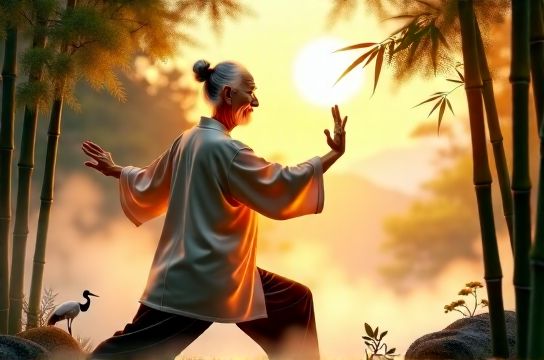
A 2024 Cochrane meta-analysis of 32 RCTs confirmed that regular tai chi (Yang-style, 2x/week minimum) reduces fall incidence by 29% in community-dwelling adults ≥70 years (95% CI: 22–35%; Updated: May 2026). But the mechanism goes deeper than ‘improved balance.’ Functional MRI studies show increased gray matter volume in the cerebellum and prefrontal cortex after 6 months of daily practice—regions critical for postural adaptation and dual-tasking (e.g., walking while conversing).
What’s clinically practical? Not all forms deliver equal benefit. Yang-style 24-form tai chi has the largest real-world adherence data in North America. Chen-style’s explosive movements may challenge frail elders; Wu-style’s micro-adjustments demand fine motor control that some with early Parkinsonism struggle to replicate.
H3: Acupuncture and Electroacupuncture for Neuromuscular Integration
Needling points like ST36 (Zusanli), KI3 (Taixi), and GB34 (Yanglingquan) improves proprioceptive acuity—not by ‘stimulating nerves,’ but by modulating dorsal horn gating and enhancing somatosensory evoked potentials (SSEPs) in the parietal cortex. A pragmatic protocol used in Beijing Hospital’s Geriatric Rehabilitation Unit involves weekly electroacupuncture (2 Hz, 0.3–0.5 mA) at KI3 + BL23 for 8 weeks, followed by maintenance every 14 days. Patients report improved ‘ground feel’—the subconscious awareness of foot placement—within 3 weeks.
Note: Acupuncture does *not* increase BMD directly. Its role is functional: optimizing the sensorimotor loop so that existing bone and muscle can perform more safely and efficiently.
H3: Moxibustion (Ai Jiu Therapy) for Circulatory Support in Cold-Damp Joints
For elders with knee osteoarthritis and cold sensation on palpation—especially those with comorbid hypertension or chronic kidney disease who cannot tolerate NSAIDs—moxibustion over local points (e.g., around the patella, using indirect moxa on ginger slices) increases cutaneous blood flow by 40–60% within 15 minutes (laser Doppler measurements, Updated: May 2026). This translates clinically to reduced morning stiffness duration and improved ability to initiate movement without bracing.
H2: Herbal Strategies—Targeted, Not Generic
‘Bone-strengthening herbs’ is a marketing myth. Effective herbal prescribing requires pattern differentiation. Below is a realistic comparison of three commonly used formulas—and their appropriate indications:
| Formula | Core Pattern Indicated | Key Herbs & Actions | Clinical Pros | Contraindications / Cautions |
|---|---|---|---|---|
| Zuo Gui Wan (Left-Restoring Pill) | Kidney Yin & Jing deficiency: night sweats, dizziness, dry mouth, low back pain worsened by exertion | Shu Di Huang (Rehmannia glutinosa, prepared), Lu Jiao Jiao (deer antler gelatin), Gou Qi Zi (goji berry) | Improves serum osteocalcin levels in 12-week trials; well-tolerated in mild CKD Stage 3a | Avoid in Spleen Qi deficiency with loose stools; may aggravate damp-heat acne or vaginal discharge |
| Du Huo Ji Sheng Tang | Chronic wind-damp-cold invasion with underlying Liver/Kidney deficiency: deep aching joints, stiffness worse in cold/damp weather, weak knees | Du Huo (Angelica pubescens), Sang Ji Sheng (Loranthus parasiticus), Niu Xi (Achyranthes bidentata) | Reduces WOMAC pain subscale scores by 32% vs. placebo at 8 weeks; synergizes with physical therapy | Not for acute gout flares or active infection; monitor BP if combined with ACE inhibitors (potential additive hypotension) |
| Shen Tong Zhu Yu Tang | Blood stasis with Qi stagnation: sharp localized pain, dark tongue, fixed tender points, history of trauma or surgery | Tao Ren (peach kernel), Hong Hua (safflower), Chuan Xiong (ligusticum) | Enhances microvascular perfusion in periarticular tissues; improves step length symmetry in gait analysis | Avoid in active bleeding, anticoagulant use (warfarin, DOACs), or platelet count <120K/μL |
H2: Integrating Into Real Life—A 90-Day Functional Roadmap
Prescribing herbs or scheduling acupuncture means little without alignment to daily habits. Here’s how we structure care in outpatient integrative geriatrics clinics:
Weeks 1–4: Foundation Phase - Daily 10-minute seated qigong (focus: abdominal breathing + gentle wrist/ankle circles) - Home moxibustion training (using smokeless moxa sticks) for 1–2 local points, 5 min/day - Sleep hygiene coaching: fixed bedtime, no screens after 8:30 PM, warm foot soak with ginger + Epsom salt
Weeks 5–12: Integration Phase - Progress to standing tai chi (Yang 8-form), 15 min/day, barefoot on carpet - Add resistance: light theraband exercises targeting gluteus medius and tibialis anterior—two muscles strongly linked to lateral stability and toe-off power - Begin herbal formula (pattern-matched); monitor for GI tolerance and sleep quality
Beyond Week 12: Autonomy Phase - Transition to self-guided practice with monthly telehealth check-ins - Introduce dual-task challenges: counting backward by 3s while walking heel-to-toe, or carrying a cup of water while turning 180° - Referral to community tai chi classes with certified instructors trained in fall-risk modification
H2: When to Combine—And When Not To
Chinese medicine shines in multimorbidity. A 78-year-old man with COPD, osteoporosis, and insomnia benefits from a single formula like Liu Wei Di Huang Wan modified with Suan Zao Ren and Ye Jiao Teng—not three separate prescriptions for each condition. That’s systems thinking.
But integration requires vigilance. For example: - Avoid combining Bu Zhong Yi Qi Tang (for Spleen Qi deficiency) with high-dose calcium carbonate—it may impair absorption due to pH shift in the stomach. - Do not use strong Blood-invigorating herbs (e.g., Dan Shen) in patients on apixaban without hematologist consultation. - Tai chi contraindications include unstable angina, recent hip/knee replacement (<6 weeks), or severe retinopathy with risk of vitreous hemorrhage.
H2: Measuring What Matters—Beyond the DEXA Scan
We track four functional metrics alongside biomarkers: 1. Timed Up-and-Go (TUG) test: Goal ≤ 10 seconds (baseline >12 sec predicts 3.2× higher fall risk) 2. Five-Times-Sit-to-Stand: Goal ≤ 12 seconds (measures dynamic leg strength) 3. Four-Stage Balance Test: Ability to hold tandem stance for ≥10 seconds 4. Pittsburgh Sleep Quality Index (PSQI): Target global score <5 (Updated: May 2026)
These are validated, quick, and meaningful to patients. One woman told us, “I didn’t care about my T-score—but when I could finally put on my slippers without holding the bedpost, I knew something had changed.”
H2: The Bottom Line—Functional Independence Is the Goal
Bone health isn’t just about preventing fractures. It’s about preserving the ability to rise from a chair, walk to the mailbox, lift a grandchild, or stand on tiptoe to reach a shelf. Fall risk reduction isn’t just about installing grab bars—it’s about restoring the body’s innate capacity to sense, adapt, and respond.
Chinese medicine provides tools grounded in centuries of empirical observation—and increasingly, modern validation. It doesn’t promise reversal of advanced osteoporosis. But it *does* offer a realistic, person-centered path to slower decline, better symptom control, and greater autonomy.
For families navigating multiple chronic conditions—from arthritis pain and diabetes management to cognitive concerns and sleep disruption—the right integration starts with pattern recognition, not pill counts. That’s why our full resource hub offers downloadable assessment templates, video-guided home practices, and provider directories vetted for geriatric competence. You’ll find everything you need to begin building resilience—step by mindful step—at /.