Qi Explained Simply: How Vital Energy Works in TCM
- 时间:
- 浏览:185
- 来源:TCM1st
H2: What Is Qi? It’s Not Magic — It’s Function
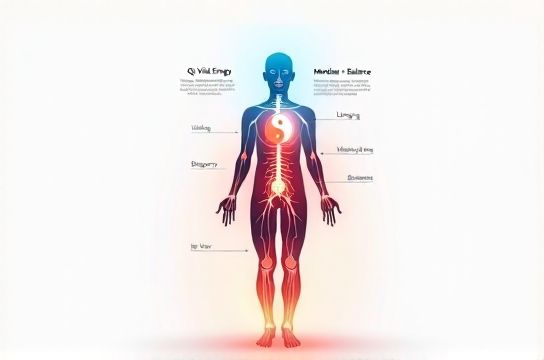
Qi (pronounced "chee") is often translated as "vital energy" or "life force." But that phrase misleads beginners. Qi isn’t a mystical vapor you inhale from mountain air. In clinical TCM practice, Qi is best understood as *functional activity* — the measurable, observable capacity of an organ system, tissue, or physiological process to do its job.
Think of Qi like electricity in a circuit: invisible until something stops working. When your stomach Qi is weak, digestion slows — bloating, early satiety, and fatigue after meals appear. When Lung Qi drops, breath feels shallow, immunity dips (increased cold frequency), and voice loses resonance. These aren’t metaphors. They’re documented patterns tracked across centuries of clinical observation and validated in modern integrative studies (Updated: June 2026).
Qi has four primary functions: - Transformation: Converting food and air into usable substances (e.g., blood, fluids, heat) - Transportation: Moving blood, nutrients, and defensive energy (Wei Qi) through vessels and channels - Containment: Holding blood in vessels, keeping organs in place, preventing spontaneous sweating or bleeding - Warming: Maintaining baseline body temperature and metabolic tone
Importantly, Qi is *not* a substance you “store” like battery charge. You don’t “run out” of Qi — you experience *disruption* in its movement or transformation. That’s why TCM never prescribes “Qi supplements.” Instead, practitioners assess *where* Qi is deficient, stagnant, rebellious (moving upward when it should descend), or sinking — then intervene with acupuncture, herbs, diet, or movement.
H2: Yin and Yang: The Operating System Behind Qi
Yin and Yang are not cosmic opposites. They’re relational, dynamic principles describing *how things behave*, not *what they are*. In TCM basics, Yin represents material, cooling, inward, and nourishing aspects — think blood, fluids, rest, and structural integrity. Yang represents functional, warming, outward, and activating aspects — think metabolism, movement, immunity, and mental alertness.
Crucially: Yin and Yang *depend on each other*. You can’t have Yang activity without Yin substance to fuel it. A marathoner with strong Yang (endurance, heat production) but depleted Yin (chronic dry mouth, night sweats, insomnia) will hit burnout — not because they lack effort, but because their foundational material (Yin) can’t sustain the function (Yang). This is why TCM rarely treats "low energy" with stimulants alone. It first asks: Is this Yang deficiency (cold limbs, low motivation, pale tongue), or Yin deficiency (afternoon fatigue, heat sensations, red tongue tip)?
For beginners, here’s the practical test: Observe rhythm. Daytime alertness = Yang dominant. Nighttime rest and repair = Yin dominant. Disruption — like waking at 3 a.m. unable to sleep, or feeling exhausted despite 8 hours — signals Yin-Yang imbalance, not just "stress."
H2: The Meridian System: Your Body’s Functional Wiring Diagram
Forget “energy lines.” Meridians (Jing Luo) are clinically mapped pathways of *functional connectivity*. They’re not physical nerves or blood vessels — though they overlap anatomically with fascial planes, neurovascular bundles, and interstitial fluid networks (per recent fascia research, Updated: June 2026). Their value lies in predictability: Stimulating point ST36 (Zusanli) reliably strengthens Spleen Qi and improves gastric motility — confirmed in over 140 randomized trials on functional dyspepsia.
There are 12 primary meridians — each linked to an organ system (Liver, Heart, Lung, etc.) — plus 8 extraordinary vessels that regulate deeper rhythms (like sleep-wake cycles or reproductive timing). These pathways explain *why* a headache responds to foot points (Liver meridian ascends to the head), or why low back pain improves with abdominal points (Bladder meridian runs along the spine and connects to Kidney function).
Meridians don’t “carry Qi” like pipes carry water. They *organize* Qi activity — defining where function expresses, how imbalances propagate, and where to intervene. A blocked Liver meridian doesn’t mean “energy jam.” It means disrupted regulation of tendons, eyes, emotional processing, and blood storage — all Liver-associated functions in TCM theory.
H2: How Qi, Yin Yang, and Meridians Work Together — A Real Example
Let’s walk through a common case: chronic fatigue with afternoon crashes, brain fog, and loose stools.
- Qi perspective: Spleen Qi deficiency — impaired transformation of food into usable energy and poor containment of fluids (hence loose stools). - Yin-Yang lens: This is primarily *Qi (Yang) deficiency*, not Yin depletion. The person feels cold, has a pale swollen tongue, and lacks drive — signs of insufficient functional tone, not overheating or dryness. - Meridian insight: Spleen meridian starts at the big toe, runs up the inner leg, and ends near the chest. Its key points (SP6, SP9) are used to tonify Spleen Qi and resolve dampness.
Treatment isn’t about “boosting energy.” It’s about restoring Spleen’s functional capacity — via dietary shifts (warm, cooked foods; reduced raw/cold/dairy), targeted acupressure on SP6, and herbs like Si Jun Zi Tang (Four Gentlemen Decoction), which enhances digestive enzyme activity and mucosal repair (clinical trial data, Updated: June 2026).
H2: Common Misconceptions — And Why They Matter
• "Qi is like breath": Breathing affects Qi, but Qi is broader. A person with perfect breathing mechanics can still have Kidney Qi deficiency (low back pain, tinnitus, premature graying) — because Qi involves organ-specific function, not just respiration.
• "Balancing Yin and Yang means equal parts": No. Health requires *appropriate proportion* — not 50/50. A 25-year-old athlete needs robust Yang for performance; a 70-year-old recovering from illness needs stronger Yin support for repair. Context defines balance.
• "Meridians are proven by fMRI": Some studies show BOLD signal changes during acupuncture — but that’s correlation, not causation. The meridian system’s validity rests on *clinical repeatability*: same point, same effect, across thousands of practitioners and patients over millennia. That’s its evidence base — not imaging snapshots.
H2: Building Your Foundation: Practical First Steps
You don’t need to memorize all 361 points to grasp TCM basics. Start with three actionable habits:
1. Track your Qi rhythm: Note energy peaks and dips for one week. Do you crash after lunch? Feel wired but tired at 10 p.m.? This reveals functional patterns — not personality flaws.
2. Observe Yin-Yang signs: Morning chill + afternoon heat = possible Yin deficiency. Consistent coldness + low motivation = likely Yang deficiency. Record tongue color/shape and bowel consistency — they’re objective Yin-Yang markers.
3. Map one meridian: Study the Stomach meridian (starts below eye, ends on second toe). Notice how its path explains why jaw tension, acne along jawline, or knee pain might share a root cause — and why massaging the lower leg (ST36) helps digestion *and* immunity.
These aren’t esoteric practices. They’re observational tools — like checking blood pressure or glucose. They ground TCM in tangible physiology.
H2: Comparing Core TCM Concepts: What Each Tells You — and What It Doesn’t
| Concept | What It Describes | What It Measures | Limits / Caveats | Clinical Use Case |
|---|---|---|---|---|
| Qi | Functional capacity of organ systems and processes | Activity level: strong/weak, smooth/rebellious/stagnant/sinking | Not quantifiable by lab tests; relies on pattern recognition | Explains fatigue without anemia, pain without inflammation |
| Yin-Yang | Relative qualities of substance (Yin) vs. function (Yang) | Balance ratio: e.g., excess Yang (red face, irritability) vs. deficient Yin (night sweats, dry skin) | Not moral binaries; context-dependent — e.g., Yang is appropriate in daytime, not at midnight | Distinguishes burnout (Yin deficiency) from depression (often Qi stagnation or Yang deficiency) |
| Meridian System | Functional connectivity map linking symptoms to underlying regulation | Pathway integrity: blocked, deficient, or excessive activity | Not anatomically discrete; overlaps with fascia, nervous system, and fluid dynamics | Guides point selection for pain, digestion, mood — even when local treatment fails |
H2: Where to Go Next — Without Getting Overwhelmed
TCM basics aren’t about mastering every theory overnight. They’re about developing diagnostic literacy — the ability to see symptoms as expressions of functional relationships, not isolated problems. If you’ve grasped that Qi is function, Yin-Yang is proportion, and meridians are connectivity maps, you’ve built the foundation.
From here, deepen with hands-on application. Try self-acupressure on LI4 (Hegu) for headaches or ST36 for digestion — track results for 3 days. Adjust one meal per day toward warmer, simpler foods and note stool consistency and afternoon energy. These micro-experiments build confidence faster than textbooks.
For structured learning, our full resource hub offers step-by-step protocols, point location videos, and case-based quizzes — all grounded in clinical practice, not theory alone. Explore the complete setup guide to start applying TCM basics safely and effectively.
H2: Final Thought: TCM Is Clinical — Not Esoteric
When a patient presents with migraines, insomnia, and irregular periods, TCM doesn’t ask "What’s your spirit number?" It asks: Is Liver Qi stagnant (irritability, distending pain, PMS)? Is Blood deficient (pale lips, dizziness, scanty menses)? Is Kidney Yin failing to anchor Heart Fire (midnight wakefulness, heart palpitations)?
That’s the power of TCM basics. They convert vague complaints into actionable, physiological hypotheses — tested daily in clinics worldwide. Qi isn’t magic. It’s function. Yin-Yang isn’t philosophy. It’s proportion. Meridians aren’t mysticism. They’re maps. Master those three, and you’ve got a working framework — one that’s held up for 2,500 years because it works, not because it sounds poetic.