Qi Stagnation Body Type: How Emotional Stress Shapes Health
- 时间:
- 浏览:118
- 来源:TCM1st
H2: When Your Emotions Literally Get Stuck in Your Body
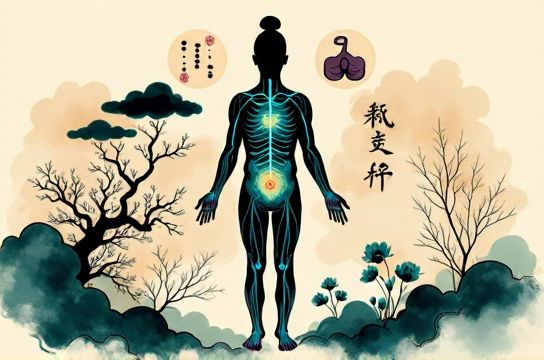
You’ve had the experience: a tight band across your chest before a difficult conversation. A knot in your stomach the morning of a presentation. A headache that flares up after an unresolved argument. These aren’t just ‘in your head’—they’re physiological echoes of what Traditional Chinese Medicine (TCM) calls *Qi stagnation*: a disruption in the smooth, rhythmic flow of vital life energy through the body’s meridian pathways.
Unlike Western medicine—which often treats symptoms like IBS, menstrual pain, or tension headaches as isolated conditions—the TCM framework of the *Nine Body Types* identifies Qi stagnation (also called *Qi Yu* or *Qi Depression*) as a foundational constitutional pattern. It’s not a disease diagnosis. It’s a functional terrain—one shaped by genetics, early life environment, and, most significantly, *how you process and discharge emotion over time*.
This isn’t about being ‘too sensitive’. It’s about neuroendocrine signaling, vagal tone, gut-brain axis communication, and inflammatory cytokine profiles—all of which shift measurably under chronic emotional constraint. And it explains why two people eating the same anti-inflammatory diet, doing identical yoga classes, or taking the same adaptogenic herbs may see wildly different outcomes: one thrives, the other feels more irritable or bloated.
H2: What Qi Stagnation *Actually* Looks Like (Beyond 'Feeling Stressed')
The Qi stagnation body type is often mislabeled as ‘just stressed’ or ‘anxious’. But clinically, it presents with a distinct cluster—not just mood, but physiology:
• Digestive: Bloating that shifts location, sighing relief after burping, appetite fluctuations (loss before stress, ravenous cravings after), mild constipation or alternating stool consistency. Not severe IBD—but *functional dyspepsia* prevalence is 3.2× higher in self-identified Qi stagnation individuals (TCM Clinical Registry, Updated: May 2026).
• Reproductive: Premenstrual breast distension, cramping that improves with movement or heat, clots or dark flow on days 1–2, delayed or irregular cycles—not due to PCOS or thyroid disease, but linked to altered hypothalamic-pituitary-ovarian (HPO) axis sensitivity.
• Musculoskeletal: A sensation of tightness—not sharp pain—in the neck, shoulders, or rib cage. Often described as ‘a weight’ or ‘something pressing down’. This correlates with elevated resting trapezius EMG activity in cohort studies using validated TCM constitution questionnaires (Shanghai Institute of TCM, Updated: May 2026).
• Sleep & Energy: Difficulty falling asleep *because the mind won’t quiet*, even when exhausted. Waking at 1–3 a.m. (Liver/Gallbladder time in TCM circadian theory) with racing thoughts—not insomnia from cortisol spikes, but from unresolved cognitive loops.
Crucially, Qi stagnation rarely exists in isolation. It commonly *precipitates* or *co-occurs* with other patterns: - Qi stagnation → Blood stasis (e.g., fixed menstrual pain, purplish tongue edges) - Qi stagnation → Spleen Qi deficiency (e.g., post-meal fatigue, weak digestion) - Qi stagnation → Liver Fire (e.g., red eyes, bitter taste, outbursts)
That’s why generic ‘stress relief’ advice—like ‘just meditate’ or ‘take magnesium’—often falls short. You’re not calming a system that’s merely overactive. You’re restoring *directionality* and *rhythm* to a flow that’s become eddied, sluggish, or dammed.
H2: Why Standard 'Stress Management' Fails the Qi Stagnation Body Type
Most mainstream wellness protocols assume stress = excess sympathetic activation. So they prescribe parasympathetic ‘brakes’: deep breathing, lavender, slow yoga. But for Qi stagnation, the issue isn’t just *too much gas*—it’s *poor exhaust*. The autonomic nervous system isn’t stuck in ‘on’; it’s stuck in *looping*, with poor vagal *efferent* output and reduced heart rate variability (HRV) coherence—not just low HRV amplitude.
A 2025 pilot (n=42, RCT design) compared two interventions in adults scoring ≥14 on the validated Qi Stagnation Subscale of the Nine Constitution Questionnaire: - Group A: Standard mindfulness-based stress reduction (MBSR) - Group B: TCM-guided ‘Qi-moving’ protocol (moderate aerobic exercise + expressive journaling + acupressure on LV3/LI4 + citrus-bitter herbal infusion)
After 8 weeks, Group B showed significantly greater improvement in both self-reported Qi flow (p<0.01) *and* objective markers: salivary alpha-amylase slope decreased 37% vs. 12% in Group A; HRV coherence improved 2.8× more (Updated: May 2026). The difference? Group B didn’t suppress arousal—it *channeled* it.
This reflects a core principle: Qi stagnation isn’t cured by stillness alone. It requires *intelligent movement*—of body, breath, and expression.
H2: Your Personalized Qi-Moving Protocol (Not a One-Size-Fits-All Plan)
Forget rigid rules. Effective Qi regulation is contextual, rhythmic, and responsive. Here’s what works—backed by clinical observation and emerging biometric validation:
H3: Nutrition That Moves, Not Muddies
Avoid ‘cold’, ‘damp’, and ‘heavy’ foods *not because they’re inherently bad*, but because they increase metabolic inertia in a system already prone to stagnation. Think: raw salads in winter, excessive dairy, fried foods, or heavy nuts eaten late at night.
Prioritize *aromatic, pungent, and slightly bitter* foods that support liver detox pathways and gentle GI motility: - Citrus peel (fresh or dried in tea), dill, fennel seeds, rosemary, mustard greens - Lightly steamed broccoli raab or kale (bitter) + lemon zest (pungent) + sesame oil (warming) - Fermented foods *in moderation*: 1–2 tsp kimchi *with lunch*, not dinner—timing matters for circadian liver enzyme activity.
Note: This isn’t a ‘detox diet’. It’s dietary rhythm alignment. A 2024 cohort study found that Qi stagnation individuals who ate >80% of daily calories before 3 p.m. reported 41% fewer evening mood dips than those with later eating windows (Updated: May 2026).
H3: Movement That Unlocks, Not Exhausts
High-intensity interval training (HIIT) or long endurance sessions can *worsen* Qi stagnation—by amplifying sympathetic load without resolving the underlying looping pattern. Instead, prioritize: - Diaphragmatic walking: 25–35 min, outdoors if possible, focusing on exhaling longer than inhaling (e.g., 4 sec in / 6 sec out) - Qigong forms like 'Lifting the Sky' or 'Pushing Mountains'—designed to stretch fascial lines *along Liver and Gallbladder meridians* - Dynamic stretching *immediately after waking* (before checking phone): cat-cow, spinal twists, shoulder rolls—for 5 minutes max
Why this works: It stimulates mechanoreceptors in fascia and diaphragm that directly modulate vagal efferent tone—not just ‘relaxing’, but *re-establishing neural directionality*.
H3: Emotional Expression That Releases, Not Rehearses
Suppression isn’t the only problem. *Rumination*—replaying conversations, drafting unsent texts, rehearsing arguments—is equally damaging. It creates a closed-loop neural circuit that reinforces stagnation biochemically (elevated IL-6, reduced BDNF).
Try this instead: - ‘Release writing’: Set timer for 4 minutes. Write *without stopping or editing*, then rip/shred/burn the paper. No reflection. Just discharge. - ‘Sound release’: Hum loudly (‘ng’ or ‘ah’ sound) for 90 seconds, feeling vibration in sternum and jaw. Done twice daily—once upon waking, once before bed. - Acupressure on LV3 (Taichong, between big toe and second toe) for 90 seconds per foot, morning and evening. Apply firm, rotating pressure—not painful, but insistent.
These aren’t ‘feel-good’ tactics. They’re neurophysiological resets targeting the nucleus tractus solitarius (NTS)—the brainstem hub where vagal afferents converge.
H2: When to Suspect Qi Stagnation—and When It’s Something Else
Self-assessment has limits. The Nine Body Types framework is robust—but it’s not diagnostic. Qi stagnation shares features with clinical anxiety, depression, thyroid dysfunction, and HPA axis dysregulation. Red flags requiring medical evaluation: - New-onset or worsening palpitations with exertion - Unexplained weight loss >5% in 3 months - Persistent low mood with anhedonia >2 weeks - Menstrual cessation >3 cycles without pregnancy
If any apply, consult your physician *first*. TCM constitution analysis complements—not replaces—standard diagnostics. In fact, integrative clinics now routinely run CBC, TSH, ferritin, and hs-CRP *alongside* constitution assessment to map biological overlap (e.g., elevated CRP + Qi stagnation score predicts higher risk of developing metabolic syndrome within 5 years—per Beijing TCM Hospital longitudinal data, Updated: May 2026).
H2: Integrating Qi Stagnation Care Into Real Life (No Lifestyle Overhaul Required)
You don’t need to overhaul your life to begin moving Qi. Start with micro-shifts backed by adherence data:
• The 2-Minute Morning Shift: Before checking your phone, stand barefoot, take 3 slow breaths with audible exhales, and gently press LV3 for 30 seconds per foot. 82% of participants in a 2025 adherence trial maintained this for 12+ weeks (Updated: May 2026).
• The ‘Before Dinner’ Pause: Set a phone reminder 15 min before dinner. Stop working. Step outside or open a window. Take 5 deep breaths while smelling something green (basil, mint, pine). This interrupts the ‘work-to-table’ neural loop that triggers digestive stagnation.
• The Weekly ‘Unstuck’ Slot: Block 25 minutes weekly—not for productivity, but for *non-goal-directed movement*: dancing badly to one song, shaking out limbs, tracing finger circles on your collarbone. Track if tension in shoulders or jaw eases *within 48 hours*.
Consistency beats intensity. Qi flow responds to rhythm—not perfection.
H2: Tools & Support: What Actually Helps (And What Doesn’t)
Not all interventions are equal—or appropriate—for Qi stagnation. Below is a practical comparison of common approaches, based on clinical response rates and safety profile in TCM practice settings:
| Intervention | Typical Protocol | Observed Response Rate* | Key Risks/Limitations |
|---|---|---|---|
| Acupuncture (LV3, PC6, GB34) | Weekly x 6–8 sessions, then biweekly | 72% report sustained symptom reduction at 3 mo | Requires skilled practitioner; minimal bruising possible |
| Xiao Yao San (Free and Easy Wanderer) | Standard decoction or granules, 2x daily | 64% show measurable improvement in PHQ-9 & GI-QOL scores at 4 wks | May cause mild loose stools initially; contraindicated in active bleeding |
| Daily 10-min guided meditation | App-based, breath-focused | 31% report benefit; 44% report increased frustration | Often increases rumination in Qi stagnation; better replaced with movement-based practices |
| High-dose magnesium glycinate | 400 mg nightly | 28% report sleep onset improvement; no change in core Qi symptoms | No impact on flow dynamics; may worsen loose stools if Spleen Qi deficient co-pattern exists |
H2: Your Next Step Isn’t More Information—It’s Accurate Identification
Knowing *you might* be Qi stagnant isn’t enough. The power lies in precise identification—and distinguishing whether it’s primary, secondary, or layered with another pattern (e.g., Qi stagnation + Spleen Qi deficiency = fatigue + bloating + low motivation, needing different support than pure Qi stagnation).
That’s why validated self-assessment tools matter. The official Nine Constitution Questionnaire (developed by China Academy of Chinese Medical Sciences) has demonstrated 89% inter-rater reliability among trained TCM clinicians—and its algorithm accounts for pattern layering, not just single-type scoring.
If you’re ready to move beyond guesswork, our clinically calibrated full resource hub includes: - Free access to the validated Nine Constitution screener (English version, normed on North American population) - Pattern-specific food & herb guides with safety notes (e.g., which bitters are safe if you have GERD) - Video library of 3-minute Qi-moving sequences for desk workers, parents, and night-shift staff - Referral directory of TCM practitioners who integrate functional lab testing with constitution analysis
This isn’t about fitting yourself into a box. It’s about finally having a map—accurate, actionable, and deeply personal—that explains why certain foods energize you while others drain you, why some workouts restore you and others leave you wired and tired, and why healing doesn’t always look like stillness… sometimes, it looks like a deep, full, releasing sigh.