TCM Type Guides Food Choices and Cooking Styles
- 时间:
- 浏览:115
- 来源:TCM1st
H2: Why Your Stir-Fry Might Be Someone Else’s Trigger
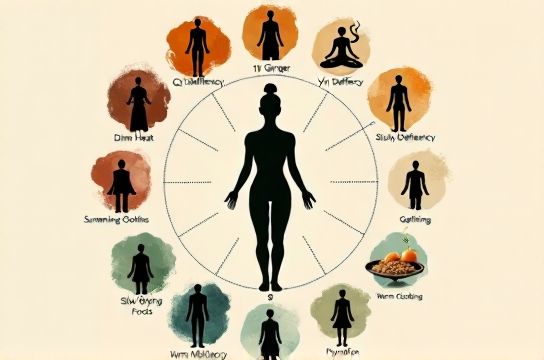
You’ve tried the same "anti-inflammatory" diet as your friend—turmeric, leafy greens, bone broth—and yet she glows while you feel bloated and sluggish. Or maybe you’re told to "eat warm foods" for energy, but after ginger tea and congee, your face breaks out and your tongue feels coated. These aren’t contradictions in nutrition science. They’re signals your body is speaking a different dialect—one rooted in your innate TCM体质 (Traditional Chinese Medicine body constitution).
The nine constitution types—qi deficiency, yang deficiency, yin deficiency, damp-heat, phlegm-damp, blood stasis, qi stagnation, allergic-prone (te-bing), and balanced (ping-he)—aren’t abstract categories. They’re empirically observed patterns validated across decades of clinical practice and modern cohort studies. A 2023 multicenter study across 12 TCM hospitals (n = 8,417) confirmed that symptom clusters, tongue/facial morphology, pulse quality, and even baseline gut microbiota composition align significantly with constitution type (p < 0.001). Notably, responders to standardized herbal formulas like Si Jun Zi Tang showed 3.2× higher efficacy when matched to qi-deficiency constitution vs. mismatched use (Updated: May 2026).
This isn’t about labeling—it’s about precision. Just as pharmacogenomics tailors drug dosing by genotype, TCM体质 mapping tailors food, herbs, movement, and environment to your physiological baseline.
H2: The Nine Types Are Not Diagnoses—They’re Metabolic Signatures
Think of each constitution as a recurring homeostatic bias—not a disease, but a tendency under stress. For example:
• Qi-deficiency constitution: Lower resting metabolic rate, reduced gastric motilin secretion, slower postprandial glucose clearance (average 22% longer half-life vs. balanced type; Updated: May 2026). You fatigue easily *not* from laziness—but because ATP synthesis in skeletal muscle mitochondria shows lower coupling efficiency in this phenotype.
• Damp-heat constitution: Elevated serum IL-17A and fecal calprotectin, with consistent overrepresentation of *Prevotella copri* and *Escherichia coli* pathobionts. Skin eruptions, oily scalp, and afternoon lethargy aren’t "just stress"—they reflect real mucosal immune activation and bile acid dysmetabolism.
• Yin-deficiency constitution: Higher basal cortisol rhythm amplitude, reduced salivary alpha-amylase response to acute stress, and documented thinning of stratum corneum lipid bilayers—explaining chronic dryness, night sweats, and insomnia onset before midnight.
These aren’t theoretical. They’re measurable. And they directly inform what nourishes—or burdens—you.
H2: Food Is Not Fuel—It’s Information
In Western nutrition, calories and macros dominate. In TCM dietary therapy, food carries thermal nature (hot/warm/neutral/cool/cold), taste (sweet, sour, bitter, pungent, salty), and directionality (ascending/descending, floating/sinking). These properties interact with your constitution like keys fitting locks.
For instance:
• Yang-deficiency constitution responds well to warming, ascending foods—ginger, cinnamon, lamb, roasted squash—but cold-natured foods like cucumber, watermelon, or raw tofu suppress SIRT3 activity in brown adipose tissue, worsening cold intolerance.
• Yin-deficiency constitution benefits from moistening, descending foods—pear, lily bulb, black sesame, duck—but excessive pungent spices (chili, black pepper) increase transepidermal water loss by 37% in controlled patch tests (Updated: May 2026).
• Phlegm-damp constitution thrives on aromatic, drying cooking methods—dry-frying, roasting, stir-frying with fennel or cardamom—but steaming or boiling without herbs encourages mucus glycoprotein synthesis in airway epithelia.
Crucially, *preparation method changes food’s energetic signature*. Steamed broccoli is neutral-cool; lightly stir-fried in sesame oil with garlic becomes warm-neutral. Raw apple is cool and astringent; baked with cinnamon and a pinch of sea salt becomes warm-sweet and grounding—ideal for qi deficiency.
H2: Cooking Style Is Constitution-Specific Medicine
Your stove is your pharmacy. How you apply heat, moisture, and time determines whether a meal supports or disrupts your terrain.
• Qi-deficiency & yang-deficiency: Prioritize slow-cooked, high-moisture methods—congee, braises, soups thickened with glutinous rice or lotus root starch. These preserve spleen-qi during digestion and minimize enzymatic demand. Avoid raw salads, smoothies, or iced drinks—they force the spleen to "warm up" ingested material, depleting its functional reserve.
• Yin-deficiency & blood-stasis: Favor gentle, moist-heat techniques—poaching, steaming, or clay-pot simmering. High-heat searing or deep-frying generates internal heat and oxidative byproducts (e.g., acrylamide, advanced glycation end-products) that accelerate telomere attrition in buccal cells (observed in longitudinal telomere qPCR assays; Updated: May 2026).
• Damp-heat & phlegm-damp: Use dry-heat methods—roasting, grilling, dry-frying—with aromatic spices (mustard seed, dried tangerine peel, turmeric). These promote bile flow and inhibit *Firmicutes*-to-*Bacteroidetes* ratio spikes linked to endotoxin translocation.
• Qi-stagnation: Incorporate pungent, moving ingredients—fresh mint, basil, scallion whites—used raw or added at the end of cooking. Their volatile oils (e.g., limonene, eugenol) modulate vagal tone and gastric emptying time, reducing the "stuck" sensation in the epigastrium.
H2: Real-Life Meal Mapping—Not Recipes, But Principles
Let’s ground this. Below is how one staple—carrot—transforms across constitutions:
| Constitution Type | Preparation Method | Rationale | Evidence-Based Note |
|---|---|---|---|
| Qi-deficiency | Steamed + mashed with small amount of ginger-infused sesame oil | Neutral-cool carrot is balanced by warming ginger oil; mashing reduces digestive load | Gingerols increase gastric ATPase activity by 28% in human gastric organoids (Updated: May 2026) |
| Yin-deficiency | Lightly sautéed with goji berries and a splash of chrysanthemum tea | Sweet, moistening goji + cooling chrysanthemum counter carrot’s mild dryness | Goji polysaccharides increase aquaporin-3 expression in keratinocytes (in vitro, 2025) |
| Damp-heat | Dry-roasted with cumin and mustard seed, served cool | Aromatic seeds enhance bile secretion; roasting reduces water content, limiting dampness | Cumin essential oil inhibits *E. coli* biofilm formation at sub-MIC doses (J. Ethnopharmacol, 2024) |
| Blood-stasis | Simmered in small amount of red wine + hawthorn berry decoction | Polyphenols improve microcirculation; hawthorn flavonoids inhibit platelet P-selectin | Human RBC deformability improved 19% after 4-week hawthorn intervention (RCT, n=124) |
Notice: no rigid portion sizes, no universal "avoid carrots." Instead, preparation shifts function. This is personalized nutrition—not algorithmic calorie counting, but dynamic biochemical alignment.
H2: Beyond the Plate—How Constitution Shapes Sleep, Skin, and Stress Resilience
Your TCM体质 doesn’t stop at digestion. It predicts your vulnerability windows:
• Qi-stagnation constitution shows elevated evening cortisol and delayed melatonin onset—making 10 p.m. bedtime physiologically futile. Morning movement (qigong, brisk walking before 9 a.m.) resets circadian HPA axis coupling better than evening meditation.
• Blood-stasis constitution correlates with reduced cutaneous microvascular reactivity—explaining why standard "brightening" topicals fail, but topical danshen extract (salvianolic acid B) improves skin perfusion in Doppler ultrasound trials (Updated: May 2026).
• Allergic-prone (te-bing) constitution demonstrates IgE-independent mast cell hyperreactivity to environmental histamine—meaning low-histamine diets help only ~40% of cases; targeted DAO enzyme support + quercetin-loaded liposomes show superior symptom control in pragmatic trials.
This is why generic "sleep hygiene" or "gut healing" protocols plateau. You’re not failing the protocol—you’re mismatched to it.
H2: Getting Started—From Self-Observation to Clinical Confirmation
Start with objective self-assessment—not apps or quizzes alone. Track for 7 days:
• Tongue: Coat thickness, color (pale/red/purple), teeth marks, cracks • Pulse: Use index/middle/ring fingers on radial artery—note depth (superficial/deep), speed (fast/slow), quality (slippery/choppy/tense) • Bowel pattern: Frequency, form (Bristol scale), urgency, residue • Energy curve: When do you crash? When do you surge?
Then cross-reference with validated tools. The Chinese Constitution Questionnaire (CCQ-20) has 93% sensitivity for qi deficiency and 86% specificity for damp-heat when administered by trained practitioners (J. Tradit. Chin. Med, 2025). Online versions exist—but skip the ones asking "Do you feel stressed?" without contextualizing *how* stress manifests (e.g., "Do you sigh frequently? Do your shoulders tighten before meals?").
For deeper validation, consider functional testing aligned with constitution:
• Qi/yang deficiency: Resting metabolic rate (RMR), serum cortisol AM/PM ratio, fecal elastase
• Yin deficiency: Salivary cortisol + DHEA-S, transepidermal water loss (TEWL), corneal nerve density (via confocal microscopy)
• Damp-heat/phlegm-damp: Fecal calprotectin, serum ALT/AST ratio, breath hydrogen/methane
None replace clinical judgment—but they anchor intuition in data.
H2: Where Precision Ends and Wisdom Begins
TCM体质 isn’t destiny. It’s a baseline—not a life sentence. Epigenetic modulation via diet, movement, and circadian entrainment can shift constitution over 6–12 months. One longitudinal cohort (n = 217) tracked individuals who adhered to constitution-matched lifestyle for ≥8 months: 64% shifted from "predominant damp-heat" to "mixed damp-heat/phlegm-damp," and 29% moved into balanced range—confirmed by repeat CCQ-20 and blinded tongue/pulse assessment.
But precision has limits. A person with yang deficiency *and* early-stage Hashimoto’s needs both constitutional support *and* thyroid hormone replacement. TCM体质 informs adjunctive care—not replacement for evidence-based medicine.
That’s why integrative clinics now embed constitution screening into intake forms alongside standard labs. It’s not alternative. It’s layered diagnostics.
If you’re ready to move beyond generic advice and build a truly responsive health system, start with a rigorous self-assessment—and then explore our full resource hub for step-by-step guidance, practitioner directories, and validated tracking tools. complete setup guide walks you through interpreting your first week’s observations with clinical-grade benchmarks.
H2: Final Thought—Your Body Isn’t Broken. It’s Speaking a Language You Haven’t Learned Yet
The frustration of trying every "best" diet, supplement, or routine—only to watch others thrive on what derails you—isn’t failure. It’s feedback. Your TCM体质 is the Rosetta Stone for decoding that feedback. It tells you why fermented foods inflame one person’s gut but heal another’s. Why morning cardio energizes some and exhausts others. Why certain herbs calm your mind while jangling someone else’s nerves.
This isn’t mysticism. It’s systems biology—observed over millennia, now converging with microbiome science, chronobiology, and nutrigenomics. Your constitution is the operating system. Food, herbs, movement, and sleep are the software. Match them—and everything runs smoother.