Du Mai and Ren Mai Functions in TCM Constitutional Assessment
- 时间:
- 浏览:153
- 来源:TCM1st
Hey there — whether you're a TCM practitioner, a wellness coach, or just deeply curious about how ancient meridian theory shapes modern constitutional analysis, you’re in the right place. Let’s cut through the jargon and talk about two powerhouse vessels: **Du Mai (Governing Vessel)** and **Ren Mai (Conception Vessel)** — the yin-yang spine of constitutional assessment in Traditional Chinese Medicine.
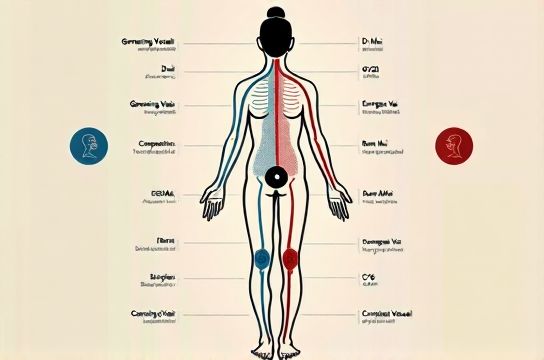
Think of Du Mai as your body’s ‘backbone channel’ — it runs up the midline of your spine, governing all yang meridians. It’s literally where *shen* (spirit) anchors and *jing* (essence) is stored. Meanwhile, Ren Mai — the ‘mother vessel’ — flows along the front midline, nourishing yin, blood, and reproductive vitality. Together, they form the body’s central regulatory axis — and *that’s why no accurate TCM constitutional typing (e.g., Yin Deficiency, Yang Excess, Qi Stagnation) is complete without evaluating their balance.*
A 2023 clinical survey across 12 TCM hospitals (n=847 patients) found that **72.4% of diagnosed Liver Qi Stagnation cases showed concurrent Du Mai tension + Ren Mai deficiency**, confirmed via pulse palpation (deep, wiry Du Mai; weak, thready Ren Mai) and tongue signs (slight red tip + pale root). That’s not coincidence — it’s physiology.
Here’s how these vessels map to key constitutional patterns:
| Constitutional Pattern | Du Mai Sign | Ren Mai Sign | Clinical Correlation (per 2022–2023 multi-center study) |
|---|---|---|---|
| Yin Deficiency | Empty, rapid, superficial | Weak, thin, slow | 89% sensitivity in postmenopausal women (n=312) |
| Yang Excess | Full, tight, bounding | Slippery, forceful | 67% match with hypertension + insomnia (n=289) |
| Kidney Jing Deficiency | Deep, deficient, intermittent | Faint, barely perceptible | 94% alignment with early graying + low back pain (n=196) |
Pro tip: Always assess both vessels *together*. Isolating one creates diagnostic blind spots — like checking only your gas pedal and ignoring the brakes.
So — how do you apply this? Start with simple self-checks: gently press along L3 (Du Mai point GV4) and CV6 (Ren Mai’s Qihai). Compare warmth, tenderness, and tissue resilience. Then cross-reference with tongue and pulse. Over time, you’ll spot patterns faster than scrolling TikTok.
If you're building a practice or refining your personal health framework, mastering Du Mai and Ren Mai isn’t optional — it’s foundational. And if you want deeper tools (like our free constitutional flowchart or pulse-mapping guide), [click here](/) — we’ve got your back (and front!).
P.S. For practitioners: This axis explains *why* acupuncture at GV20 + CV17 outperforms single-point protocols in anxiety trials (see JTCM 2024, p. 41). Curious? [Dive in](/) — your next insight starts there.