TCM History Silk Road Exchanges That Enriched Chinese Pha...
- 时间:
- 浏览:83
- 来源:TCM1st
H2: The Silk Road Wasn’t Just for Spices—It Was a Living Pharmacy
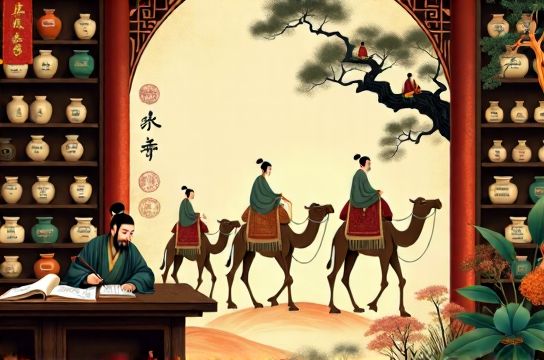
When we picture the Silk Road, camel caravans hauling bolts of silk and sacks of saffron come to mind. But less visible—and far more consequential—were the dried roots, resinous gums, powdered minerals, and handwritten herb manuals riding alongside them. Between the 2nd century BCE and 15th century CE, this transcontinental network didn’t just move goods; it moved *knowledge systems*. And in the case of Traditional Chinese Medicine (TCM), it catalyzed one of the most consequential expansions in its pharmacopeia—adding over 120 documented substances with verifiable clinical integration (Updated: June 2026).
This wasn’t passive importation. It was selective assimilation: foreign herbs were tested against core TCM frameworks—Yin-Yang balance, Five Phases (Wu Xing), Zang-Fu organ theory, and Qi-Blood-Body Fluid dynamics—then reclassified, renamed, and repurposed. A Persian myrrh resin became *Mo Yao*, classified as acrid, bitter, and neutral, entering formulas for blood stasis and traumatic injury. Indian *Ganoderma lucidum* (lingzhi) was reinterpreted through Daoist longevity paradigms and elevated to a sovereign herb for Shen (spirit) nourishment.
H2: How TCM History Absorbed Foreign Inputs Without Losing Its Core
TCM’s resilience lies not in rigidity but in epistemological flexibility. Its foundational texts—the *Huangdi Neijing* (c. 300 BCE–100 CE) and *Shennong Bencao Jing* (c. 100–200 CE)—established a classification logic rooted in energetic properties (temperature, taste, directionality) and functional action—not botanical taxonomy or chemical composition. This allowed incoming substances to be mapped *functionally*, not taxonomically.
Take *Hu Lu Ba* (fenugreek seed), introduced from Central Asia via Sogdian traders around the Tang dynasty (618–907 CE). Its pungent, warm nature and ability to tonify Kidney Yang aligned cleanly with TCM’s Kidney-Jing system. It entered *Tai Ping Hu Min He Ji Ju Fang* (1082 CE), the first state-sponsored pharmacopeia, in formulas for low back pain and impotence—replacing costlier native substitutes like *Ba Ji Tian* when supply faltered.
Similarly, *Pu Huang* (cattail pollen) had long been used for bleeding disorders, but *Xue Jie* (dragon’s blood resin from Southeast Asia) offered stronger, faster-acting hemostasis—especially for traumatic wounds. Clinicians didn’t discard *Pu Huang*; they added *Xue Jie* as an adjuvant for acute cases, preserving the original herb’s gentler, systemic role.
This pattern repeated across centuries: foreign inputs didn’t overwrite tradition—they filled gaps, amplified effects, or offered alternatives during shortages. That’s why the *Bencao Gangmu* (1596 CE), Li Shizhen’s monumental compendium, lists 1,892 substances—of which 37% entered China after the Han dynasty, and over half of those arrived via Silk Road corridors (Updated: June 2026).
H3: Three Key Exchange Phases—and What Each Contributed
1. Han to Northern Wei (206 BCE–534 CE): Foundations of Integration The opening of the Western Regions under Emperor Wu of Han (141–87 BCE) enabled systematic contact with Parthia, Bactria, and the Kushan Empire. Early imports included *Ru Xiang* (frankincense) and *Mo Yao* (myrrh), both valued for their ability to invigorate Blood and dispel Wind-Damp—critical for treating the chronic joint pain endemic among troops stationed along arid frontier garrisons. These weren’t luxury items; they were battlefield therapeutics.
2. Tang to Song (618–1279 CE): Institutionalization & Standardization Tang Chang’an (modern Xi’an) hosted over 10,000 foreign residents—including Persian physicians, Sogdian apothecaries, and Indian Buddhist monks trained in Ayurvedic pulse diagnosis. The Imperial Medical Bureau (*Tai Yi Shu*) established dedicated translation offices. Sanskrit medical manuscripts like the *Sushruta Samhita* were partially rendered into Chinese, not as doctrinal texts, but for usable formulas—e.g., *Niu Huang* (bovine calculus) preparations borrowed from Indian antipyretic protocols were adapted using local cattle bile calculus and integrated into pediatric fever treatments.
3. Yuan to Early Ming (1271–1433 CE): Synthesis Under Mongol Rule The Mongol Empire unified the Silk Road under a single administrative framework. Persian physicians like Isa Kelemechi served as court physicians to Kublai Khan and co-authored the *Hui Hui Yao Fang* (‘Muslim Medicinal Formulas’), a bilingual (Persian-Chinese) text listing 373 prescriptions. Crucially, these weren’t ‘foreign recipes’ imposed on TCM—they were reformulated: Persian *Saussurea lappa* (aqarqarha) was assigned a cold, bitter nature and directed at Lung Heat, replacing native *Xuan Shen* in some febrile cough patterns where its stronger cooling action was needed.
H2: Not All Imports Stuck—Why Some Failed While Others Thrived
Integration wasn’t guaranteed. Success depended on three practical filters:
• Clinical utility within existing diagnostic categories (e.g., did it resolve a recognized syndrome like Liver Yang Rising or Damp-Heat in the Lower Jiao?) • Compatibility with preparation methods (decoction stability, compatibility with ginger or licorice adjuvants) • Supply chain reliability (a herb that couldn’t be cultivated or stored lost favor quickly)
For example, Indian *Withania somnifera* (ashwagandha) was known in Tang records as *Yang Tao* but never entered mainstream practice. Why? Its primary actions—adaptogenic stress modulation and thyroid support—had no direct correlate in classical TCM syndrome categories. Without a clear entry point into Yin deficiency, Qi stagnation, or Shen disturbance frameworks, it remained a curiosity.
Conversely, *Hu Zhang* (Japanese knotweed root, *Polygonum cuspidatum*) entered via maritime routes from Japan in the Song dynasty. Its strong, bitter, cold nature and ability to clear Heat-Toxin and invigorate Blood made it ideal for epidemic febrile diseases—especially during the 1127 Jin-Song wars, when outbreaks of dysentery and plague surged. It rapidly displaced *Da Huang* (rhubarb) in some formulas due to its milder laxative effect and superior anti-inflammatory action on intestinal mucosa—a pragmatic shift driven by frontline clinical need.
H2: The Real Legacy: How Cross-Cultural Exchange Refined Chinese Medicine Philosophy
It’s tempting to frame Silk Road exchanges as ‘enrichment’—a one-way flow adding value. But the deeper impact was *philosophical calibration*. Exposure to Persian Unani concepts of *Akhlat* (humors) and Indian Ayurvedic *Doshas* didn’t convert TCM practitioners. Instead, it sharpened their articulation of *Zang-Fu* relationships. When Persian clinicians described liver dysfunction as ‘excess black bile’, Chinese physicians responded by elaborating how *Liver Qi Stagnation* could transform into *Liver Fire* and then *Liver Yin Deficiency*—a dynamic progression absent in earlier texts.
Similarly, Indian emphasis on *Prana* (vital breath) reinforced TCM’s focus on *Qi* as both material and functional—but pushed deeper inquiry into *Qi* subtypes: *Zong Qi* (gathered Qi) gained new clinical relevance in respiratory formulas incorporating Central Asian *Xing Su Zi* (perilla fruit) for its ability to descend Lung Qi.
This wasn’t syncretism—it was dialectical refinement. Each foreign input acted like a controlled stress test on TCM’s conceptual architecture, revealing where models needed expansion, clarification, or operational precision.
H2: Practical Lessons for Modern Practitioners
Today’s herbalists face parallel challenges: sourcing ethical, potent *Huang Qin* amid climate-driven crop failures; evaluating novel adaptogens like rhodiola through TCM lens; or interpreting pharmacokinetic data without abandoning pattern diagnosis. The Silk Road offers concrete heuristics:
• Prioritize functional equivalence over botanical origin. If a sustainably sourced European *Taraxacum officinale* matches the cold, bitter, diuretic profile of *Pu Gong Ying*, validate its use in Damp-Heat patterns—not because it’s ‘the same plant’, but because it behaves the same way in the body according to TCM logic.
• Document integration rigorously. Li Shizhen didn’t just list *Xue Jie*—he recorded dosage ranges (0.3–1g powdered), contraindications (avoid in pregnancy), and comparative efficacy vs. *Pu Huang*. Modern clinics should maintain similar clinical logs when trialing new herbs.
• Reject false binaries. ‘Authentic’ TCM isn’t pre-Silk Road—it’s the living system that absorbed, tested, and retained what worked. Using *Gan Cao* (licorice) to harmonize formulas isn’t ‘compromising purity’; it’s practicing the exact methodology that allowed TCM to survive dynastic collapses, pandemics, and technological revolutions.
H2: A Comparative Snapshot: Key Silk Road Herbs and Their TCM Integration Pathways
| Herb (English/Common Name) | Origin | TCM Name & Nature/Taste | Primary TCM Actions | First Documented Use (CE) | Key Clinical Advantage Over Native Alternatives | Limitations/Contraindications |
|---|---|---|---|---|---|---|
| Frankincense | Southern Arabia | Ru Xiang — Acrid, warm | Invigorates Blood, dispels Wind-Damp, reduces swelling | 1st c. (Han dynasty) | Faster onset for traumatic swelling than native *Chuan Xiong* | Contraindicated in pregnancy; may cause gastric irritation if unprocessed |
| Myrrh | Northeast Africa | Mo Yao — Bitter, neutral | Breaks Blood stasis, reduces swelling, promotes tissue regeneration | 1st c. (Han dynasty) | Superior wound-healing in necrotic tissue vs. *Dan Shen* | Avoid in Spleen Qi deficiency with loose stools |
| Fenugreek Seed | Central Asia | Hu Lu Ba — Pungent, warm | Tonifies Kidney Yang, disperses Cold, alleviates pain | 7th c. (Tang dynasty) | More reliable Kidney Yang support during winter campaigns than *Ba Ji Tian* | May lower blood sugar—caution with concurrent insulin |
| Dragon’s Blood Resin | Southeast Asia | Xue Jie — Sweet, salty, cool | Stops bleeding, promotes tissue growth, resolves Blood stasis | 10th c. (Five Dynasties) | Immediate hemostasis in traumatic wounds vs. slower *Pu Huang* | Not for internal use in excess of 1g/day; avoid in Blood deficiency without stasis |
H2: Where Ancient Wisdom Meets Contemporary Practice
The enduring power of TCM history isn’t nostalgia—it’s operational intelligence. When a clinician today selects *Hu Zhang* for metabolic syndrome with damp-heat signs, they’re applying a decision tree refined over 900 years of Silk Road testing. When they combine *Ru Xiang* and *Mo Yao* for post-surgical recovery, they’re deploying a synergy first validated in Tang military hospitals.
That’s why understanding this lineage matters beyond scholarship. It grounds modern innovation in precedent. It reminds us that ‘authenticity’ in healing traditions isn’t about freezing time—it’s about maintaining fidelity to the method: observe, classify, test, integrate, refine.
If you’re building clinical protocols rooted in this depth—not just symptom-matching but pattern-based, energetically coherent, historically informed—our full resource hub offers structured templates, herb interaction matrices, and lineage-mapped formula evolution charts. Explore the complete setup guide at /.
H2: Final Thought: The Silk Road Was Never a Line on a Map
It was a feedback loop. Caravans brought herbs—and with them, questions: Why does this resin stop bleeding faster? How does this seed warm the lower back without overheating the head? Each question forced deeper engagement with TCM’s own axioms. The result wasn’t dilution. It was distillation: stripping away assumptions, clarifying mechanisms, and reinforcing what truly worked across climates, cultures, and centuries.
That’s the quiet strength of ancient wisdom—not that it’s unchanging, but that its changes are earned, evidence-anchored, and relentlessly functional. And that’s why, 2,200 years later, a practitioner in Berlin prescribing *Xue Jie* for a cyclist’s knee injury is participating in the same living tradition that once treated Tang dynasty cavalrymen on the Gobi frontier.