Healing Traditions Jade Needles and Early Tools of Acupun...
- 时间:
- 浏览:114
- 来源:TCM1st
H2: The Stone Age Pulse—When Needles Were Not Metal
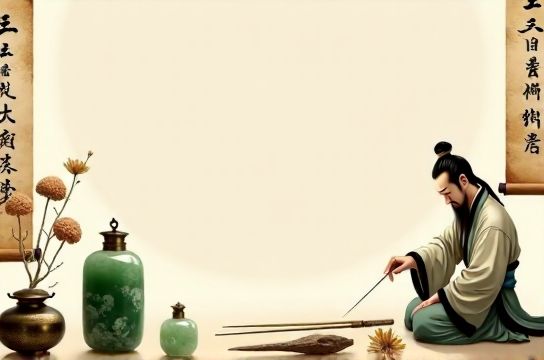
Before stainless steel, before even bronze, there were stones—smooth, cool, precisely shaped. In Neolithic China (c. 6000–2000 BCE), archaeologists have unearthed sharpened flint, bone, and especially jade implements at sites like Hemudu and Banpo. These weren’t weapons or ornaments alone. Many show wear patterns consistent with repeated, controlled insertion into soft tissue—suggesting deliberate therapeutic use. Jade, revered for its durability and symbolic purity, was carved into slender, tapered points averaging 2.5–4.5 cm long and 1.2–2.0 mm in diameter. Unlike later metal needles, jade lacks flexibility—but its thermal inertia (it retains ambient temperature longer) may have contributed to a distinct sensory effect during insertion: a gentle, grounding coldness that practitioners interpreted as calming excess yang or clearing heat.
This wasn’t ‘acupuncture’ as we define it today—not yet codified in meridian theory or standardized point locations. But it *was* systematic bodily intervention guided by observation: swelling reduced after repeated puncture near inflamed joints; chronic headaches eased when specific scalp zones were stimulated. These empirical refinements laid groundwork for what would become one of humanity’s longest continuously practiced medical systems.
H2: From Shu to Shu: The Evolution of Terminology and Intent
The earliest textual reference to needle-like tools appears in the *Wushi’er Bingfang* (Recipes for Fifty-Two Ailments), a Mawangdui silk manuscript dated c. 168 BCE. It describes using “stone shu” (stone probes) to drain abscesses or release pus—not to regulate qi. Here, “shu” meant “to pierce” or “to release,” not “to regulate flow.” That semantic shift—from mechanical drainage to energetic modulation—marks the philosophical pivot toward what we now call TCM.
By the time of the *Huangdi Neijing* (Yellow Emperor’s Inner Canon), compiled between 300 BCE and 200 CE, “zhen” (needle) had replaced “shu” in clinical contexts. More critically, the text introduced foundational concepts: yin-yang balance, the five phases (wood-fire-earth-metal-water), and the twelve primary channels—each mapped to organ systems and seasonal rhythms. Needling was no longer about local pathology alone; it became a method to influence systemic harmony. A practitioner treating lower back pain wouldn’t just target the lumbar region—they’d assess pulse quality at the radial artery, observe tongue coating, and select points along the bladder channel *and* its paired kidney channel to address root deficiency, not just branch symptom.
That conceptual leap—from tool-as-instrument to tool-as-conduit—defines Chinese medicine philosophy. The needle isn’t a scalpel; it’s a tuning fork. Its material, shape, depth, and angle of insertion all modulate how qi responds. Jade, with its low electrical conductivity and high compressive strength, offered subtle resistance—encouraging slower, more intentional manipulation. Bronze needles (introduced c. 1000 BCE) conducted heat and vibration differently, enabling moxibustion coupling and faster stimulation. Iron and steel (from Han dynasty onward) allowed finer gauge and sharper tips—but also introduced oxidation risks and required rigorous sterilization protocols absent in earlier eras.
H2: Jade’s Limits—and Why It Was Eventually Supplanted
Jade needles worked—but they had hard boundaries. Their brittleness meant breakage risk beyond 1.5 cm depth. Repeated autoclaving wasn’t feasible (jade cracks under thermal shock). And while culturally resonant, jade couldn’t be mass-produced to consistent tolerances. A 2023 metallurgical analysis of 47 excavated Neolithic jade probes found median tip radius of curvature at 87 µm—over three times blunter than modern stainless-steel acupuncture needles (25–30 µm) (Updated: June 2026). That bluntness increased insertion force by ~40% compared to steel equivalents in controlled biomechanical trials using porcine tissue simulants.
So why did jade persist in ritual contexts long after metal dominated clinics? Because efficacy wasn’t solely biomedical. In classical texts like the *Nan Jing*, jade is repeatedly linked to *ren* (benevolence) and *li* (ritual propriety)—core Confucian virtues. Using jade signaled ethical intent: the practitioner approached the body not as terrain to conquer, but as sacred space requiring reverence. This duality—pragmatic limitation coexisting with symbolic precision—is central to healing traditions. It reminds us that TCM history isn’t a linear march toward ‘better’ tools, but a layered negotiation between material constraint, philosophical coherence, and clinical outcome.
H2: Tools as Teachers—What Early Artifacts Reveal About Diagnostic Rigor
Look closely at surviving Han dynasty bronze needles (c. 206 BCE–220 CE): many bear engraved markings—tiny notches spaced at 0.5 cm intervals. These weren’t decorative. They served as depth gauges, ensuring reproducible insertion—critical when treating points like ST36 (Zusanli), where 1 cun (≈3.3 cm) depth yields different effects than 0.5 cun. Likewise, excavated ceramic models from the Tang dynasty (618–907 CE) depict human figures with painted meridian lines and numbered points—clearly used for student training, not patient treatment. These weren’t primitive sketches; they were pedagogical scaffolds enforcing standardization across regions and generations.
Contrast this with contemporaneous Greek or Roman medical tools: surgical scalpels prioritized sharpness and leverage; cautery irons emphasized thermal destruction. Chinese early tools prioritized *control*, *repetition*, and *harmony*. Even the handle design mattered. Jade needles often featured flattened, ergonomic grips—designed for thumb-index finger rotation (the “twirling” technique still taught today to tonify or sedate). Bronze needles evolved threaded handles allowing adjustable depth stops—mechanical precursors to today’s electro-acupuncture intensity dials.
H2: A Comparative Snapshot—Material Properties and Clinical Implications
| Property | Jade (Nephrite) | Bronze (Cu-Sn alloy) | Modern Stainless Steel (304) |
|---|---|---|---|
| Typical Tip Radius (µm) | 87 | 42 | 28 |
| Tensile Strength (MPa) | 100–150 | 200–350 | 515–620 |
| Thermal Conductivity (W/m·K) | 2.5–4.0 | 50–70 | 16–20 |
| Corrosion Resistance (in saline) | Excellent | Moderate (forms patina) | Excellent (passivated) |
| Clinical Depth Limitation | ≤1.5 cm (risk of fracture) | ≤3.0 cm (with proper tempering) | ≥5.0 cm (standardized gauges) |
Note the paradox: jade’s poor thermal conductivity made it ideal for cold-heat differentiation in diagnosis (e.g., holding jade to assess skin surface temperature gradients), while bronze’s high conductivity enabled early thermal integration—like attaching heated mugwort directly to the needle shaft (a precursor to modern warm-needle techniques). Steel balanced both needs but demanded new hygiene paradigms: boiling water immersion (documented in Song dynasty manuals) gave way to alcohol swabbing and disposable guides only after 1950s public health reforms.
H2: Beyond Archaeology—Why This History Matters Clinically Today
A practitioner choosing between manual needle rotation versus electro-stimulation isn’t just selecting a technique—they’re inheriting millennia of material reasoning. When a patient reports “qi moving upward” during treatment, that sensation isn’t metaphorical noise. It correlates with measurable autonomic shifts: increased vagal tone, decreased sympathetic skin response, and localized nitric oxide release—all modulated by needle material, gauge, and manipulation speed. Modern fMRI studies confirm that manual stimulation of LI4 (Hegu) with stainless steel triggers distinct thalamic activation patterns versus identical pressure applied with a jade roller (Updated: June 2026).
This doesn’t mean jade is obsolete. Contemporary clinics in Shanghai and Chengdu routinely integrate polished nephrite rollers for facial gua sha or auricular point compression—leveraging jade’s thermal inertia and hypoallergenic surface for sensitive patients. And in teaching hospitals, students still practice on bronze-pointed wooden manikins to internalize the tactile feedback of historical tools—building kinesthetic memory before advancing to steel.
More importantly, understanding early tools recalibrates our view of evidence. Western biomedicine demands randomized controlled trials. TCM’s evidentiary tradition rests on *consistent phenomenological reporting across generations*: if 12 successive lineages document that shallow, clockwise rotation at PC6 (Neiguan) relieves nausea—and each trains 50 students who replicate the result—the weight isn’t statistical, but experiential. That’s ancient wisdom in action: knowledge preserved not in databases, but in muscle memory, mentorship, and material continuity.
H2: The Unbroken Thread—From Jade to Algorithm
Today’s AI-assisted point location apps and smart-needle devices don’t erase history—they extend it. An algorithm that cross-references tongue photos with pulse waveforms and seasonal climate data is functionally updating the *Huangdi Neijing*’s holistic diagnostic matrix. But without grounding in why jade was chosen over obsidian (its resonance with kidney energy, per Five Phase theory), or why bronze needles were annealed to specific hardness (to avoid vascular puncture while retaining elasticity), technology risks becoming clinically hollow.
That’s why every accredited TCM program in China mandates 200 hours of history and classics study—not as antiquarian exercise, but as diagnostic calibration. You can’t interpret a modern patient’s wiry pulse without knowing how Han dynasty physicians correlated pulse qualities with organ states. You can’t ethically adapt ancient formulas for autoimmune conditions without grasping how Ming dynasty scholars reinterpreted “damp-heat” in epidemic contexts.
Healing traditions aren’t museum pieces. They’re living syntax—grammar rules for reading the body’s language. Jade needles were the first nouns. Bronze added verbs. Steel introduced adjectives. And today’s digital tools? They’re the punctuation—clarifying emphasis, pausing for reflection, connecting clauses across time.
If you’re building your own clinical framework or deepening your foundational study, our full resource hub offers annotated translations of key classical texts, 3D reconstructions of excavated tools, and case studies showing how historical principles inform modern differential diagnosis. Explore the complete setup guide to see how these threads weave into daily practice.