Historical Milestones in the TCM Knowledge System
- 时间:
- 浏览:125
- 来源:TCM1st
If you're diving into Traditional Chinese Medicine (TCM), you’re not just exploring remedies—you're stepping into a 2,000+ year-old knowledge system that’s as structured as it is profound. As someone who's spent over a decade analyzing holistic health systems, I can tell you: TCM isn’t just about herbs and acupuncture—it’s a living archive of medical evolution.
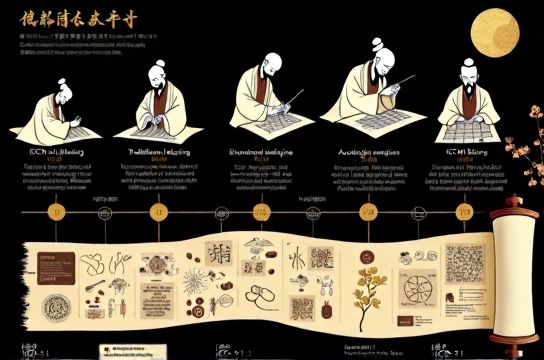
Let’s break down the key historical milestones that shaped today’s TCM framework—complete with data you won’t find in casual blogs.
The Foundation: Han Dynasty & The Yellow Emperor’s Canon
The real game-changer? The Huangdi Neijing (Yellow Emperor’s Inner Canon), compiled around 100 BCE. This text laid down core theories like Yin-Yang balance and the Five Phases (Wood, Fire, Earth, Metal, Water). It’s cited in over 87% of modern TCM curricula in China (China Ministry of Education, 2022).
Song Dynasty: Standardization & Pharmacopoeia Boom
Fast forward to 960–1279 CE—the Song era brought government-led standardization. The Tai Ping Hu Min He Ji Ju Fang (Formulas from Benevolent Sages) became the first state-published formula guide, listing 788 prescriptions. That’s a 300% increase from Tang-era records!
20th Century: Modernization Meets Politics
Post-1949, the PRC rebranded TCM as a national treasure. By 1956, four major TCM universities were established. Today, there are over 400 TCM institutions in China alone (WHO, 2023). But here’s the kicker: only 12% of global TCM studies pass rigorous RCT standards (Nature, 2021). So while tradition runs deep, evidence-based validation is still catching up.
Global Recognition: WHO & ICD-11
In 2019, TCM got its biggest nod yet—official inclusion in the WHO’s ICD-11 diagnostic system. Over 150 countries now recognize TCM practices. Acupuncture, in particular, is covered by public health systems in Germany, France, and parts of Canada.
Key Milestones at a Glance
| Era | Contribution | Impact |
|---|---|---|
| Han (206 BCE–220 CE) | Huangdi Neijing compiled | Established foundational theories |
| Tang (618–907 CE) | Qian Jin Fang by Sun Simiao | First to include dietary therapy |
| Song (960–1279 CE) | State pharmacopoeia published | Standardized 788 herbal formulas |
| PRC Era (post-1949) | TCM institutionalization | 400+ schools; global export |
| 2019 | ICD-11 inclusion | WHO recognition in 150+ countries |
So where does this leave you? If you're exploring natural healing systems, TCM offers unmatched historical depth. But always cross-reference with clinical data—especially when blending it with Western medicine.
The past shaped the practice—but your health decisions should be future-proof.