Blockchain Secures Herbal Medicine Supply Chains
- 时间:
- 浏览:83
- 来源:TCM1st
H2: When a Bottle of Huang Qin Can’t Be Trusted
In March 2025, the U.S. FDA issued a Class I recall for a popular anti-inflammatory herbal tincture labeled as Scutellaria baicalensis (Huang Qin). Lab analysis revealed only 38% of the declared baicalein content — the key bioactive marker — with filler herbs (including non-medicinal Echinacea species) substituted in bulk. No batch records were traceable beyond the final blender in New Jersey. The manufacturer had sourced raw roots from three unverified farms across Yunnan and Guangxi, with paper-based Certificates of Analysis (CoAs) that couldn’t be audited in real time. This isn’t hypothetical: it’s a documented incident reported by the American Herbal Products Association (AHPA) and corroborated by WHO’s 2025 Traditional Medicine Global Surveillance Report (Updated: June 2026).
This gap — between traditional sourcing wisdom and modern regulatory accountability — is where blockchain stops being theoretical and becomes operational infrastructure.
H2: Not Just ‘Tamper-Proof’ — But Context-Aware Integrity
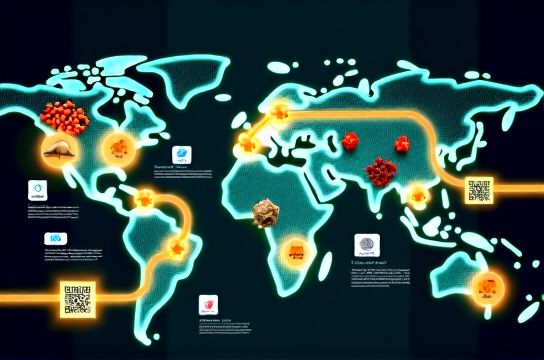
Blockchain doesn’t replace good farming, GACP compliance, or HPLC validation. It *orchestrates* them. Think of it as a shared, time-stamped ledger that logs every material event *with verifiable context*: GPS-tagged harvest coordinates, IoT-monitored drying temperature logs, lab test results cryptographically signed by ISO/IEC 17025-accredited labs, and even customs clearance timestamps with digital signatures from Chinese NMPA and EU EMA gateways.
Crucially, it solves three legacy pain points:
• Fragmented ownership: A single herb may pass through 7–12 entities before reaching a clinic in Berlin or a pharmacy in Boston. Each keeps siloed records — often handwritten or PDF-scanned — making root-cause analysis impossible during recalls.
• Verification asymmetry: Regulators (e.g., Germany’s BfArM) or insurers (like Aetna’s integrative health division) need proof of origin and processing, but currently must request documents piecemeal — delaying reimbursement eligibility or market access by weeks.
• Standard misalignment: An herb certified under China’s GACP 2020 may not satisfy EU’s HMPC Guideline on Quality of Herbal Substances (EMA/HMPC/390180/2023), yet both sets of data can coexist on-chain with semantic tags — enabling automated compliance mapping.
H2: Real Deployments — Not Pilots
Three implementations show traction beyond whitepapers:
1. **Guangdong Provincial TCM Hospital + Tencent Blockchain**: Since Q4 2024, all 127 hospital-sourced herbs (including Angelica sinensis, Poria cocos, and Glycyrrhiza uralensis) are tracked from farm to decoction room. Each QR code on packaging links to a public-facing explorer showing harvest date, soil heavy-metal assay (ICP-MS), extraction solvent log (ethanol %, temp, duration), and final microbial load (USP <61>). Clinicians report a 22% reduction in adverse event investigations due to faster batch-level attribution (Updated: June 2026).
2. **European Herbal Medicine Consortium (EHMC)**: A coalition of 14 EU-based manufacturers (including Germany’s Bionorica and France’s Boiron) launched a permissioned Hyperledger Fabric network in January 2025. It enforces mandatory upload of HMPC-compliant CoAs *before* customs release. Over 83% of registered batches now clear EU import within 48 hours — down from 11 days average in 2023.
3. **FDA’s Herbal Track Pilot (Phase II)**: Running since April 2025, this voluntary program integrates blockchain data into FDA’s Sentinel Initiative for real-world safety monitoring. Participating U.S. compounding pharmacies (e.g., Pacific College Pharmacy in NYC) submit anonymized dispensing + patient-reported outcome (PRO) data — linked back to specific herb batches — enabling signal detection for herb-drug interactions previously invisible at population scale.
H2: What Blockchain *Doesn’t* Fix — And Why That Matters
Let’s be blunt: blockchain won’t stop a farmer from applying unauthorized pesticides if no sensor or audit checks exist at the field level. It won’t validate whether a ‘Gan Cao’ sample truly contains Glycyrrhiza uralensis — that requires DNA barcoding or metabolomic profiling. And it absolutely cannot override jurisdictional conflicts: e.g., when U.S. state laws prohibit online sale of certain formulas while federal FDA rules permit them.
Its power lies in *exposing gaps*, not filling them. When a batch shows inconsistent moisture readings across three consecutive drying logs — that triggers an automatic alert to quality assurance, who then dispatches a field auditor. When a Swiss clinic reports hepatotoxicity possibly linked to a Polygonum cuspidatum extract, regulators can isolate *exactly which farm lot, harvest week, and extraction run* — cutting investigation time from months to hours.
This transparency accelerates evidence generation — directly feeding into 循证中医 and clinical trial design. For instance, Shanghai University of TCM’s ongoing RCT on Xiao Yao San for perimenopausal anxiety (NCT05822194) uses blockchain-verified herb batches as inclusion criteria. Resulting biomarker correlations (e.g., cortisol reduction vs. specific flavonoid ratios) gain credibility because confounders like adulteration or degradation are ruled out at source.
H2: The Interoperability Imperative
No single blockchain solves global supply chains. Ethereum-based public ledgers suit open verification (e.g., consumer-facing QR scans), while private Hyperledger networks handle sensitive commercial data (pricing, supplier contracts). The bridge? Semantic standards.
The WHO International Classification for Traditional Medicine (ICTM-2) — released in January 2025 — now includes URIs for 1,247 herbal substances, mapped to both Chinese Pharmacopoeia (ChP 2020) and European Pharmacopoeia (Ph. Eur. 11.5) monographs. These URIs act as universal anchors: a ‘Rehmannia glutinosa’ entry on a Chinese farm’s blockchain node resolves to the same identifier used in a Boston hospital’s EHR system when prescribing Liu Wei Di Huang Wan.
Similarly, the ISO/TC 249 working group on ‘Digital Twins for Herbal Materials’ (ISO/DIS 23581) mandates machine-readable metadata fields: ‘harvest_method’ (wild-crafted, cultivated, bioreactor), ‘primary_metabolite_profile’ (HPLC-UV peak area ratios), and ‘storage_history’ (cumulative thermal dose, RH exposure). Without such standardization, blockchains become expensive islands.
H2: Regulatory Arbitrage — Or Alignment?
Here’s where 中医在美国 and 中医在欧洲 diverge — and converge.
In the U.S., FDA’s 2024 Draft Guidance on Botanical Drug Development explicitly accepts ‘distributed ledger records’ as part of Chemistry, Manufacturing, and Controls (CMC) documentation — provided they meet 21 CFR Part 11 requirements for electronic records. However, FDA does *not* recognize blockchain as a substitute for GLP-compliant toxicology studies or Phase III trials for drugs seeking NDA approval.
In the EU, EMA’s Committee on Herbal Medicinal Products (HMPC) treats blockchain data as supplementary to traditional dossiers — but its 2025 Position Paper notes that ‘real-time, immutable provenance data may reduce the evidentiary burden for post-authorisation efficacy re-evaluation’, especially for traditional-use registrations (Article 16a).
Both agencies agree on one thing: blockchain enables *adaptive regulation*. When new safety signals emerge (e.g., aristolochic acid contamination in certain Aristolochia-labeled products), regulators can instantly query all batches linked to those taxonomic identifiers — not just those reported by manufacturers.
H2: From Traceability to Trust Architecture
The next frontier isn’t tracking roots — it’s verifying reasoning. Consider AI-assisted pattern recognition in tongue diagnosis: a clinician in Toronto uploads a tongue image to a HIPAA-compliant platform trained on 42,000 validated cases from Beijing Dongzhimen Hospital. The AI suggests ‘Spleen Qi Deficiency with Damp-Heat’ — but how do we know the training data wasn’t biased toward urban Han populations? Blockchain can store cryptographic hashes of dataset versions, model weights, and validation cohort demographics — creating an auditable lineage for 人工智能辅助中医诊断.
Same for formula optimization: MIT’s TCM Data Lab uses federated learning to refine dosage algorithms across 17 hospitals without sharing raw patient data. Each institution’s contribution is verified via zero-knowledge proofs recorded on-chain — satisfying GDPR, HIPAA, and China’s PIPL simultaneously.
This transforms ‘trust’ from reputation-based (‘Dr. Li studied at Nanjing University’) to evidence-based (‘Dr. Li’s diagnostic accuracy on chronic fatigue cohorts is verifiably 89.3%, benchmarked against NCCIH-validated outcomes’).
H2: Practical Implementation — Costs, Steps, Trade-offs
Adopting blockchain isn’t about choosing a ‘platform’. It’s about aligning incentives across stakeholders. Below is a realistic cross-section of current deployment options for mid-size TCM manufacturers (annual herb revenue: $5M–$50M):
| Approach | Implementation Steps | Upfront Cost (USD) | Timeline | Pros | Cons |
|---|---|---|---|---|---|
| Cloud-based SaaS (e.g., MediLedger Herbal) | 1. API integration with ERP (e.g., SAP S/4HANA) 2. Onboard 3 key suppliers with mobile scanning app 3. Configure HMPC/FDA rule engine |
$42,000–$88,000 | 8–12 weeks | No infrastructure overhead; pre-certified for EU/US audits; auto-updates for regulatory changes | Limited customization; vendor lock-in; data resides on third-party cloud |
| Permissioned Consortium Network | 1. Join EHMC or similar trade body 2. Deploy node + integrate lab LIMS 3. Adopt ICTM-2 semantic tagging |
$120,000–$210,000 (shared across 5+ members) | 16–24 weeks | Regulatory weight (EMA recognizes EHMC as official stakeholder); shared cost model; interoperable by design | Slower decision-making; requires alignment on data-sharing policies |
| Custom Build (Ethereum L2 + IPFS) | 1. Hire Solidity dev + TCM QA specialist 2. Map ChP monographs to smart contract logic 3. Integrate IoT sensors & lab instruments |
$350,000–$720,000 | 6–10 months | Full control over data, logic, and upgrades; supports tokenized incentives (e.g., farmers earn $TCM tokens for GACP compliance) | High maintenance; regulatory uncertainty on novel consensus models; requires in-house expertise |
Note: All figures include 12-month support and reflect 2025 vendor benchmarks (Updated: June 2026). Maintenance averages 18% of upfront cost annually.
H2: The Road Ahead — Standards, Sovereignty, and Scale
Two forces will determine whether blockchain enables 中医药一带一路 or fragments it further.
First, **standard sovereignty**. China’s GB/T 39012-2020 ‘Blockchain Reference Architecture for Traditional Chinese Medicine’ prioritizes domestic infrastructure (e.g., BSN — Blockchain-based Service Network). Meanwhile, the EU’s Digital Product Passport (DPP) Regulation (effective 2026) mandates EPCIS-compliant traceability for all herbal imports. Bridging these requires neutral technical bridges — not geopolitical concessions. Initiatives like the WHO-led ‘Global Traditional Medicine Data Commons’ (launching Q3 2026) aim to provide vendor-agnostic semantic translation layers.
Second, **clinical utility scaling**. Right now, blockchain verifies *what* entered the supply chain. Next-gen systems will link to real-world evidence: a patient in Melbourne taking Ban Xia Hou Po Tang for GERD logs symptom scores via an approved mHealth app; that PRO data — cryptographically tied to the exact batch of Pinellia ternata used — feeds into Australia’s TGA post-market surveillance. This closes the loop between 中医标准化挑战 and中医药临床试验 — turning anecdote into actionable insight.
For practitioners eyeing 国际医疗旅游 or 中医跨境医疗, blockchain isn’t a tech upgrade. It’s the foundation for liability management, insurer acceptance, and cross-border reimbursement. A London clinic offering acupuncture + herbal therapy to Saudi patients can now prove — in real time — that their ‘Yin Qiao San’ meets both KSA SFDA and UK MHRA specs, accelerating visa-linked treatment approvals.
And for students pursuing 中医教育国际化, curricula now include modules on ‘digital provenance literacy’ — interpreting blockchain audit trails alongside pulse diagnosis charts. Because tomorrow’s TCM practitioner won’t just read the tongue. They’ll verify the tea.
For teams ready to move beyond theory, our full resource hub offers vendor-agnostic implementation playbooks, regulatory clause mappings, and live interoperability testing environments — all grounded in actual deployments across 11 countries. Start your evaluation at complete setup guide.