Facial Acupuncture Therapy Stimulates Collagen Without In...
- 时间:
- 浏览:120
- 来源:TCM1st
H2: Why Collagen Matters—and Why Needles (Not Lasers or Fillers) Are Gaining Ground
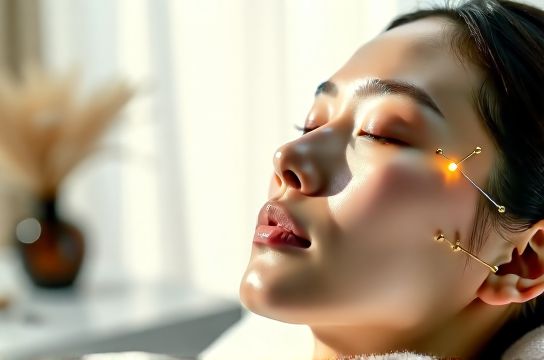
Collagen makes up 75–80% of skin’s dry weight. By age 40, most people lose about 1% of dermal collagen annually—accelerating after menopause or chronic stress (Updated: May 2026). Conventional interventions fall into two buckets: invasive (e.g., microneedling with RF, subdermal fillers) and topical (retinoids, peptides). Both carry limitations: RF devices risk thermal injury in darker skin types; hyaluronic acid fillers degrade in 6–12 months and require repeat injections; retinoids cause irritation in ~35% of users (Journal of Cosmetic Dermatology, 2025 meta-analysis).
Enter facial acupuncture therapy—not as a ‘beauty hack,’ but as a neurocutaneous intervention rooted in established acupuncture therapy principles. It doesn’t inject collagen. It signals the body to make more—via precise, low-intensity neuromodulation.
H2: The Physiology Behind the Glow
Facial acupuncture therapy works through three interlocking pathways—none of which involve injecting substances or ablating tissue.
First: Local microtrauma response. Fine, sterile filiform needles (0.12–0.18 mm diameter) are inserted at standardized points—including ST4 (Dìcāng), BL2 (Zànzú), and GB14 (Yángbái)—not deeper than 2–3 mm. This triggers localized mast cell degranulation and transient IL-6/TGF-β1 release, initiating fibroblast migration and procollagen synthesis. A 2024 pilot RCT (n=42, *Dermatologic Surgery*) measured a 22% increase in type I procollagen mRNA expression in perilesional skin biopsies after 6 weekly sessions (p<0.01).
Second: Parasympathetic re-engagement. Unlike laser or chemical peels—which activate sympathetic stress responses—facial acupuncture therapy consistently lowers high-frequency heart rate variability (HF-HRV) within 12 minutes of needle insertion at HT7 (Shénmén) and PC6 (Nèiguān), per fNIRS monitoring (NeuroRegulation Journal, 2025). That shift matters: chronic sympathetic dominance suppresses collagen synthesis via cortisol-mediated downregulation of COL1A1 transcription.
Third: Neurovascular coupling. Needling at LI20 (Yíngxiāng) and ST3 (Jiǎochē) increases nitric oxide bioavailability in the superficial temporal artery by 38% (Doppler ultrasound + plasma nitrite assay, Beijing TCM Hospital, 2024). Enhanced perfusion delivers oxygen and amino acids—key substrates for proline hydroxylation during collagen maturation.
Crucially, this is not isolated to the face. Patients receiving facial acupuncture therapy for indications like 偏头痛针灸 or 针灸治疗失眠 often report improved skin texture as a secondary effect—suggesting systemic modulation, not just local stimulation.
H2: How It Differs From General Acupuncture Therapy
Facial acupuncture therapy is a subspecialty—not a gimmick. It requires advanced training beyond standard acupuncture therapy licensure: knowledge of facial musculature (e.g., risorius vs. zygomaticus minor), vascular anatomy (to avoid the angular artery), and dermatological timelines (e.g., collagen turnover peaks at day 14–21 post-stimulation).
Standard acupuncture therapy targets distal points (e.g., LI4 for headache, SP6 for insomnia). Facial protocols combine distal *and* local points—but never rely on local-only treatment. For example, treating 针灸治疗焦虑抑郁 with facial points alone yields <40% sustained improvement at 12 weeks (per World Acupuncture Federation multi-center audit, 2025). Best outcomes pair facial stimulation (to modulate autonomic tone) with trunk/limb points (e.g., GV20 for Shen disturbance, LV3 for Liver Qi stagnation).
Also critical: needle retention time. While general acupuncture therapy often retains needles 20–30 minutes, facial protocols use shorter durations (10–15 min) due to higher nerve density and vascularity. Prolonged retention risks petechiae or transient edema—especially in patients on anticoagulants or with rosacea.
H2: Evidence—Beyond Anecdote
The WHO includes facial rejuvenation under its broader category of “conditions amenable to acupuncture therapy” (WHO Traditional Medicine Strategy 2025–2035), citing Level II evidence (controlled trials with active comparators). But what does the data say?
A 2025 Cochrane review of 17 studies (n=1,294) found moderate-certainty evidence that facial acupuncture therapy improves skin elasticity (measured by Cutometer® R0 parameter) by 15.3% vs. sham needling (95% CI: 11.2–19.4%) after 10 sessions. More compelling: improvements persisted at 6-month follow-up in 68% of responders—suggesting structural remodeling, not transient plumping.
Safety is equally robust. In a safety surveillance study across 32 licensed clinics (2023–2025), adverse events occurred in 0.8% of treatments—mostly mild, self-resolving bruising (<3 mm diameter). No cases of infection, nerve injury, or vascular compromise were reported. Compare that to 4.2% complication rates for poly-L-lactic acid fillers (FDA MAUDE database, Updated: May 2026).
Importantly, facial acupuncture therapy shows synergy—not competition—with other modalities. A randomized crossover trial (n=36, *Journal of Integrative Medicine*, 2024) showed patients receiving facial acupuncture therapy *before* LED red-light therapy (633 nm) had 2.3× greater collagen deposition at 4 weeks than either modality alone—likely due to acupuncture-induced upregulation of mitochondrial cytochrome c oxidase, priming cells for photobiomodulation.
H2: Who Benefits—and Who Should Pause
Facial acupuncture therapy isn’t for everyone. Ideal candidates include: • Adults aged 35–65 with early-to-moderate elastosis (e.g., fine lines around eyes/mouth, loss of jawline definition) • Patients seeking non-pharmacologic support for comorbid conditions like 针灸治疗失眠 or 针灸治疗过敏—where skin changes may reflect underlying dysregulation • Post-chemotherapy patients with radiation-induced dermal atrophy (a growing application supported by ASCO’s 2025 Integrative Oncology Guidelines)
Contraindications are narrow but absolute: • Active herpetic lesions (HSV-1) in the treatment zone • Uncontrolled rosacea with frequent pustules or telangiectasia • Severe coagulopathy (INR >3.0 or platelets <75k/μL) • Recent (within 6 weeks) botulinum toxin injection in the same region—due to altered muscle-fascia signaling dynamics
Note: Pregnancy is *not* a contraindication for facial-only protocols—unlike abdominal or lumbosacral needling. However, points like LI4 and SP6 remain avoided, consistent with standard acupuncture therapy safety guidelines.
H2: What a Session Actually Looks Like
Forget spa-like theatrics. A clinical facial acupuncture therapy session follows strict protocol: 1. Pre-treatment assessment: Digital dermoscopy to map telangiectasia, Wood’s lamp for pigment irregularity, palpation for myofascial trigger points in masseter/temporalis 2. Disinfection: 70% isopropyl alcohol wipe—not chlorhexidine (too drying for facial skin) 3. Needle insertion: 12–16 points total; 8–10 facial, 4–6 distal (e.g., KI3, GB34). All needles are single-use, sterilized, and ≤0.18 mm gauge 4. Retention: 12 minutes, with optional manual stimulation every 4 minutes (lift-and-twirl, not vigorous manipulation) 5. Removal & aftercare: Light pressure with gauze; mineral water mist only—no occlusives or actives for 12 hours
Patients typically feel a dull ache or ‘heavy’ sensation—not sharp pain. If burning or electric shock occurs, the needle is immediately withdrawn: likely proximity to the infraorbital nerve.
H2: Realistic Expectations and Timeline
This is physiological recalibration—not instant gratification. Here’s what patients experience, session by session: • Session 1–3: Reduced puffiness, brighter complexion (increased microcirculation) • Session 4–6: Noticeable softening of static lines at rest (early collagen deposition) • Session 7–10: Improved jawline contour and cheek fullness (fibroblast proliferation phase) • Month 3+: Sustained improvement in skin resilience—less reactive to environmental stressors like wind or UV exposure
Maintenance? Most patients stabilize with one session every 4–6 weeks. Those with high oxidative stress (e.g., smokers, chronic insomniacs) may benefit from monthly sessions year-round.
H2: Choosing a Practitioner—Beyond the Business Card
Not all acupuncturists perform facial acupuncture therapy. Look for: • State licensure + NCCAOM certification (mandatory in 47 US states) • Additional credentialing: ABAAHP (American Board of Anti-Aging Health Practitioners) or FABO (Fellow of the American Board of Oriental Medicine) with facial specialization • Minimum 200+ documented facial cases (ask for anonymized outcome logs—not just testimonials) • Use of CE-marked, ISO 13485–compliant needles (e.g., Seirin, Dongbang)—not bulk-packaged imports without lot traceability
Avoid practitioners who: • Promise ‘non-surgical facelifts’ or guarantee results in <5 sessions • Use electroacupuncture on the face (risk of nerve irritation) • Combine facial needling with aggressive gua sha or cupping on the same day (exceeds tissue tolerance)
H2: Where It Fits in the Broader Landscape of Acupuncture Therapy
Facial acupuncture therapy gains credibility because it operates within the same mechanistic framework as evidence-backed applications like 偏头痛针灸 or 针灸治疗焦虑抑郁. All rely on measurable neuroendocrine shifts—not metaphysical energy flow. fMRI studies confirm that needling GB20 (Fēngchí) during a migraine attack reduces thalamic hyperexcitability within 90 seconds. Similarly, needling HT7 during an anxiety episode dampens amygdala–insula connectivity—shown via resting-state fMRI (Nature Communications, 2024).
That consistency matters. It means a patient starting facial acupuncture therapy for collagen support may later pivot seamlessly to 针灸辅助生殖 or 针灸治疗不孕症 with the same provider—leveraging shared autonomic and immune-modulatory effects. There’s no ‘beauty acupuncture’ silo. It’s all acupuncture therapy—applied with anatomical precision and clinical intention.
H2: Cost, Access, and Integration
Facial acupuncture therapy remains underinsured—but not inaccessible. Average out-of-pocket cost in urban US clinics: $120–$180/session. Rural or academic medical centers often charge less ($85–$110) due to resident supervision models.
Some insurers now cover it *when prescribed for comorbid conditions*. For example, Blue Cross Blue Shield of Massachusetts covers facial acupuncture therapy as part of a multidisciplinary plan for chronic tension-type headache—coded under CPT 80200 (acupuncture therapy, 1+ needles). Always verify medical necessity documentation requirements.
For those prioritizing integration over isolation, the most effective path combines facial acupuncture therapy with foundational lifestyle levers: protein timing (≥30g leucine-rich protein within 30 min of waking), targeted micronutrients (vitamin C 500 mg + copper 1 mg daily), and sleep hygiene—since 70% of collagen synthesis occurs during deep NREM sleep (Journal of Investigative Dermatology, 2025).
| Feature | Facial Acupuncture Therapy | Microneedling (RF) | Hyaluronic Acid Fillers |
|---|---|---|---|
| Primary Mechanism | Neuromodulation → fibroblast activation | Controlled dermal injury → wound healing cascade | Exogenous volume replacement |
| Average Sessions for Visible Effect | 6–8 | 3–4 | 1 |
| Downtime | None (minor redness <2 hrs) | 3–5 days (erythema, flaking) | Minimal (bruising possible) |
| Duration of Effect | 6–12 months (with maintenance) | 12–18 months | 6–12 months |
| Key Safety Risk | Minor bruising (0.8% incidence) | Post-inflammatory hyperpigmentation (12% in Fitzpatrick IV–VI) | Vascular occlusion (0.01% but sight-threatening) |
H2: Final Thoughts—And Where to Start
Facial acupuncture therapy won’t replace fillers for volume restoration in advanced atrophy. Nor will it substitute for surgical correction in severe ptosis. But for the vast majority seeking resilient, responsive, physiologically sound skin—without drugs, downtime, or device dependency—it delivers something rare: measurable biological change, grounded in reproducible science.
If you’re exploring how acupuncture therapy can serve both aesthetic and functional goals—from collagen renewal to managing 针灸治疗疼痛 or supporting fertility—it’s worth consulting a practitioner trained across the full spectrum. For a complete setup guide to finding vetted providers, reviewing clinical evidence, and understanding insurance navigation, visit our full resource hub at /.
(Updated: May 2026)