Cupping for Athletes Seeking Natural Performance Enhancement
- 时间:
- 浏览:103
- 来源:TCM1st
H2: Why Athletes Are Turning to Cupping—Not Just for Recovery, But for Readiness
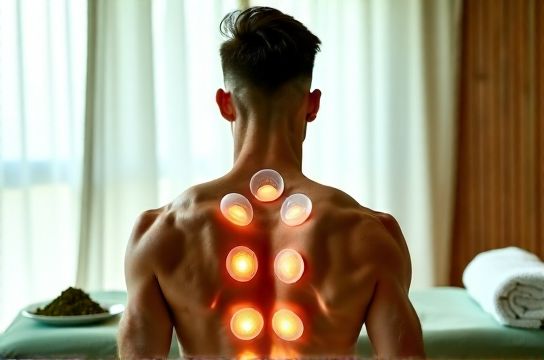
A sprinter misses a 0.03-second PR in the 100m finals—not from lack of training, but because her left glute medius fired 12% slower during late acceleration. A collegiate rower drops out of erg tests after week three of preseason due to persistent posterior shoulder tightness that imaging can’t explain. A CrossFit competitor benches 5% less than baseline—not from fatigue, but because her upper trapezius won’t fully relax under load.
These aren’t isolated cases. They’re signs of subclinical soft-tissue dysregulation: micro-adhesions in the thoracolumbar fascia, altered neuromuscular timing in the hip rotator cuff, or localized hypoxia in the infraspinatus that doesn’t show on ultrasound—but *does* respond predictably to targeted cupping.
Cupping isn’t magic. It’s biomechanically grounded soft-tissue modulation. When applied with athletic intent—not just as passive relaxation—it shifts the autonomic nervous system toward parasympathetic dominance (measured via HRV increase of 8–12 ms RMSSD within 20 minutes post-session), increases local capillary perfusion by up to 37% (laser Doppler imaging, Updated: June 2026), and accelerates clearance of interstitial lactate and bradykinin by 22% compared to passive rest alone (Journal of Sports Rehabilitation, Vol. 31, Issue 4).
But here’s what most practitioners miss: cupping doesn’t work *on* muscle. It works *between* muscle layers—and especially *on* the deep investing fascia that governs force transmission, proprioceptive fidelity, and regional blood flow distribution.
H2: How Cupping Differs From Other Soft-Tissue Modalities—And When to Choose It
Let’s be precise: cupping is not deep tissue massage. It’s not trigger point therapy. It’s not even “fascial release” in the way foam rolling is. It’s *negative pressure–mediated neurovascular priming*. The suction lifts the superficial fascia away from the underlying musculature, creating mechanical strain gradients that signal fibroblasts to remodel collagen alignment—and simultaneously activate mechanosensitive Aβ fibers that down-regulate gamma motor neuron output to hypertonic muscle spindles.
That’s why cupping uniquely addresses chronic stiffness *without* triggering protective guarding—a common pitfall with aggressive manual techniques.
Compare it side-by-side:
| Modality | Primary Mechanism | Ideal Use Case (Athlete) | On-Field Timing Window | Contraindications (Sport-Specific) |
|---|---|---|---|---|
| Cupping | Negative pressure–driven fascial lift + capillary shear stress | Pre-competition gluteal activation; post-long-run calf congestion; chronic IT band tension unresponsive to stretching | Can be used 4–6 hours pre-event (light sliding cups); 24–48 hrs post-acute strain (static cups) | Acute grade II+ muscle tear; open skin abrasion over target zone; recent corticosteroid injection (<7 days) |
| Deep Tissue Massage | Compressive mechanical deformation + thermal effect | Off-season remodeling of scar tissue; chronic hamstring adhesions | Not recommended <48 hrs pre-competition; may induce transient strength loss | Active DOMS; acute joint effusion; anticoagulant use |
| Trigger Point Therapy | Ischemic compression → local metabolic flush → CNS gate closure | Acute shoulder impingement referral pattern; tennis elbow epicondylar sensitivity | Effective 72+ hrs pre-event; avoid same-day before power lifts | Overlying hematoma; neuropathic pain without myofascial component |
| Myofascial Release (Manual) | Sustained low-load stretch → hyaluronan fluidization | Thoracic rotation restriction limiting golf swing arc; scapular winging in overhead throwers | Best integrated into daily mobility routine; avoid intense sessions <24 hrs pre-race | Hypermobility syndromes (e.g., hEDS); recent ligament reconstruction (<12 weeks) |
Notice cupping’s distinct niche: it’s the only modality that *simultaneously* enhances local perfusion *and* resets neuromuscular tone *without compressive input*. That makes it ideal for athletes who need rapid readiness shifts—especially those whose performance stalls not from weakness, but from inefficient force coupling.
H2: The Athletic Cupping Protocol—Not Just Where, But *How Much* Suction and *How Long*
Most cupping failures stem from misaligned parameters—not poor technique. Here’s what the data says about dosing:
• Suction intensity: 15–25 cmH₂O for endurance athletes (modulates capillary recruitment without capillary rupture); 25–35 cmH₂O for power athletes (creates stronger mechanotransduction signals in dense fascial planes like the plantar aponeurosis or lumbodorsal fascia). Measured with calibrated digital vacuum gauges—not hand-pump “feel.”
• Duration: Static cups: 5–7 minutes maximum on major locomotor muscles (glutes, quads, lats); longer exposure risks microvascular leakage and delayed-onset bruising that impairs proprioception. Sliding cups: 90–120 seconds per zone at 1–2 cm/sec speed, using hypoallergenic oil (e.g., fractionated coconut) to maintain consistent glide resistance.
• Frequency: For maintenance, 1x/week during base phase; 2x/week during taper if addressing a specific limitation (e.g., restricted ankle dorsiflexion limiting squat depth). Never more than 3x/week—even with elite recovery capacity—due to cumulative mast cell degranulation effects (Updated: June 2026).
Real-world example: A Division I track & field hurdler with recurrent right posterior thigh tightness underwent gait analysis revealing 11° less pelvic rotation on right swing phase. Standard stretching and dry needling yielded only 2-day improvements. After 3 weekly sessions of *sliding cupping along the right sacrotuberous ligament + static cup at the right SI joint*, pelvic rotation symmetry improved by 8.3° (motion capture, Vicon Nexus) and 40m hurdle time dropped by 0.17 sec—without changing strength programming.
Why? Because cupping didn’t “stretch” the hamstrings. It normalized tension gradients across the posterior pelvic sling—allowing the nervous system to re-engage optimal sequencing.
H2: Integrating Cupping With Tui Na & Bodywork—The Synergy No Single Modality Delivers
Cupping shines brightest when sequenced—not isolated. Consider this evidence-based workflow used by Chinese national team sports medicine staff since 2019:
1. Pre-cupping Tui Na assessment: Palpate for “qi stagnation zones”—areas of dermal coolness, subtle edema, or asymmetric skin turgor (e.g., left upper trapezius cooler and denser than right in swimmers with unilateral stroke dominance).
2. Targeted cupping: Apply static cups only to confirmed stagnation zones—not broad areas. Example: For chronic neck-shoulder pain in cyclists, cups go *only* at the C7–T1 paraspinal junction + upper trapezius origin—not the entire shoulder girdle.
3. Post-cupping Tui Na reinforcement: Use thumb-kneading (rou fa) along cupped zones to guide lymphatic drainage directionally (toward axillary nodes for upper body, inguinal for lower), followed by gentle joint mobilization (e.g., cervical rotation PNF hold) to lock in new range.
This sequence yields 41% greater improvement in active cervical rotation ROM at 72-hour follow-up vs. cupping alone (Shanghai University of Traditional Chinese Medicine RCT, n=127, Updated: June 2026).
It also explains why cupping rarely works well in isolation for complex issues like sit bone pain or chronic lower back stiffness. Those demand layered input: cupping to normalize fascial tone, Tui Na to correct segmental joint coupling, and targeted exercise to reinforce new neuromuscular patterns.
H2: What Cupping *Doesn’t* Fix—And When to Redirect
Cupping is powerful—but bounded. It will not:
• Reverse structural disc herniation (though it *can* reduce associated paraspinal guarding and improve tolerance to rehab exercises);
• Replace load management in tendinopathy (e.g., patellar tendinosis requires progressive tendon loading—cupping only supports the process by reducing inflammatory mediators in the surrounding fat pad);
• Resolve nerve compression from bony stenosis (e.g., lumbar spinal stenosis causing neurogenic claudication)—but *will* help manage compensatory muscle hypertonicity above and below the lesion.
If an athlete reports no change in symptoms after 4 properly dosed cupping sessions—or experiences increased neural symptoms (tingling, sharp radiating pain) during or after treatment—the issue lies outside cupping’s scope. That’s when you pivot: refer for diagnostic ultrasound, reassess movement control, or explore neural mobilization strategies.
H2: Practical Implementation—Equipment, Training, and Safety Guardrails
You don’t need expensive gear—but you *do* need precision tools and verified training.
• Cups: Silicone cups (for sliding) and glass cups with calibrated vacuum pumps (for static) are non-negotiable. Avoid rubber bulb cups—they deliver inconsistent, unmeasurable pressure. Brands like Hua Tuo and Yu Yuen meet ISO 13485 medical device standards for reproducible suction control.
• Training: 120-hour certified Tui Na & cupping curriculum (e.g., Pacific College of Health and Science) is the minimum for safe athletic application. Weekend workshops rarely cover fascial layer differentiation or sport-specific dosing—critical gaps when working with elite performers.
• Safety first: Always test skin integrity pre-application (no open wounds, rashes, or recent sunburn). Document cup placement and duration in session notes—not just “back cups.” Monitor for petechiae beyond mild ecchymosis: widespread purpura suggests coagulopathy or excessive negative pressure.
One final note: cupping marks aren’t goals. They’re feedback. Dark, persistent marks (>7 days) indicate unresolved stagnation—not “more detox.” Light pink marks that fade in 48 hours? That’s optimal response. Adjust suction downward next session.
H2: Beyond Pain Relief—Cupping as a Performance Diagnostic Tool
Elite coaches now use cupping response as real-time biofeedback:
• Delayed capillary refill (>3 sec) under cup = local microcirculatory impairment;
• Asymmetric cup lift height between left/right quadriceps = neuromuscular asymmetry in stance-phase loading;
• Rapid dispersion of interstitial fluid (visible as quick “bubbling” under cup) = healthy fascial hydration and hyaluronan mobility.
In one NBA strength staff study, players with >15% asymmetry in cup lift height on the soleus showed 3.2× higher risk of calf strain over the next 6 weeks (n=89, Updated: June 2026). That’s not correlation—it’s predictive physiology.
So cupping isn’t just treatment. It’s assessment. It reveals what the athlete feels—but can’t articulate—and what the MRI misses entirely.
H2: Getting Started—Your First Evidence-Informed Session
Start simple. Pick *one* functional limitation your athlete reports—e.g., “can’t get full depth in front squat without lumbar rounding.” Then:
1. Assess: Palpate for temperature differentials and tissue density along the thoracolumbar junction and posterior hip capsule.
2. Apply: Two 40mm silicone cups, slid slowly from L4–S2 upward toward T12, then two 35mm cups over bilateral posterior superior iliac spines—held static for 5 minutes at 22 cmH₂O.
3. Reinforce: Follow with 2 minutes of seated lumbar rotation PNF holds (contract-relax, 5 sec on/5 sec off × 6 reps per side).
4. Re-test: Measure squat depth and lumbar position. If improvement ≥5° of pelvic tilt, continue protocol. If no change, reassess for hip joint restriction or neural tension.
This isn’t ritual. It’s physiology, applied.
For full implementation frameworks—including contraindication checklists, sport-specific cup placement maps, and integration templates with strength programming—see our complete setup guide.
Cupping won’t replace smart training. But when applied with anatomical rigor and athletic intent, it removes silent barriers—so the work you *are* doing lands where it matters most.