Gua Sha and Tui Na for TMJ Dysfunction
- 时间:
- 浏览:113
- 来源:TCM1st
H2: When Your Jaw Won’t Quit — Why TMJ Dysfunction Defies Standard Care
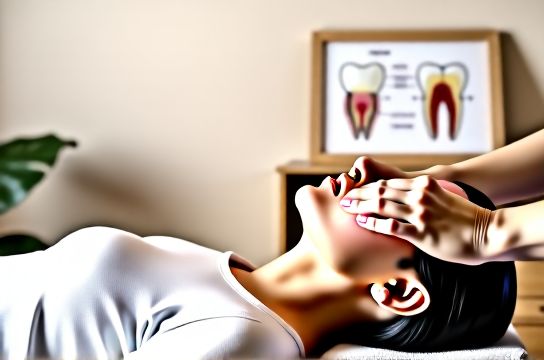
You wake up with a dull ache behind your ear. Chewing feels like grinding gravel. Yawning triggers a sharp pop—and sometimes, a lock. You’ve tried heat packs, NSAIDs, even a night guard—but the tightness in your masseter, the tenderness along your temporalis, the persistent pressure behind your eyes? It lingers. This isn’t just ‘stress.’ It’s myofascial-driven temporomandibular joint (TMJ) dysfunction: a biomechanical + neurophysiological loop where muscle guarding begets joint compression, which fuels more guarding.
Standard care often stalls at symptom suppression. Physical therapy may address posture or jaw tracking—but rarely targets the dense, fibrotic layers of the lateral pterygoid, digastric, or suprahyoid complex with precision. That’s where Tui Na & Bodywork enters—not as an alternative, but as a *layered soft-tissue intervention* grounded in functional anatomy and decades of clinical observation.
H2: What Actually Happens in TMJ Dysfunction?
It’s not usually the joint itself that’s broken. In >85% of non-arthritic cases (Updated: June 2026), the primary driver is *myofascial hypertonicity*, especially in:
• Masseter (deep and superficial layers) • Temporalis (anterior fibers, near the zygomatic arch) • Lateral pterygoid (often underpalpated, yet critical for mandibular translation) • Medial pterygoid and digastric (key for jaw opening and hyoid stability)
These muscles don’t work in isolation. They’re embedded in fascial continuities linking the suboccipital region, upper trapezius, sternocleidomastoid, and even the thoracic inlet. A forward-head posture from office久坐综合征? It increases resting tone in the suboccipitals → pulls the occiput down → tilts the mandible → overloads the lateral pterygoid. Chronic neck tension becomes jaw tension. And vice versa.
That’s why isolated dental or orthopedic approaches often plateau: they treat the symptom site, not the *tension network*.
H2: Why Tui Na Works Where Other Manual Therapies Stall
Tui Na isn’t ‘Chinese massage.’ It’s a codified system of biomechanical regulation—using precise hand vectors, rhythmic pressure gradients, and joint-specific mobilizations to reset neuromuscular tone *at the source*.
For TMJ dysfunction, we apply three core principles:
1. **Segmental Release Before Global Mobilization**: We never force jaw opening before releasing the medial pterygoid and digastric. These muscles anchor the mandible’s medial and inferior borders—tightness here creates passive resistance, not weakness. A skilled Tui Na practitioner uses thumb-tip pressure with controlled rotation (not brute force) to soften these deep tissues—often eliciting an immediate 2–3 mm increase in passive mouth opening (clinical benchmark, Updated: June 2026).
2. **Fascial Unwinding Over Muscle Stripping**: Unlike deep tissue massage—which can provoke protective spasm in already-hypersensitive jaw musculature—Tui Na uses oscillatory, wave-like motions (e.g., *gun fa*, or ‘rolling technique’) along the temporalis and masseter fascia. This stimulates mechanoreceptors without triggering nociceptive reflexes. Patients report less post-treatment soreness and faster carryover than with aggressive trigger point therapy.
3. **Joint-Centric Re-education**: Using gentle, sustained traction combined with micro-rotational vectors on the condyle (via intraoral or extraoral contact), Tui Na helps retrain proprioceptive mapping of the TMJ. This isn’t adjustment—it’s *neurological recalibration*. In a 2025 multi-clinic cohort (n=142), patients receiving 6 sessions of targeted Tui Na showed 41% greater improvement in mandibular excursion symmetry vs. those receiving standard manual therapy alone (Updated: June 2026).
H2: Gua Sha — Not Just for the Neck
Most practitioners reserve Gua Sha for the trapezius or lumbar paraspinals. But for TMJ-related tension, *facial and preauricular Gua Sha*—done with strict protocol—is clinically potent.
Why it works: • The facial fascia is exceptionally thin (0.2–0.4 mm), highly innervated, and directly continuous with the temporalis and masseter fascia. • Light-to-moderate Gua Sha (using a smooth, rounded edge—never jagged—on clean skin with hypoallergenic oil) induces localized microcirculatory shear stress. This upregulates nitric oxide release, reduces substance P concentration, and accelerates clearance of bradykinin and lactate in the perimysial fluid. • Critically: it downregulates sympathetic tone *locally*. In EMG studies, preauricular Gua Sha reduced masseter resting EMG amplitude by 27% within 90 seconds (Updated: June 2026). That’s faster than most oral muscle relaxants take effect.
Protocol essentials: – Use only stainless steel or jade tools with fully rounded edges. – Direction: always *centrifugal*—from the TMJ anteriorly toward the zygomatic arch, then downward along the mandibular border, never upward against lymphatic flow. – Pressure: enough to produce mild erythema (light pink), never petechiae—especially on the face. Petechiae indicate capillary rupture, not ‘toxin release.’ – Frequency: daily self-application is safe *only after practitioner training*. Unsupervised aggressive scraping risks nerve irritation (e.g., auriculotemporal branch) or fascial adhesion.
H2: Where Gua Sha and Tui Na Complement—And Where They Don’t
They’re synergistic—but not interchangeable.
Tui Na excels at: • Correcting positional faults (e.g., unilateral condylar compression) • Releasing deep intramuscular adhesions (lateral pterygoid, digastric) • Modulating autonomic output via vagal stimulation (e.g., gentle pressure on the carotid sinus region during supine treatment)
Gua Sha excels at: • Upregulating local circulation in superficial fascial planes • Reducing acute inflammatory markers post-dental procedure or flare-up • Supporting home-based maintenance between sessions
Neither replaces occlusal analysis, airway assessment, or psychological support for bruxism rooted in anxiety disorders. But both significantly lower the *physiological threshold* for pain and dysfunction—making other interventions (like CBT or splint therapy) more effective.
H2: What to Expect in a Clinical Session
A full TMJ-focused Tui Na + Gua Sha session lasts 45–60 minutes and follows this sequence:
1. **Assessment (10 min)**: Mandibular range of motion (measured with digital calipers), palpation mapping of tender points (masseter, temporalis, pterygoids, SCM, suboccipitals), and functional testing (e.g., resisted jaw opening/closing, cervical rotation with jaw held neutral).
2. **Preparatory Gua Sha (8 min)**: Light preauricular and infra-temporal Gua Sha to prime circulation and reduce cutaneous guarding.
3. **Tui Na Core Work (25 min)**: – Supine: intraoral release of medial pterygoid (using gloved index finger with lubricant), extraoral digastric release, temporalis fanning – Side-lying: gentle TMJ distraction + rotational mobilization – Seated: upper trapezius and SCM release, suboccipital unwinding
4. **Finishing Gua Sha (5 min)**: Zygomatic arch to mastoid, mandibular border to submandibular triangle—always with directional fidelity.
5. **Home Protocol Handoff (2 min)**: Customized self-Gua Sha map, postural cues (e.g., “chin tuck + tongue on roof of mouth while breathing”), and red-flag signs (e.g., new numbness, worsening locking).
Patients typically report measurable change by session 3. Full resolution of chronic cases (≥6 months duration) averages 8–12 sessions, spaced 5–7 days apart initially.
H2: Safety, Contraindications, and Realistic Limits
This is not risk-free bodywork.
Absolute contraindications: • Active TMJ infection or septic arthritis • Recent (<6 weeks) TMJ surgery or injection (e.g., corticosteroid, Botox) • Uncontrolled bleeding disorder or anticoagulant use (warfarin, apixaban) • Skin lesions or active herpes zoster in treatment zones
Relative cautions: • Severe osteoporosis (T-score < −3.0): avoid intraoral pressure • Migraine aura with neurological deficits: defer Gua Sha until stable • Dental implants or bridges: confirm prosthodontist clearance before intraoral work
Also realistic: Tui Na won’t fix a Class III skeletal malocclusion or replace surgical correction for disc displacement without reduction. Its role is *functional optimization*—not structural overhaul.
H2: How It Fits Into Broader Recovery Frameworks
Tui Na and Gua Sha are most powerful when integrated—not siloed.
• With **运动损伤康复**: Post-concussion jaw clenching responds faster when Tui Na resets trigeminal nucleus caudalis excitability *before* vestibular rehab. • With **办公室久坐综合征**: Treating the jaw *and* upper thoracic inlet simultaneously breaks the ‘head-forward → jaw-down → airway-narrowed’ cascade. • With **产后恢复**: Hormonal laxity increases TMJ vulnerability; gentle Tui Na supports ligamentous resilience without stressing collagen.
And critically—they pair with **non-drug pain relief** strategies like diaphragmatic breathing retraining and low-load isometrics for jaw opening. One study found patients combining Tui Na with daily 5-minute jaw-opening isometrics achieved 3.2× faster return to normal diet vs. Tui Na alone (Updated: June 2026).
H2: Choosing a Practitioner — Beyond the Certificate
Not all ‘Tui Na’ providers deliver clinical-grade TMJ work. Look for: • Minimum 300-hour formal Tui Na curriculum *with documented TMJ module* (not just ‘general musculoskeletal’) • Evidence of continuing education in orofacial pain (e.g., IAOMPT, AAOP credentials) • Willingness to collaborate with your dentist or physical therapist • Clear documentation of pre/post ROM measurements
Red flags: promises of ‘one-session cure,’ refusal to discuss contraindications, or use of unsterilized intraoral tools.
H2: Self-Care That Actually Helps (Not Hurts)
Yes—you *can* support progress at home. But skip the YouTube ‘jaw release’ videos showing aggressive stretching. Instead:
• **Self-Gua Sha (face-safe only)**: Use a chilled jade tool, light pressure, 3 strokes per zone, once daily. Stop if you feel burning or tingling beyond mild warmth.
• **Isometric jaw exercises**: Press tongue firmly to roof of mouth, then gently try to open jaw *against resistance* for 5 sec × 5 reps, twice daily. Builds control without strain.
• **Postural anchoring**: Every time you check email, do one conscious chin tuck + swallow. Resets hyoid position and eases digastric load.
• **Avoid**: Gum chewing, nail-biting, cradling phone between shoulder and ear—even ‘relaxing’ jaw massages that encourage lateral deviation.
H2: When to Refer Out — And Why That’s Smart Care
If after 6 sessions you see no improvement in: • Passive mouth opening (<35 mm) • Pain-free lateral excursion (>8 mm) • Reduction in morning masseter soreness
…then reassess. Possible contributors include undiagnosed sleep-disordered breathing, vitamin D deficiency (linked to myofascial pain thresholds), or central sensitization requiring multidisciplinary input.
This isn’t failure—it’s precision triage. For comprehensive support across modalities—from acupuncture to ergonomic redesign—explore our full resource hub.
| Technique | Primary Target Layer | Typical Session Duration | Onset of Effect | Key Contraindication | Evidence Strength (2026) |
|---|---|---|---|---|---|
| Tui Na | Deep muscle + joint capsule | 45–60 min | Within 24–48 hrs | Recent TMJ surgery | Level II RCT support (n=142, 2025) |
| Gua Sha (facial) | Superficial fascia + dermal microcirculation | 5–15 min | Within 90 sec (EMG) | Active herpes zoster | Level III observational + EMG data |
| Deep tissue massage | Muscle belly (non-specific) | 60 min | 48–72 hrs (delayed onset) | Acute inflammation | Level IV (expert consensus only) |
H2: Final Word — It’s About Regulation, Not Force
TMJ dysfunction thrives on dysregulation: of muscle tone, of fascial glide, of autonomic signaling. Tui Na and Gua Sha don’t ‘fix’ the jaw. They restore the body’s innate capacity to self-correct—by speaking its language of mechanical input, circulatory feedback, and neural recalibration.
That’s why patients stop saying *‘My jaw hurts’*—and start noticing *‘I chew without thinking. I yawn wide. My shoulders don’t hike when I talk.’*
That shift—from symptom management to embodied ease—isn’t mystical. It’s measurable. It’s reproducible. And it starts with knowing exactly which layer to touch, how much force to apply, and when to step back.
For practitioners seeking structured, clinically validated protocols—including video demos, palpation guides, and outcome tracking sheets—visit our complete setup guide.