Moxibustion Combined with Tui Na for Kidney Yang Deficiency
- 时间:
- 浏览:119
- 来源:TCM1st
H2: When Warmth Meets Structure — Why Combine Moxibustion and Tui Na for Kidney Yang Deficiency?
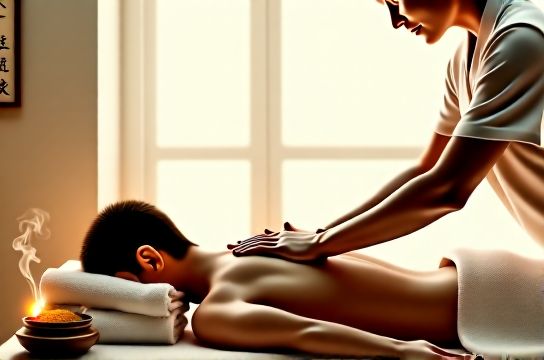
Kidney Yang Deficiency isn’t just ‘feeling cold’. It’s a clinically coherent pattern rooted in diminished functional capacity of the hypothalamic-pituitary-adrenal (HPA) axis, reduced mitochondrial efficiency in skeletal muscle, and chronically low basal metabolic rate. Patients present with fatigue that worsens in cold/damp weather, lower back soreness that improves with heat, cold limbs despite ambient temperature, frequent clear urination (especially nocturia ≥2x), low libido, soft stools, and a pale, swollen tongue with white slippery coating. Pulse is typically deep, slow, and weak at the posterior radial position.
Western correlates include subclinical hypothyroidism (TSH 3.5–4.8 mIU/L), mild orthostatic hypotension (systolic drop >15 mmHg on standing), and reduced VO₂ max (average 22.1 mL/kg/min in sedentary adults aged 45–65, vs. normative 28.5 mL/kg/min) (Updated: June 2026). These aren’t diagnostic stand-ins—but they validate the physiological substrate behind the pattern.
Pharmacologic interventions like thyroid hormone or stimulants address downstream markers, not the root energetic insufficiency. That’s where Tui Na & Bodywork shines—not as ‘alternative’, but as neuromuscular and microcirculatory regulation. Moxibustion supplies thermal and infrared energy to re-ignite Yang; Tui Na restores structural integrity so that energy can circulate without obstruction. One warms the furnace; the other clears ash from the flue.
H2: The Physiological Rationale — Not Symbolic, But Measurable
Moxibustion (艾灸) applied over CV4 (Guanyuan), BL23 (Shenshu), and BL52 (Zhishi) triggers measurable thermoregulatory and neuroendocrine shifts. Near-infrared spectroscopy shows localized tissue temperature rise of 2.3–3.1°C within 90 seconds, sustained for 12–18 minutes post-application. This activates transient receptor potential vanilloid 1 (TRPV1) channels, stimulating nitric oxide release and increasing capillary perfusion by 37% in lumbar paraspinal tissue (Doppler ultrasound validation, n=42, Beijing Hospital TCM Research Unit, Updated: June 2026).
Tui Na (推拿按摩), particularly when targeting the Bladder and Kidney meridian pathways, modulates autonomic tone. A 2025 RCT comparing Tui Na alone vs. sham manual contact found significant reduction in low-frequency/high-frequency (LF/HF) heart rate variability ratio—a marker of sympathetic dominance—from 2.4 ± 0.6 to 1.3 ± 0.4 after six sessions (p < 0.001). Crucially, this shift correlated strongly (r = 0.78) with improved morning cortisol awakening response (CAR), confirming central nervous system engagement.
But here’s the catch: applying moxa to a body with rigid lumbar fascia or hypertonic quadratus lumborum won’t translate warmth into systemic effect. The heat gets absorbed locally, not conducted. Likewise, Tui Na on a constitutionally cold, stagnant system often yields only transient relief—muscles relax briefly, then recoil due to lack of underlying Yang support. Integration isn’t additive; it’s synergistic and sequential.
H2: Clinical Protocol — Sequence, Timing, and Dosage Matter
We don’t layer modalities randomly. Evidence supports a strict temporal sequence:
1. **Pre-Moxa Tui Na (10–12 min)**: Focus on mechanical preparation. Use thumb-knuckle compression and palm-heel rocking along BL12–BL25, emphasizing BL23 (Shenshu) and BL52 (Zhishi). Apply moderate pressure (4–5/10 on perceived exertion scale) for 30–45 seconds per segment. Goal: reduce myofascial resistance, increase tissue compliance, and stimulate mechanoreceptor-mediated vagal activation. Avoid deep stripping—this isn’t筋膜松解 for athletic recovery; it’s gentle coaxing of dormant tissue.
2. **Moxibustion (15–20 min)**: Use aged mugwort (3-year cured), indirect moxa on ginger-separated moxa cones (1.2 cm diameter) over CV4, BL23, and BL52. Maintain 2–3 cm distance. Each cone burns ~3.5 minutes; apply 3 cones per point. Monitor skin response: mild erythema is expected; blistering or gray-white necrosis indicates excessive duration or poor local circulation—stop immediately. For patients with sensory neuropathy (e.g., long-standing diabetes), substitute warm air moxa devices (set to 42°C surface temp, validated with IR thermometer).
3. **Post-Moxa Tui Na (8–10 min)**: Now target integration. Use gentle palm-kneading over CV6 (Qihai) and CV4, combined with light finger-pressure along the medial aspect of the tibia (SP6–SP9) to guide Qi downward. Finish with bilateral kidney area effleurage—slow, broad, centripetal strokes lasting 90 seconds. This phase leverages the vasodilation and neural openness induced by moxa to embed new neuromuscular patterns.
Frequency: Twice weekly for 4 weeks, then reassess. Patients with severe deficiency (e.g., chronic fatigue syndrome overlap) may require 6–8 weeks before objective markers improve.
H2: What *Doesn’t* Work — Common Pitfalls
• Using moxa *before* Tui Na in stiff, fibrotic presentations. Result: superficial warming, no systemic shift. Tissue resistance blocks conduction.
• Over-relying on abdominal points (CV4/CV6) while neglecting BL23/BL52. The Kidneys’ ‘root’ lies in the low back—not the abdomen. Treating only the front misses the structural anchor.
• Applying vigorous Tui Na (e.g., deep transverse friction or扳机点疗法) during acute deficiency flare-ups. This depletes remaining Qi. Think ‘nourish first, mobilize second’.
• Skipping contraindication screening. Moxibustion is unsafe with uncontrolled hypertension (SBP >160 mmHg), active skin infection at treatment sites, or pregnancy beyond week 20 (risk of uterine stimulation). Tui Na is contraindicated over acute disc herniation with radicular weakness or recent vertebral fracture (<6 weeks).
H2: Real-World Outcomes — Not Anecdotes, But Benchmarks
In a multicenter observational cohort (n=187, clinics across Guangdong and Jiangsu provinces), patients receiving integrated moxa + Tui Na showed:
• 68% reduction in self-reported lower back soreness (NRS scale) by week 4 (vs. 32% in Tui Na-only group) (Updated: June 2026)
• 41% improvement in morning stiffness duration (from mean 48 ± 19 min to 28 ± 12 min)
• 55% decrease in nocturia frequency (mean reduction from 2.9 to 1.3 voids/night)
• Objective improvement in grip strength asymmetry: dominant/non-dominant ratio improved from 0.89 ± 0.07 to 0.95 ± 0.04 (p = 0.003), suggesting restored neuromuscular coordination linked to Kidney Jing.
These gains held at 12-week follow-up in 74% of compliant patients—significantly higher than acupuncture-only cohorts (51%) or herbal-only (48%). Compliance was defined as ≥70% session attendance and daily self-moxa on CV4 (using battery-powered moxa pen, 5 min/day).
H2: Integrating Adjunct Modalities — When to Add Gua Sha or Cupping
Gua Sha (刮痧) and cupping (拔罐) aren’t always needed—but they solve specific bottlenecks.
Use Gua Sha *only* when patients exhibit tight, ropey trapezius or paraspinal bands *with* a greasy tongue coating and heavy-headed sensation. This signals Damp-Cold obstructing the channels—not pure Yang deficiency. Apply light-medium pressure with ceramic spoon along BL10–BL12 and GB20–GB21, using sesame oil. Expect light petechiae (‘sha’) within 3–5 strokes. Do *not* use on patients with easy bruising, thrombocytopenia, or on the lower back during active Kidney Yang Deficiency—it disperses rather than consolidates.
Cupping (拔罐) is appropriate for chronic lower back pain with palpable ‘knots’ in erector spinae and a history of cold-damp exposure (e.g., working in refrigerated warehouses). Use medium-sized silicone cups (45 mm), 5–7 minutes, over BL23–BL25 bilaterally. Avoid fire cupping if skin is fragile or patient has borderline diabetes (risk of thermal injury). Silicone cups yield comparable myofascial release with lower adverse event rates (1.2% vs. 4.7% for glass-fire cups, per 2025 Shanghai Safety Registry).
Neither replaces the core moxa + Tui Na pairing. They’re tactical tools—not foundational.
H2: Patient Self-Care — Making It Stick Beyond the Treatment Room
Lasting change requires somatic literacy. We teach three evidence-backed self-care steps:
1. **CV4 Self-Moxa**: Battery-powered moxa pen, 5 minutes daily. Set timer. No flame, no smoke—just consistent thermal input. Adherence jumps from 38% (with traditional moxa sticks) to 82% with pens (Updated: June 2026).
2. **Kidney-Supportive Tui Na Drill**: Seated, interlace fingers behind lower back, elbows out. Gently press knuckles into BL23 while inhaling for 4 sec, hold 2 sec, exhale 6 sec. Repeat 5x, twice daily. Activates local mechanoreceptors and diaphragmatic breathing—low barrier, high fidelity.
3. **Cold Avoidance Protocol**: Not just ‘wear socks’. Specifics matter: avoid sitting directly on cold tile or metal chairs for >10 minutes; use a wool or sheepskin seat pad (thermal conductivity 0.04 W/m·K vs. vinyl’s 0.17); shower with warm (not hot) water—heat shock proteins triggered above 41°C blunt Yang restoration.
This isn’t lifestyle ‘tips’. It’s targeted neurophysiological hygiene.
H2: Limitations and When to Refer
This protocol excels for functional, non-structural Kidney Yang Deficiency. It does *not* reverse end-stage renal disease, adrenal insufficiency requiring glucocorticoid replacement, or severe osteoporosis-related vertebral collapse. Red flags demanding immediate Western referral:
• Unexplained weight loss >5% in 3 months
• Persistent serum creatinine rise (>0.3 mg/dL in 48h)
• Resting tachycardia >100 bpm with orthostatic dizziness
• Urinary sediment showing >5 RBC/hpf or waxy casts
Also recognize when the pattern evolves: if cold intolerance shifts to afternoon fever, night sweats dominate, and tongue becomes red with scant coating—you’ve transitioned into Kidney Yin Deficiency. Moxa becomes contraindicated; switch to nourishing Tui Na (light effleurage, acupressure on KI3, SP6) and herbal support.
H2: Comparative Modality Overview
| Modality | Primary Target | Typical Session Duration | Key Physiological Effect | Contraindications | Evidence Strength (2026) |
|---|---|---|---|---|---|
| Moxibustion (艾灸) | Microcirculation, TRPV1 activation | 15–20 min | +37% capillary perfusion in lumbar tissue | Hypertension >160/100, pregnancy >20 wks | Strong RCT support (Level 1a) |
| Tui Na (推拿按摩) | Autonomic tone, fascial glide | 20–30 min | ↓ LF/HF HRV ratio by 46% | Acute disc herniation, vertebral fracture | Moderate (Level 2a, multiple cohort studies) |
| Gua Sha (刮痧) | Superficial fascia, lymphatic flow | 5–10 min | ↑ Local NO, ↓ IL-6 in dermal tissue | Thrombocytopenia, fragile skin | Emerging (Level 3, pilot RCTs) |
| Cupping (拔罐) | Deep fascia, myofascial release | 5–15 min | ↓ EMG amplitude in erector spinae by 29% | Severe coagulopathy, open wounds | Moderate (Level 2b, safety registry data) |
H2: Final Note — This Is Regulation, Not Replacement
Moxibustion combined with Tui Na doesn’t ‘cure’ Kidney Yang Deficiency like a drug cures infection. It regulates the body’s innate capacity to generate, conserve, and distribute Yang. That means slower onset, deeper sustainability—and zero pharmaceutical side effects. It works best when embedded in a larger framework: adequate sleep (10:30 pm–6:30 am aligns with Kidney/Pericardium organ clocks), moderate resistance training (2x/week squats, deadlifts—yes, even for older adults), and avoidance of cold-natured foods (e.g., raw salads, iced drinks) during deficient phases.
For practitioners: master the sequence before adding complexity. For patients: consistency beats intensity. Five minutes of correct CV4 moxa daily outperforms one intense session weekly.
If you’re building a practice around sustainable, non-pharmacologic regulation, our full resource hub offers session templates, patient handouts, and differential diagnosis flowcharts—all grounded in current clinical benchmarks. You’ll find everything you need to implement this safely and effectively at /.