Network Pharmacology Decoding Multi Target Herbal Actions
- 时间:
- 浏览:137
- 来源:TCM1st
If you're diving into the world of herbal medicine, you’ve probably heard claims like “this herb cures everything from fatigue to inflammation.” But how does it *actually* work? Enter network pharmacology—the game-changing approach that’s finally decoding how herbal remedies hit multiple targets in the body. Spoiler: it’s not magic, it’s molecular mapping.
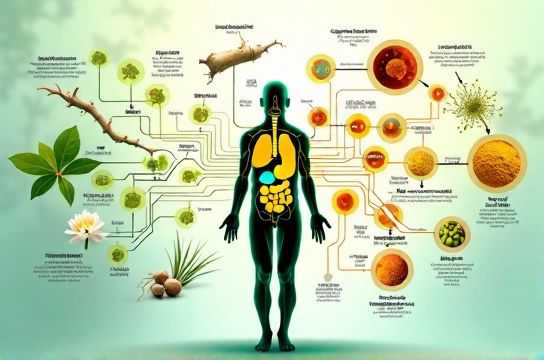
Unlike conventional drugs designed for a single target (think ibuprofen blocking just one inflammation pathway), herbs are more like a SWAT team—hitting several biological pathways at once. That’s where network pharmacology shines. It uses big data and AI-driven models to map out how dozens of compounds in a plant interact with genes, proteins, and cellular networks.
Take Curcuma longa (turmeric) as a prime example. Its active compound, curcumin, has been linked to anti-inflammatory, antioxidant, and even anticancer effects. But here’s the kicker: curcumin alone doesn’t explain all the benefits. Network studies show over 32 bioactive compounds in turmeric interacting with more than 150 molecular targets. That’s why traditional use often outperforms isolated extracts.
Why Single-Target Thinking Fails Herbs
Pharma-style reductionism—pulling one compound out of a plant and testing it solo—often fails because herbs work through synergy. A 2021 study in Nature Communications found that whole-plant extracts showed 68% higher efficacy in modulating inflammatory networks compared to isolated actives.
This is where network pharmacology flips the script. Instead of asking “What does this compound do?” it asks “How do all the compounds work together across the body’s systems?”
Real Data: How Herbs Hit Multiple Targets
Here’s a breakdown of key herbs and their multi-target actions, based on integrated pharmacological databases like TCMSP and SymMap:
| Herb (Latin Name) | Key Bioactives | Molecular Targets | Biological Effects |
|---|---|---|---|
| Salvia miltiorrhiza | Tanshinones, Salvianolic acids | VEGFA, TNF, IL-6 | Cardioprotective, anti-fibrotic |
| Glycyrrhiza glabra | Glycyrrhizin, Liquiritin | ACE2, NF-κB, CYP3A4 | Antiviral, anti-inflammatory, metabolic modulation |
| Scutellaria baicalensis | Baicalin, Wogonin | STAT3, COX-2, Bcl-2 | Anticancer, neuroprotective |
As you can see, these herbs aren’t just hitting one pathway—they’re modulating entire networks. That’s why they’re so effective in complex diseases like diabetes, cancer, and autoimmune disorders.
Another breakthrough? Network pharmacology helps validate traditional formulas. For instance, the classic Chinese formula Xue Bi Jing, used for sepsis, was found through network analysis to regulate immune response, coagulation, and endothelial function simultaneously—exactly what modern critical care aims to do.
And here’s the best part: this science is making herbal medicine more credible. Regulatory bodies like the EMA and FDA are starting to accept network-based evidence for botanical drug approval. In fact, two herbal formulations are now in Phase III trials using network pharmacology as part of their clinical rationale.
So if you’re serious about understanding how herbs really work, stop looking for the “magic bullet” compound. Start exploring the network. Dive into platforms like TCMSP or HerbDock to visualize interactions yourself.
The future of herbal medicine isn’t reductionist—it’s interconnected. And with tools like network pharmacology leading the way, we’re finally bridging tradition and science in a way that’s both rigorous and revolutionary.