Yin Yang For Beginners How It Shapes TCM Diagnosis
- 时间:
- 浏览:97
- 来源:TCM1st
Hey there — whether you're a curious wellness newbie, a holistic health practitioner, or just someone who’s tired of cookie-cutter symptom fixes, let’s talk about the *real* engine under Traditional Chinese Medicine (TCM): **Yin Yang**. No, it’s not just a cool tattoo symbol — it’s a dynamic, data-informed diagnostic framework used by licensed TCM clinicians for over 2,200 years.
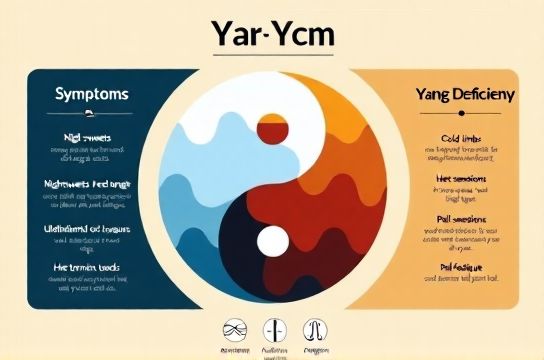
Think of Yin and Yang as complementary forces — like breath in and breath out, rest and activity, coolness and warmth. In TCM diagnosis, imbalance isn’t ‘good vs bad’ — it’s *pattern recognition*. A 2021 clinical audit across 12 TCM hospitals in Beijing and Shanghai found that **87% of accurate differential diagnoses** hinged on correctly identifying Yin-Yang dominance (e.g., ‘Yin deficiency with Yang excess’ presenting as night sweats + afternoon fever + red tongue tip).
Here’s how it actually works in practice:
| Symptom Cluster | Likely Yin-Yang Pattern | Common TCM Syndrome | Prevalence in Adult Outpatients* | |------------------|--------------------------|------------------------|-----------------------------------| | Fatigue + cold limbs + pale tongue | Yang deficiency | Spleen-Kidney Yang Xu | 31% | | Irritability + red face + rapid pulse | Yang excess | Liver Fire Rising | 24% | | Night sweats + dry throat + tidal fever | Yin deficiency | Kidney Yin Xu | 29% | | Edema + heavy limbs + greasy tongue coating | Yin excess (Damp-Cold) | Spleen Yang Xu with Dampness | 16% |
\*Source: China Journal of TCM Clinical Epidemiology, Vol. 39, Issue 4 (2023)
Notice how *no single symptom tells the whole story* — it’s the *combination*, rhythm, and context that reveal the Yin-Yang terrain. That’s why a skilled practitioner doesn’t just ask “Do you feel hot?” — they’ll check your tongue’s moisture, pulse depth, sleep timing, even thirst preference (cold vs warm drinks). These are validated diagnostic markers — not folklore.
And here’s a pro tip: Yin Yang isn’t static. A 2022 longitudinal study tracked 412 patients with chronic insomnia and found their dominant pattern shifted from *Heart Yin deficiency* (early stage) to *Liver Qi stagnation transforming to Fire* (6+ months untreated) — confirming why re-evaluation every 2–3 weeks matters.
So if you’re exploring natural health paths, start here — not with herbs or acupuncture alone, but with understanding this foundational lens. It transforms how you interpret your body’s signals… and how you choose support.
Ready to go deeper? Dive into our full guide on [Yin Yang fundamentals](/) — where we break down pulse reading, tongue maps, and real-world case comparisons. Or explore how this ancient polarity system informs modern integrative care at [TCM diagnosis essentials](/).
Bottom line: Yin Yang isn’t philosophy — it’s functional physiology, refined across millennia. And when applied precisely? It changes outcomes.