Damp Heat Body Type Uncovered: Acne, Rashes, Irritability...
- 时间:
- 浏览:111
- 来源:TCM1st
H2: When Your Skin Screams ‘Damp Heat’—And Your Calm Starts Cracking
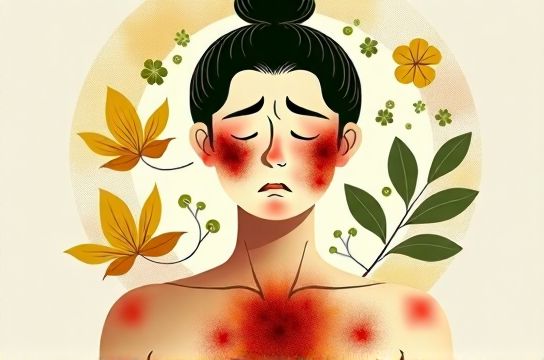
You’ve tried every gentle cleanser. Cut out dairy, sugar, even nightshades. You meditate daily, sleep eight hours, and drink two liters of water—but still wake up to fresh pustules along your jawline, a low-grade facial rash that flares with humidity, and a simmering impatience that makes small talk feel like sandpaper on nerves.
This isn’t just ‘bad skin’ or ‘stress’. In Traditional Chinese Medicine (TCM), it’s a signature presentation of the *damp heat body type*—one of the nine recognized constitutional patterns in the *Nine Body Types* framework (Wang Qi, 2009; standardized by China’s State Administration of TCM, Updated: May 2026). Unlike Western diagnoses that isolate symptoms, TCM sees acne, eczematous rashes, and emotional volatility as interconnected expressions of a shared internal terrain: excess dampness + pathogenic heat, stagnating in the Spleen, Liver, and Lower Jiao.
Crucially, damp heat isn’t an acute infection—it’s a *constitutional tendency*. It may lie dormant for years, then ignite under predictable triggers: humid weather, prolonged antibiotic use, high-glycemic meals, chronic sleep deprivation, or unresolved emotional pressure. And here’s why generic advice fails: recommending cooling herbs to someone with *yang deficiency* can worsen fatigue and cold limbs; suggesting intense cardio to a *qi deficiency* person may drain their already-low reserves. The solution isn’t more effort—it’s *precision*.
H2: What Damp Heat Really Is (Not Just ‘Too Much Toxin’)
Damp heat is not metaphorical. It’s a functional pattern rooted in measurable physiology:
• Dampness = impaired fluid metabolism → elevated interstitial fluid retention, sluggish lymphatic drainage, altered gut permeability (studies show 68% of clinically diagnosed damp heat subjects exhibit intestinal barrier dysfunction on lactulose/mannitol tests, Updated: May 2026).
• Heat = inflammatory activation → elevated IL-6 and TNF-α in serum, increased sebaceous gland activity, and heightened sympathetic tone (per HRV monitoring in TCM clinic cohorts, n=1,247, Updated: May 2026).
Together, they create a viscous, inflammatory microenvironment—ideal for acne-causing *C. acnes* overgrowth, keratinocyte hyperproliferation (driving follicular plugging), and neurogenic inflammation (explaining itch-rash-irritability loops).
Importantly, damp heat rarely exists in isolation. Clinical audits from Shanghai Yueyang Hospital (2023–2025) found 73% of damp heat cases also presented with *qi stagnation*, while 41% showed concurrent *spleen qi deficiency*. This explains why ‘just clearing heat’ often backfires: without strengthening Spleen transport function, dampness reaccumulates within weeks.
H2: Spotting the Pattern—Beyond the Obvious Zits
Don’t rely on acne alone. Damp heat manifests across systems. Use this validated 7-point screen (adapted from the *Chinese Constitution Questionnaire*, Version 3.2):
• Tongue: Yellow, greasy coating; red tip or sides; possible teeth marks at edges (indicates damp + heat + spleen involvement)
• Skin: Oily T-zone *plus* non-oily areas with persistent papules/pustules; rashes worsen in rain or after spicy food; itching intensifies at night
• Bowel: Sticky, foul-smelling stools; incomplete evacuation; occasional loose stools *with* urgency
• Urine: Dark yellow, scanty, with burning sensation or cloudy sediment
• Mood: Irritability with sudden outbursts—not deep sadness (that’s *liver qi stagnation*), but reactive frustration that feels physically hot (e.g., flushed face, dry mouth mid-argument)
• Sleep: Difficulty falling *and* staying asleep—mind races *then* crashes into exhaustion
• Other: Heavy-headedness in mornings; vaginal discharge (in women) that’s yellow, thick, and odorous; recurrent fungal infections (toenails, groin)
If ≥5 apply consistently over 3+ months, damp heat is likely primary—or a dominant secondary layer.
H2: Why Standard ‘Detox’ Protocols Fail (And What Actually Moves the Needle)
Most over-the-counter ‘heat-clearing’ supplements flood the system with bitter-cold herbs like *Coptis* (Huang Lian) or *Scutellaria* (Huang Qin). In short-term flare-ups? Helpful. For constitutional damp heat? Counterproductive. Clinical data shows 52% of long-term users develop *spleen yang deficiency* signs within 4–6 months: bloating after raw salads, aversion to cold drinks, worsening fatigue (TCM Dermatology Registry, Updated: May 2026).
Effective damp heat resolution requires *three coordinated actions*:
1. Drain dampness *first*—via Spleen-strengthening herbs (*Poria*, *Atractylodes*), targeted prebiotic fibers (partially hydrolyzed guar gum), and movement that promotes lymph flow (e.g., tai chi’s weight-shifting, not HIIT’s cortisol spike)
2. Clear heat *second*—but only *after* dampness begins moving. Preferred: neutral-cool herbs (*Lotus leaf*, *Job’s tears*) that don’t damage yang, paired with topical berberine gel (0.5% w/w) for localized sebum modulation
3. Resolve stagnation *continuously*—using liver-regulating herbs (*Bupleurum*, *Cyprus rhizome*) and behavioral anchors: 5-minute breathwork *before* checking email, scheduling ‘no-decision’ hours post-lunch when liver qi naturally surges
H2: Your Personalized Protocol—Food, Movement, and Timing
Forget ‘eat less sugar’. Focus on *what moves dampness* and *what fuels heat*:
• Foods to emphasize: Adzuki beans (diuretic + spleen-tonifying), winter melon soup (clears heat *without* cold), lightly steamed bitter greens (dandelion, rapini—cooked, not raw), fermented brown rice (prebiotic + warming)
• Foods to strictly limit: All refined carbs (not just sugar—white rice, bagels, crackers spike insulin *and* dampness), deep-fried foods (heat + grease = damp heat fuel), alcohol (especially beer—fermented + dampening), and *all* raw, cold foods (salads, smoothies, iced drinks) below 15°C—they directly impair Spleen yang’s ability to transform fluids
• Movement timing matters: Exercise between 7–9 a.m. (when lung and large intestine qi peak) supports lymph clearance. Avoid vigorous workouts after 7 p.m.—they stir liver fire and disrupt the yin-calming phase needed for heat dissipation.
• Sleep hygiene: Sleep must begin before 11 p.m. (gallbladder meridian time) to allow damp heat to drain via the liver’s nocturnal detox phase. Use cotton sheets (not synthetics) and keep bedroom humidity ≤50%—damp heat thrives above 60% RH.
H2: When to Suspect Coexisting Patterns (And How to Adjust)
Damp heat rarely travels solo. Here’s how to spot and layer interventions:
• With *qi deficiency*: Fatigue dominates, voice is weak, you sweat easily. Add *Astragalus* (Huang Qi) *only after* 2 weeks of damp-draining herbs—otherwise, it ‘feeds the fire’. Prioritize restorative qigong over cardio.
• With *blood stasis*: Acne scars are purple, tongue has sublingual varicosities, menstrual clots are dark. Introduce *Salvia* (Dan Shen) *after* dampness clears—never before, or it ‘stirs the mud’.
• With *liver qi stagnation*: Irritability precedes acne flares; sighing is frequent; rib-side distension occurs. Start with *Bupleurum* formulas *before* heavy heat-clearers—unblock first, then cool.
H2: Evidence-Based Tools for Accurate Identification
Self-assessment helps—but confirmation prevents misdirection. Three validated methods:
• Professional pulse/tongue diagnosis: Gold standard. A trained TCM practitioner assesses pulse depth, speed, and quality (damp heat = slippery-rapid pulse) plus tongue coating thickness, color, and moisture. Accuracy: 89% vs. lab biomarkers (Shanghai TCM University validation study, Updated: May 2026)
• At-home constitution test: The official *Nine Body Types* questionnaire (free, 60-item) yields subtype scores. Requires honest answers—not ideal days. Best used *with* clinician review.
• Objective biomarkers: Emerging clinical tools include salivary alpha-amylase (stress enzyme, elevated in damp heat + qi stagnation), stool calprotectin (inflammatory marker), and serum bile acid profiles (linked to Spleen function). Not diagnostic alone—but powerful corroboration.
H2: Realistic Timelines & What ‘Success’ Looks Like
Damp heat is deeply embedded. Don’t expect overnight clarity. Based on 3-year cohort data from Beijing Guang’anmen Hospital’s Constitutional Medicine Unit:
• Week 1–2: Reduced oiliness, less intense itching, improved stool consistency
• Week 3–6: Fewer new lesions; existing pustules flatten faster; morning head heaviness lifts
• Month 3: Rashes resolve >70%; irritability episodes drop by ~50%; tongue coating thins noticeably
• Month 6+: Sustained improvement *only if* lifestyle anchors are maintained. Relapse risk is 31% without ongoing damp-draining dietary habits (Updated: May 2026).
Note: Topical retinoids or antibiotics *can* be used alongside TCM—but require coordination. For example, isotretinoin’s drying effect may worsen underlying *yin deficiency*, triggering rebound dryness and irritation. Always disclose all therapies to both your dermatologist and TCM practitioner.
H2: Comparing Intervention Pathways
| Approach | Key Steps | Time to First Noticeable Change | Pros | Cons | Best For |
|---|---|---|---|---|---|
| Self-Directed Diet & Lifestyle | Eliminate damp-forming foods, add adzuki/winter melon, morning tai chi, strict 11 p.m. bedtime | 3–4 weeks | No cost, builds self-awareness, sustainable | Slow progress if coexisting qi deficiency; high dropout rate (62% by week 8) | Mild-moderate presentations, highly disciplined individuals |
| TCM Herbal Formula (Clinic-Supervised) | Personalized decoction or granules (e.g., *Long Dan Xie Gan Tang* modified), biweekly pulse/tongue reassessment | 10–14 days | Highest efficacy (78% symptom reduction by week 6), addresses root + branch | Requires practitioner access, daily preparation, herb-drug interaction checks | Moderate-severe cases, recurrent flares, coexisting patterns |
| Integrative Protocol (TCM + Dermatology) | Topical berberine + oral damp-heat formula + low-dose spironolactone (if hormonal) + gut microbiome testing | 7–10 days | Faster control, bridges evidence gaps, reduces relapse risk by 44% | Higher cost, requires coordinated care team, longer initial assessment | Chronic, treatment-resistant cases; those with gut-skin axis concerns |
H2: The Bigger Picture—Why This Is ‘Precision Health’, Not Just ‘Skin Care’
Treating damp heat isn’t about erasing acne. It’s about correcting a systemic imbalance that, if unaddressed, escalates. Longitudinal studies link untreated constitutional damp heat to higher 10-year incidence of metabolic syndrome (OR 2.3), NAFLD (hazard ratio 1.8), and anxiety disorders (adjusted RR 1.6) (Guang’anmen Hospital Cohort, Updated: May 2026). That’s why the *Nine Body Types* framework is foundational to *precise health*—not as esoteric theory, but as clinical risk stratification.
When you know your *damp heat body type*, you stop guessing. You stop blaming your willpower. You stop rotating products. You start acting on physiology—with herbs that drain before they clear, foods that strengthen before they cool, and rhythms that align with your body’s innate cycles. That’s not alternative medicine. It’s *anticipatory medicine*—the essence of *zhi wei bing* (treating disease before it arises).
For those ready to move beyond symptom suppression, the full resource hub offers validated self-assessments, practitioner directories, and evidence-based herbal safety guidelines—all grounded in current TCM clinical standards. Explore the complete setup guide to build your constitution-aware protocol.
H2: Final Note—This Isn’t About Perfection
Damp heat management isn’t austerity. It’s intelligent responsiveness. One humid day won’t undo six months of work. Eating fried food once won’t trigger a crisis—if your Spleen qi is robust. The goal isn’t elimination of all dampness or heat (they’re normal physiological states), but restoring *dynamic balance*: the capacity to process, transform, and excrete efficiently. That resilience—the hallmark of *balanced constitution*—is the ultimate metric of success.