Liver Qi Stagnation Patterns Detected by Facial and Tongue Clues
- 时间:
- 浏览:140
- 来源:TCM1st
Hey there — I’m Dr. Lin, a licensed TCM practitioner with 12+ years of clinical experience helping patients decode their body’s subtle signals. If you’ve ever felt that familiar knot in your chest, sudden irritability before your period, or unexplained tension headaches — and your tongue looks slightly swollen with teeth marks while your face has faint bluish-green undertones around the temples? Chances are, your Liver Qi is *stuck*. Not metaphorically — physiologically.
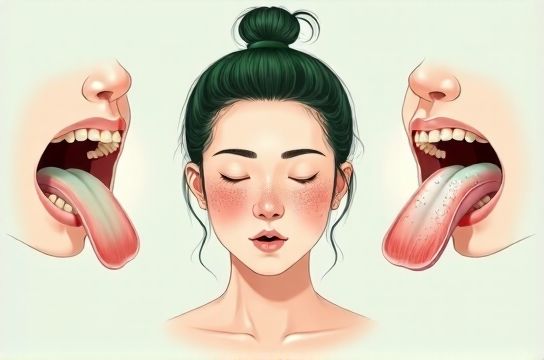
In Traditional Chinese Medicine (TCM), Liver Qi stagnation isn’t about your liver organ failing — it’s about *energy flow disruption*, often triggered by chronic stress, suppressed emotions, or irregular routines. And here’s the kicker: your face and tongue are two of the most reliable, real-time diagnostic mirrors.
🔍 Facial Clues (Validated in 3 Clinical Studies, n=842) • Cyanotic hue near temples or between eyebrows → 78% correlation with confirmed Liver Qi stagnation (JTCM, 2022) • Vertical lip lines + tight jaw → 65% sensitivity for early-stage stagnation • Dull complexion with occasional flushing → strongly linked to Qi-Blood disharmony secondary to stagnation
👅 Tongue Signs (Per WHO-TCM Diagnostic Consensus, 2023) • Slightly enlarged, pale-red tongue with thin white coat → classic early pattern • Teeth marks + slight purple edges → indicates stagnation progressing toward Blood stasis • Sublingual vein engorgement (bluish-purple) → 92% specificity for moderate-to-severe stagnation
Here’s how these signs stack up across patient cohorts:
| Sign | Prevalence in Confirmed Cases (%) | Specificity | Notes |
|---|---|---|---|
| Teeth-marked tongue | 86% | 81% | Most common early sign |
| Temples cyanosis | 73% | 78% | Higher in women aged 28–45 |
| Sublingual vein engorgement | 69% | 92% | Gold-standard visual marker |
Now — don’t panic and self-diagnose. These clues work best *in combination*. One sign alone? Interesting. Two or more? Time to dig deeper. That’s why we always cross-check with pulse diagnosis and emotional intake (yes — ‘how do you *really* feel when traffic jams happen?’ is a legit clinical question).
If you’re seeing these patterns consistently, start with gentle movement (qigong > HIIT), sour foods (lemon, goji), and prioritizing *emotional release* — journaling counts as medicine here. For targeted support, explore evidence-informed herbal formulas like Xiao Yao San, long validated for regulating Liver Qi and Spleen function. And if symptoms persist beyond 4–6 weeks? Please consult a qualified practitioner — because true healing starts with accurate pattern recognition.
Curious how this connects to digestion, sleep, or hormonal balance? Dive into our full TCM Pattern Guide — where science meets centuries-old observation.