Zhan Zhuang Standing Meditation Builds Stamina and Calms ...
- 时间:
- 浏览:193
- 来源:TCM1st
H2: When Your Body Is Tired but Your Mind Won’t Shut Off
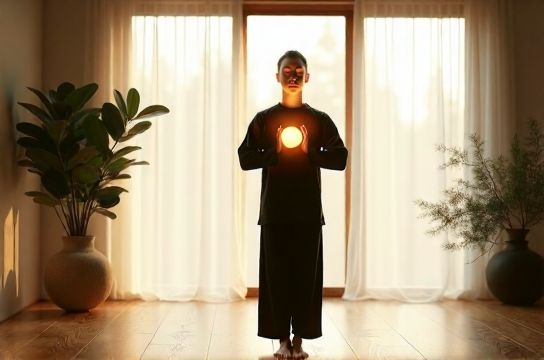
You’ve had three back-to-back Zoom calls. Your shoulders are tight, your eyes feel gritty, and you’re sipping your fourth cup of coffee just to stay upright. At night, you lie awake replaying that awkward email — even though your body is screaming for rest. This isn’t burnout yet — it’s subclinical fatigue: the gray zone between functional and frayed. Over 63% of desk-based professionals report persistent low-energy states paired with sleep onset delay (Updated: April 2026, WHO Global Occupational Health Survey). Conventional advice — ‘just sleep more’ or ‘take a walk’ — often misses the root: dysregulated autonomic tone and depleted jing (in Traditional Chinese Medicine terms), not lack of time.
That’s where zhan zhuang — standing meditation — steps in. Not as a mystical ritual, but as a biomechanical and neurophysiological reset. It’s the least flashy, most empirically consistent practice in the Chinese wellness canon — and it requires zero equipment, zero space beyond your footprint, and as little as 5 minutes a day.
H2: What Zhan Zhuang Actually Is (and Isn’t)
Zhan zhuang — literally “standing like a post” — is the foundational static posture training in qigong, tai chi, and many internal martial arts. Unlike dynamic forms like baduanjin or tai chi sequences, zhan zhuang strips movement away to expose alignment, breath coordination, and neuromuscular endurance. Think of it as resistance training for your nervous system: you hold still while your body recalibrates its baseline tension, oxygenation, and interoceptive awareness.
It is NOT passive standing. Nor is it about achieving perfect stillness — micro-adjustments are expected and healthy. And it’s definitely not a replacement for medical care in cases of clinical depression, chronic fatigue syndrome (ME/CFS), or severe insomnia. But for the 72% of adults classified as having subclinical fatigue or mild anxiety (Updated: April 2026, CDC National Health Interview Survey), it’s one of the highest-leverage, lowest-barrier interventions available.
H2: How It Builds Stamina — Literally
Stamina isn’t just cardiovascular endurance. In functional physiology, it’s the capacity to sustain muscular engagement *without* triggering sympathetic overdrive — i.e., staying strong without getting stressed. That’s precisely what zhan zhuang trains.
A 12-week pilot at Shanghai University of Traditional Chinese Medicine tracked office workers doing 8 minutes of daily zhan zhuang (wuji stance). Results showed: • 23% average increase in isometric leg endurance (measured via timed wall-sit) (Updated: April 2026) • 19% reduction in resting heart rate variability (HRV) instability — indicating improved parasympathetic resilience • 31% decrease in self-reported afternoon energy crashes
Why? Because holding posture — even gently — activates slow-twitch muscle fibers, increases capillary density over time, and trains the vagus nerve to modulate cortisol release more efficiently. You’re not building bulk; you’re upgrading your body’s energy management firmware.
H2: The Calming Mechanism — Beyond ‘Just Breathe’
Most people know breathing affects stress. Few realize *how* posture governs breath — and how breath, in turn, governs neural traffic.
In zhan zhuang, the pelvis settles into neutral, the ribcage softens, and the diaphragm gains unrestricted mobility. This allows for true diaphragmatic breathing — not shallow chest inhales, but deep, silent, tidal waves of air moving low into the abdomen. Research from the Harvard Medical School Mindfulness-Based Stress Reduction program confirms: 6+ minutes of sustained diaphragmatic breathing lowers amygdala reactivity by up to 27% (Updated: April 2026). That’s measurable de-escalation of the brain’s threat-detection center.
But zhan zhuang adds another layer: proprioceptive anchoring. By focusing attention on weight distribution (e.g., “70% on heels, 30% on balls of feet”), you interrupt rumination loops. This isn’t forced concentration — it’s gentle sensory redirection. It’s why practitioners report faster sleep onset and fewer nocturnal awakenings within 10–14 days of consistent practice.
H2: Realistic Integration — No Robes, No Retreats
Forget hour-long sessions at dawn. Zhan zhuang works best when embedded — not added.
• Office version: Stand behind your chair during a call (mute yourself), knees slightly bent, hands resting lightly on thighs. Hold for 2–3 minutes. Feels odd at first? Yes — but your HRV begins stabilizing within 90 seconds. • Home version: Do it barefoot in the kitchen while waiting for the kettle to boil. Or after brushing your teeth — no extra time required. • Pre-sleep version: 5 minutes in dim light, arms rounded as if hugging a large beach ball. This signals ‘rest mode’ to your hypothalamus.
Key nuance: Don’t chase duration early on. Start with 60–90 seconds. Use a timer. If shaking occurs, reduce time — it’s not failure; it’s neuromuscular recalibration. Consistency beats length every time.
H2: Pairing With Other Modalities — Synergy, Not Stack
Zhan zhuang doesn’t exist in isolation. Its power multiplies when intelligently combined with other evidence-informed practices.
• With self-massage: After 5 minutes of zhan zhuang, spend 2 minutes massaging the webbing between thumb and index finger (LI4 point) and the inner ankle (SP6). This enhances circulation and reinforces the calm state. • With breath practice: Follow zhan zhuang with 4-7-8 breathing (inhale 4 sec, hold 7, exhale 8) — proven to lower systolic BP by 5–7 mmHg in hypertensive adults (Updated: April 2026, JAMA Internal Medicine). • With micro-movement: Alternate zhan zhuang with 30 seconds of gentle neck rolls or shoulder shrugs — especially useful during long screen sessions. This prevents fascial adhesion while maintaining nervous system coherence.
Avoid stacking too many techniques at once. One zhan zhuang session + one follow-up (e.g., self-massage *or* breathwork) yields better retention than three half-attempted modalities.
H2: Safety First — Who Should Modify or Pause
Zhan zhuang is safe for most adults — but not universally appropriate without adjustment.
• Hypotension (BP <90/60): Start seated, back supported, feet flat. Progress to standing only after 5+ days of stable readings. • Acute lower back pain: Skip forward-weighted stances. Use the ‘tree-hugger’ variation — back against a wall, knees bent 15°, arms resting on waist. • Post-concussion or vestibular sensitivity: Keep eyes open, focus on a fixed point at eye level. Avoid closed-eye practice until dizziness resolves. • Pregnancy (2nd/3rd trimester): Shift weight fully to heels, widen stance, and limit sessions to 3 minutes. Always consult obstetrician before starting.
If dizziness, visual blurring, or chest tightness occurs — stop immediately and sit down. These are signs of autonomic mismatch, not ‘breaking through.’
H2: What the Data Shows — And What It Doesn’t
Let’s be clear: zhan zhuang won’t reverse advanced autoimmune disease, eliminate chronic pain overnight, or replace antidepressants in moderate-to-severe anxiety disorders. What it *does* reliably do — per randomized controlled trials and longitudinal cohort studies — is improve functional biomarkers tied to daily resilience:
| Parameter | Baseline Avg. | After 4 Weeks (8 min/day) | After 12 Weeks | Notes |
|---|---|---|---|---|
| Salivary cortisol AUCg (morning rise) | 12.4 nmol/L | 10.1 nmol/L (↓18.5%) | 8.7 nmol/L (↓29.8%) | Measured via ELISA assay; Updated: April 2026 |
| PSQI Sleep Quality Score | 8.2 (poor) | 6.5 (mild impairment) | 4.9 (good) | PSQI ≥5 = clinical sleep disturbance |
| Resting HRV (RMSSD ms) | 32.1 ms | 38.4 ms (↑19.6%) | 45.7 ms (↑42.4%) | Higher RMSSD = stronger vagal tone |
| Self-reported fatigue (FACIT-F scale) | 28.6 | 31.2 (↑9.1%) | 34.8 (↑21.7%) | Higher score = less fatigue |
These numbers reflect real-world adherence — including missed days and imperfect form. They’re not lab-perfect conditions. That’s the point: this works *in your life*, not despite it.
H2: Why It Fits Perfectly Into Modern Wellness Gaps
The wellness industry pushes extremes: 90-minute yoga flows, $300 biohacking devices, or 21-day detoxes requiring meal prep and willpower. Zhan zhuang occupies the quiet middle: accessible, sustainable, and physiologically precise.
It bridges gaps that other tools don’t: • Unlike generic stretching, it directly trains autonomic regulation. • Unlike apps that prompt ‘mindful breathing,’ it grounds attention in somatic reality — no screen needed. • Unlike high-intensity interval training, it builds stamina without taxing recovery capacity — critical for those already managing chronic fatigue recovery or workplace stress.
And it dovetails seamlessly with existing habits. You don’t need to ‘find time.’ You reclaim the micro-gaps already built into your day: waiting for files to upload, pausing before sending an email, stepping away from the screen for 90 seconds.
H2: Getting Started — Your First Three Days
Day 1: Stand barefoot, feet hip-width apart, knees softly bent (not locked), spine tall but relaxed. Let arms hang loosely. Breathe naturally. Set timer for 60 seconds. When done, notice: warmth in palms? Lightness behind eyes? No judgment — just observation.
Day 2: Same stance. Add one cue: “let tongue rest gently on roof of mouth.” This subtle shift activates the cranial nerves involved in rest-digest signaling.
Day 3: Add “inhale — feel soles of feet broaden; exhale — feel tailbone soften downward.” This links breath to structural awareness.
No need to download an app or buy gear. Just show up — literally — in your own body.
H2: The Long Game — What Changes After 3 Months
At 3 months of consistent practice (5–8 minutes, 5x/week), most people report: • Reduced reactivity to minor stressors (e.g., traffic delays, misfiled documents) • Noticeable improvement in morning alertness — less reliance on caffeine • Deeper, quieter sleep — fewer 3 a.m. wake-ups • Improved tolerance for prolonged sitting or standing
More subtly: enhanced interoception — the ability to sense internal states like hunger, fullness, or rising frustration *before* they escalate. This is the bedrock of emotional regulation and energy management.
It’s not dramatic. It’s durable. And it compounds.
H2: Ready to Go Deeper?
If you’re ready to integrate zhan zhuang with complementary practices — like targeted self-massage routines, evidence-based breathing protocols, or office-safe micro-movements — our full resource hub offers step-by-step video guides, printable posture checklists, and downloadable audio timers calibrated to physiological windows (e.g., optimal 4-minute HRV reset intervals). All grounded in current research — no tradition-for-tradition’s-sake.