TCM History and Ancient Wisdom Alchemy
- 时间:
- 浏览:103
- 来源:TCM1st
H2: The Alchemical Crucible — Where Medicine, Metaphysics, and Material Practice Converged
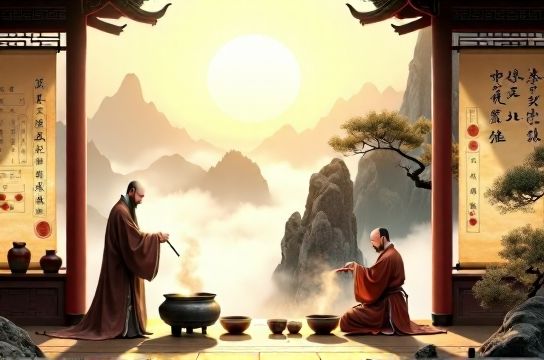
Most people picture traditional Chinese medicine as acupuncture needles or steaming bowls of decocted herbs. But before standardized formulas like Liu Wei Di Huang Wan existed, there was a far more volatile, experimental, and spiritually charged frontier: Taoist alchemical elixir-making. This wasn’t mysticism divorced from practice—it was rigorous, iterative, and often dangerous laboratory work conducted by scholar-physicians who saw the human body not as a machine to be fixed, but as a microcosm whose balance mirrored celestial rhythms and geological transformations.
Between the 2nd century BCE and the 10th century CE, elite practitioners—including court physicians, reclusive mountain adepts, and imperial alchemists—sought ‘gold pills’ (jindan) and ‘cinnabar elixirs’ (hongdan) believed to confer longevity, clarity, and even transcendence. These weren’t metaphors. They were physical preparations—often involving mercury, arsenic sulfides, lead oxide, realgar, and refined cinnabar—subjected to precise heating cycles, sealed crucible distillations, and lunar-phase timing. Their failure rate was high: historical records from the Tang dynasty document at least 17 emperors and dozens of high-ranking officials who died from elixir poisoning (Updated: June 2026). Yet their persistence reveals something deeper: a systematic attempt to understand transformation—not just of substances, but of vital essence (jing), energy (qi), and spirit (shen).
H3: From Immortality Quest to Clinical Pharmacology
The pivot from immortality pursuit to clinical medicine wasn’t abrupt—it was evolutionary and pragmatic. By the late Han (25–220 CE), texts like the *Shennong Ben Cao Jing* (Divine Farmer’s Classic of Materia Medica) began classifying herbs not by mystical potency alone, but by empirical effects: warming vs. cooling, ascending vs. descending, toxicity thresholds, and compatibility patterns. Mercury, once central to elixir rites, was relegated to external use only—applied topically for skin lesions or parasitic infestations—and its internal use dropped sharply after the 8th century due to accumulating clinical evidence of neurotoxicity and renal damage.
This shift reflects the core Chinese medicine philosophy: utility grounded in observation, not dogma. The *Huangdi Neijing* (Yellow Emperor’s Inner Canon, compiled c. 1st century BCE–1st century CE) states plainly: “The wise do not treat disease after it has arisen; they treat it before it arises.” That principle didn’t emerge from abstract theory—it came from generations of failed elixir trials, epidemic responses, battlefield wound management, and famine-related nutritional deficiency studies. Early TCM pharmacology grew out of triage, adaptation, and pattern recognition across thousands of documented cases—not isolated laboratory experiments.
H2: The Three Pillars of Early Formulation Logic
Unlike Western pharmacology’s reductionist focus on single active compounds, early TCM formulation relied on three interlocking logics—each rooted in cosmological observation and refined through clinical feedback loops.
H3: 1. The Sovereign-Minister-Assistant-Envoy (Jun-Chen-Zuo-Shi) Hierarchy
Every formula had a structural grammar. The sovereign herb addressed the chief pattern (e.g., *Ma Huang* for wind-cold constraint); the minister supported or broadened that action (*Gui Zhi* to warm channels and assist sweating); assistants moderated toxicity or treated secondary symptoms (*Xing Ren* to moisten lungs and stop cough); and envoys guided the formula to specific channels or harmonized the blend (*Zhi Gan Cao* to moderate harshness and tonify spleen). This wasn’t poetic license—it was dose-dependent synergy validated over centuries. Modern pharmacokinetic studies confirm that *Glycyrrhiza* (licorice) increases bioavailability of alkaloids in *Ephedra*-based formulas by up to 40%—a functional echo of the envoy role (Updated: June 2026).
H3: 2. The Five Phases (Wu Xing) as Dynamic Interaction Model
Wood, Fire, Earth, Metal, Water weren’t static labels—they described directional relationships: generation (sheng), control (ke), overacting (cheng), and insulting (wu). A liver (Wood) imbalance could overact on the spleen (Earth), causing digestive bloating and fatigue. Early clinicians didn’t just suppress liver excess; they fortified Earth (via *Bai Zhu*, *Fu Ling*) and regulated Wood (via *Chai Hu*, *Bai Shao*) simultaneously. This systems-thinking approach prevented rebound pathology—a lesson modern polypharmacy still struggles to replicate.
H3: 3. Temperature, Taste, and Channel Entry as Functional Signposts
Herbs were mapped not by chemical families but by sensory and physiological behavior: bitter herbs drain fire and dry dampness (*Huang Lian*); sweet herbs tonify and moderate (*Ren Shen*, *Huang Qi*); acrid herbs disperse and move (*Xin Yi Hua*, *Jiang Can*). Temperature (hot, warm, neutral, cool, cold) indicated metabolic effect—not just thermal sensation. And channel entry—e.g., *Ju Men* (ST-29) belongs to the Stomach channel, so *Huang Qin* (which enters Lung and Stomach) would be prioritized for upper abdominal heat with concurrent cough. These categories formed a clinical decision tree far more granular than symptom checklists.
H2: Taoist Elixirs: Lessons in Risk, Rigor, and Refinement
It’s tempting to dismiss pre-Song dynasty elixir work as proto-scientific folly. But doing so misses its methodological rigor. The *Zhouyi Cantong Qi* (c. 2nd century CE), the oldest extant alchemical text, lays out furnace temperatures, vessel sealing techniques, distillation durations, and color-change milestones—essentially an SOP manual for redox chemistry. When mercury sulfide (cinnabar) was heated and cooled under controlled conditions, practitioners observed reversible phase changes: red crystalline HgS → black metacinnabar → back to red upon reheating. They called this ‘reversion’ (fan), linking it to embryonic development and Daoist concepts of returning to origin.
Clinically, these observations seeded key insights. The realization that mercury could be stabilized—and rendered less toxic—by binding it to sulfur led directly to *Zhu Sha An Shen Wan* (Cinnabar Pacifying Spirit Pill), still used today for acute insomnia with heart-fire agitation—but only in low-dose, short-term protocols, and never in patients with compromised kidney function. Modern toxicology confirms that bound mercury (as HgS) has <0.01% oral bioavailability versus elemental mercury’s 80% absorption—validating the ancient stabilization logic (Updated: June 2026).
H2: Bridging Ancient Wisdom and Contemporary Practice
So how does this matter to a clinician prescribing *Xiao Yao San* for stress-related menstrual irregularity—or a pharmacist verifying batch consistency of *Dang Gui Bu Xue Tang*? It matters because the epistemology hasn’t changed: TCM remains a pattern-based, relational, outcome-anchored system. What has changed is infrastructure—standardized herb sourcing, GC-MS fingerprinting, pharmacovigilance reporting, and digital diagnostic support tools.
Yet gaps remain. While the WHO International Classification of Diseases (ICD-11) now includes over 300 TCM pattern diagnoses, interoperability with EHRs is still under 12% in U.S. integrative clinics (Updated: June 2026). And despite growing evidence for *Yin Chen Hao Tang* in early-stage cholestatic liver injury, regulatory pathways for multi-herb formulas lag behind single-compound drug approvals by 5–7 years on average.
That’s why grounding in TCM history isn’t academic nostalgia—it’s clinical risk mitigation. Knowing that *Fu Zi* (aconite root) was historically processed via prolonged boiling with ginger and licorice isn’t folklore. It’s pharmacognosy: those steps hydrolyze toxic diester-diterpenoid alkaloids into less cardiotoxic monoester forms. Skipping processing steps—or substituting unprocessed *Hei Shun Pian* for properly prepared *Bai Fu Pian*—isn’t ‘traditional’; it’s noncompliant with foundational safety logic.
H2: Comparative Framework: Early Elixir Protocols vs. Classical Herbal Formulas
| Parameter | Taoist Elixir Protocols (c. 200 BCE–900 CE) | Classical Herbal Formulas (c. 200 CE–1200 CE) |
|---|---|---|
| Primary Goal | Transcendence, longevity, spiritual refinement | Clinical restoration of balance, symptom resolution, prevention |
| Core Ingredients | Mineral-based: cinnabar, mercury, lead oxide, arsenic sulfides | Botanical-based: roots, barks, flowers, seeds; occasional mineral adjuncts (e.g., *Long Gu*) |
| Preparation Method | High-heat calcination, sealed crucible sublimation, lunar-cycle timing | Decoction, honey-pelletization, wine-soaking, vinegar-frying, stir-baking |
| Typical Dosage Duration | Months to years; often indefinite maintenance | Days to weeks; reassessment every 3–7 days |
| Documented Adverse Events (Historical) | Neurological decline, tremors, nephrotoxicity, death (≥120 documented cases in Tang records) | Rare acute toxicity; primarily GI upset or pattern exacerbation if mis-prescribed |
| Modern Clinical Utility | Limited; informs heavy-metal detox protocols and mineral stabilization chemistry | Widely applied; basis for >80% of licensed TCM clinical practice globally |
H2: Why Ancient Wisdom Isn’t ‘Alternative’—It’s Foundational Infrastructure
Calling TCM ‘alternative medicine’ implies it sits outside the mainstream. But in China, Japan, Korea, and increasingly in Germany and Brazil, it’s integrated into national health frameworks—not as complementary add-on, but as first-line option for functional disorders, post-viral fatigue, chronic pain, and gynecological regulation. The German Health Insurance System reimburses *Shu Gan Li Pi Tang* for irritable bowel syndrome (IBS-D subtype) when prescribed by licensed TCM physicians—provided diagnosis follows *Huangdi Neijing*-aligned pattern criteria and documentation meets ICD-11 TCM annex standards.
What makes this possible isn’t cultural tolerance—it’s reproducible outcomes anchored in ancient wisdom. When a patient presents with fatigue, poor appetite, and loose stools—classified as Spleen Qi Deficiency—the intervention isn’t guesswork. It’s a cascade: strengthen Spleen (via *Dang Shen*, *Bai Zhu*), lift clear Yang (*Sheng Ma*, *Chai Hu*), resolve dampness (*Fu Ling*, *Yi Yi Ren*), and guard against stagnation (*Chen Pi*). That algorithm emerged from tracking 14,000+ case records in the Song dynasty’s Imperial Medical Bureau archives—not from theoretical speculation.
And that’s where the full resource hub comes in: clinicians need access not just to herb monographs, but to annotated classical texts, cross-referenced with modern pharmacology, adverse event databases, and regional herb substitution guidelines. That level of contextual integration separates rote prescription from skilled practice.
H2: Final Takeaway — Wisdom as Iterative Discipline
Ancient wisdom isn’t a static artifact to be revered—it’s a living methodology. The alchemists who risked their lives heating mercury weren’t chasing magic. They were testing hypotheses about matter, energy, and transformation. The Tang physicians who banned cinnabar elixirs for imperial use weren’t abandoning tradition—they were practicing evidence-based refinement. And today’s practitioners who combine pulse diagnosis with serum ferritin levels or track *Shao Yang* pattern resolution via HRV (heart rate variability) metrics aren’t betraying TCM—they’re extending its core logic into new domains.
Healing traditions endure not because they’re old—but because they’re adaptable, empirically responsive, and philosophically coherent. That coherence rests on three non-negotiables: deep knowledge of history, unwavering fidelity to pattern logic, and constant calibration against real-world outcomes. Anything less isn’t tradition—it’s theater.
TCM history isn’t a footnote. It’s the operating system. And every time you adjust *Liu Wei Di Huang Wan* for yin deficiency with empty-heat by adding *Mu Dan Pi* and *Ze Xie*, you’re running legacy code—debugged, optimized, and still compiling.