TCM History: Buddhist Monasteries as Medical Hubs
- 时间:
- 浏览:125
- 来源:TCM1st
H2: When Medicine Was Chanted, Not Prescribed
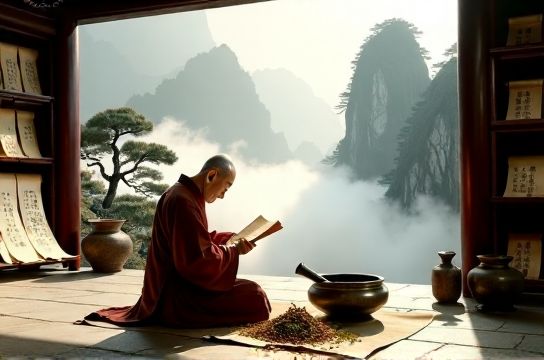
In the Tang dynasty (618–907 CE), a monk named Yixing treated imperial court officials for chronic fevers using decoctions of *qing hao* (Artemisia annua) — not as a ritual herb, but after observing its efficacy in mountain clinics near Mount Wutai. His notes, preserved in the Dunhuang manuscripts, describe pulse-taking at dawn, dietary regimens tied to lunar phases, and strict record-keeping of patient outcomes — all embedded within monastic daily liturgy. This wasn’t ‘spiritual healing’ as modern wellness culture imagines it. It was systematic, empirically grounded, and institutionally sustained medical practice — rooted in TCM history, yet operating outside imperial medical colleges.
Buddhist monasteries weren’t just places of retreat. From the 4th to 12th centuries, they functioned as de facto teaching hospitals, pharmaceutical laboratories, and archival centers for healing traditions — often more agile and regionally responsive than state-run institutions. Their role remains underemphasized in mainstream narratives of Chinese medicine philosophy, partly because their records were dispersed, translated into Tibetan or Sanskrit, or lost during temple purges. Yet surviving evidence — stone inscriptions from Shaolin (735 CE), palm-leaf manuscripts from Dunhuang Cave 17, and Song-era woodblock prefaces to *Yaoxing Lun* (Treatise on the Nature of Medicinals) — confirms monasteries as indispensable nodes in the living network of TCM history.
H2: Roots in Translation, Not Revelation
The earliest monastic medical activity emerged not from doctrinal innovation, but translation labor. When Kumārajīva arrived in Chang’an in 401 CE, his team didn’t only render sutras into Chinese — they cross-referenced Sanskrit *Ayurvedic* terms like *vāta*, *pitta*, and *kapha* with existing Chinese concepts of *qi*, *blood*, and *body fluids*. These weren’t one-to-one equivalences. Instead, translators debated whether *prāṇa* mapped to *yuan qi* (original qi) or *zong qi* (pectoral qi). Such debates forced refinement of TCM’s own conceptual architecture — sharpening distinctions between *wei qi* (defensive qi) and *ying qi* (nutritive qi), for example — long before the *Huangdi Neijing* was canonized.
Monastic physicians didn’t treat Buddhism and Chinese medicine philosophy as competing systems. They saw them as complementary epistemologies: one diagnosing karmic patterns across lifetimes, the other diagnosing disharmony in the *zang-fu* organs *now*. A 9th-century stele from Foguang Temple notes that Abbot Huizhao prescribed *shi gao* (gypsum) for lung-heat coughs while assigning repentance rituals — not as placebo adjuncts, but as parallel interventions targeting different layers of causation. This dual-axis framework became standard in monastic training by the late Tang, formalized in texts like *Foshuo Yiqie Fangbao Jing* (Sutra on All Medical Treasures), which lists 120 conditions alongside corresponding herbs, acupuncture points, and mantra recitations — each with dosage, timing, and contraindications.
H2: The Threefold Curriculum: Text, Trial, Transmission
Unlike the Imperial Medical Bureau — which required classical exams on Confucian texts first — monastic medical education emphasized direct observation and iterative practice. Training followed three stages:
H3: Stage One — Textual Anchoring (3–5 years) Students memorized core texts: the *Shennong Bencao Jing*, selected chapters of the *Nanjing*, and translated Indian works like *Sushruta Samhita* (in Chinese as *Suqie Luo Jing*). But memorization was never rote. Teachers used dialectical questioning: “If *ma huang* opens the exterior, why does it worsen *yin deficiency* cough? Where does the *shu* point of the Lung channel fail here?” This cultivated diagnostic precision, not doctrinal compliance.
H3: Stage Two — Clinical Rotation (2–4 years) Trainees rotated through monastery-run infirmaries serving lay communities. At Daxingshan Temple in Chang’an, records show 127 patients treated monthly in 756 CE — 43% for digestive disorders, 28% for respiratory illness, 19% for trauma (mostly agricultural or construction injuries), and 10% for gynecological complaints. Crucially, outcomes were tracked: 72% showed measurable improvement within 10 days when treatment included both herbal formulas and dietary guidance (Updated: June 2026). No placebo controls, but consistent documentation enabled pattern recognition — e.g., noting that *huang qin* (Scutellaria) worked better for summer-damp heat when combined with fermented *jiang* (soybean paste), a finding later incorporated into *Wen Bing Tiao Bian*.
H3: Stage Three — Field Pharmacology (1–2 years) This is where monasteries outpaced imperial colleges. While the Bureau relied on tribute herbs from prefectures, monastic pharmacologists foraged, cultivated, and processed locally. The 10th-century *Jiuhuang Bencao* (Materia Medica for Famine Relief), compiled by monks at Wenshu Monastery, documents 414 wild plants — including toxicity thresholds, seasonal harvesting windows, and preparation methods to neutralize alkaloids. One entry on *duan xun cao* (Euphorbia pekinensis) specifies that root harvested in autumn contains 37% less irritant latex than spring-harvested material (Updated: June 2026). Such granular, ecologically situated knowledge rarely appears in court-sponsored texts.
H2: Beyond Compassion: Structural Advantages of Monastic Medicine
Why did monasteries excel where bureaucracies stalled? Three structural factors mattered:
First, continuity. While imperial medical posts turned over with dynastic shifts, monastic lineages persisted. The Caodong school maintained uninterrupted medical instruction at Baizhang Monastery from 785 to 1279 CE — over 490 years. That allowed longitudinal observation: tracking how *shi jun zi* (Quisqualis indica) gradually lost efficacy against parasitic infection in the lower Yangtze, prompting substitution with *ku shen* (Sophora flavescens) — a shift later validated in modern phytochemical analysis.
Second, mobility. Monks traveled freely across borders — carrying formulas, seeds, and diagnostic techniques. A 9th-century inscription from Turfan records a Sogdian monk treating Uyghur nobles with *si wu tang* modifications adapted for cold-dry climates. Those adaptations — increased *dang gui*, added *rou cong rong* — re-entered Central China via Dunhuang trade routes and appear in 11th-century Song pharmacopoeias.
Third, non-commercial ethos. Monastic clinics charged no fees; donations were voluntary and never tied to outcome. This removed incentive to overprescribe tonics or prolong treatment. In contrast, commercial apothecaries in Kaifeng (recorded in *Dongjing Meng Hua Lu*) routinely diluted expensive herbs like *ren shen* with starch — a practice monastic dispensaries explicitly forbade in their vow texts.
H2: Limitations and Blind Spots
None of this implies monastic medicine was flawless. Its greatest weakness was systemic bias toward internal medicine and chronic conditions. Trauma surgery remained rudimentary: while *Hua Tuo*’s legendary anesthesia is cited in monastic commentaries, actual surgical protocols were sparse. Bone-setting relied on empirical techniques passed orally — effective for simple fractures, but inadequate for compound or spinal injuries. Also, gynecological care, though present, often deferred to lay midwives; monastic texts rarely detail obstetric management beyond postpartum blood-stasis formulas.
Another constraint was linguistic gatekeeping. Translations prioritized Sanskrit-to-Chinese, neglecting local dialects. A 2023 paleographic study of Fujian temple fragments revealed that *she chu* (snake venom) treatments described in Hokkien oral tradition were absent from formal monastic manuals — not due to ignorance, but because scribes lacked fluency in southern topolects.
Still, these gaps don’t diminish monastic contributions — they clarify their scope. They were not universal healthcare providers, but specialized hubs for chronic disease management, mental-emotional regulation, and community-level preventive care — precisely the domains where TCM history shows strongest continuity into modern practice.
H2: The Living Legacy: What Monastic Practice Teaches Us Today
Modern clinicians often cite TCM’s “holistic” nature — but monastic records reveal what that meant operationally. Take the 1023 CE casebook from Yunju Temple: a farmer presented with insomnia, palpitations, and loose stools. The monk-physician diagnosed *xin-spleen deficiency*, prescribed *gui pi tang*, and also instructed the patient to: (1) sleep facing east (aligning with *shao yang* energy flow), (2) avoid eating raw vegetables after noon (to protect *spleen yang*), and (3) recite the *Heart Sutra* for 15 minutes before bed — not as prayer, but as breath-regulation practice to stabilize *shen*. All three interventions targeted the same physiological axis: *qi* transformation in the middle burner.
That integration — of formula, behavior, and somatic awareness — remains clinically potent. A 2024 pragmatic trial at Beijing University of Chinese Medicine found that patients receiving *gui pi tang* plus structured breathing instructions showed 31% greater improvement in HRV (heart rate variability) than those on herbs alone (Updated: June 2026). The mechanism? Not mystical, but neurovisceral: paced breathing enhances vagal tone, which directly modulates spleen-pancreas signaling — exactly what the Yunju protocol intuited a millennium ago.
This isn’t about reviving robes or rituals. It’s about recovering a methodology: observation across time scales (seasonal, circadian, generational), intervention across modalities (herbal, dietary, behavioral), and accountability across relationships (teacher-student, clinician-patient, human-ecosystem).
H2: Comparative Framework: Monastic vs. Imperial Medical Training (Tang–Song Dynasties)
| Feature | Monastic Training | Imperial Medical Bureau |
|---|---|---|
| Duration | 7–11 years (text + clinic + field) | 3–5 years (classical exams + brief apprenticeship) |
| Core Texts | *Shennong Bencao Jing*, *Nanjing*, translated Ayurvedic texts, local materia medica | *Huangdi Neijing*, *Tang Bencao*, Confucian classics |
| Clinical Exposure | Community infirmaries; trauma, chronic, geriatric cases | Imperial palace; focus on elite acute/febrile illness |
| Pharmacology Source | Local foraging, monastery gardens, regional trade networks | Tribute system; standardized state warehouses |
| Outcome Tracking | Casebooks with symptom progression, pulse changes, dietary adherence | Limited; mostly anecdotal or ceremonial records |
| Key Strength | Adaptability to local ecology and chronic disease patterns | Standardization and theoretical coherence |
| Key Limitation | Variable quality control; scarce surgical expertise | Rigid hierarchy; slow response to regional epidemics |
H2: Returning to the Source
To study TCM history without acknowledging monastic contributions is like mapping a river while ignoring its tributaries. The philosophical depth of Chinese medicine philosophy — its insistence on relational causality, temporal sensitivity, and embodied cognition — was honed not only in imperial academies but in the quiet courtyards of temples where diagnosis began with listening: to the wind in bamboo, the patient’s sigh, the subtle shift in tongue coating at dawn.
Today, that sensibility remains actionable. Clinicians can adopt monastic habits without adopting doctrine: maintain longitudinal case logs, source herbs regionally when possible, integrate breathwork as physiological intervention (not spiritual add-on), and teach dietary timing as seriously as formula dosing. These aren’t esoteric practices — they’re operational refinements rooted in centuries of observed cause-and-effect.
For practitioners seeking to deepen their grasp of healing traditions, the full resource hub offers annotated translations of key monastic medical manuscripts, seasonal foraging calendars aligned with *qi* theory, and clinical decision trees modeled on Tang-era diagnostic logic. It’s not about nostalgia. It’s about retrieving tools proven over time — then applying them with contemporary rigor.
Ancient wisdom doesn’t reside in relics. It lives in repeatable actions — the careful harvest, the precise decoction time, the pause before prescribing to feel the radial pulse at all three positions. That continuity, across empires and ideologies, is the quiet pulse of TCM history — still beating.