Ancient Wisdom Mountain Hermit Doctors and Secret Formulas
- 时间:
- 浏览:107
- 来源:TCM1st
H2: The Unseen Custodians of TCM History
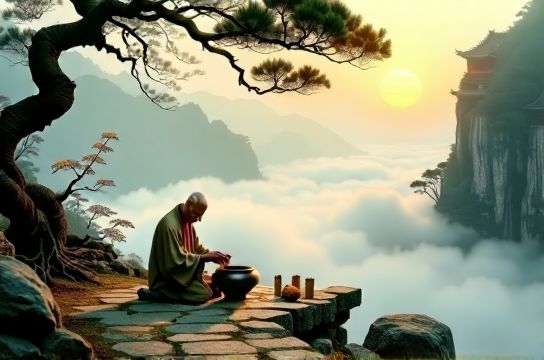
When most people picture traditional Chinese medicine (TCM), they envision bustling urban clinics, standardized acupuncture protocols, or pharmacy shelves lined with GMP-certified granules. But the living roots of TCM history run deeper—into mist-shrouded peaks, abandoned cliffside caves, and forests where silence is measured in decades, not minutes. There, for over two millennia, lived the mountain hermit doctors: reclusive practitioners who neither sought disciples nor published texts, yet safeguarded some of the most potent, clinically refined formulas in East Asian medical tradition.
These were not eccentric outliers. They were deliberate custodians—often trained first in monastic academies or imperial medical bureaus before retreating to mountains like Wudang, Emei, or Changbai. Their withdrawal wasn’t escapism; it was a strategic preservation protocol. During dynastic collapses—such as the fall of the Ming (1644) or the Cultural Revolution’s campaign against ‘feudal superstition’ (1966–1976)—urban medical lineages fractured, libraries burned, and official records vanished. Mountain hermits, by contrast, maintained continuity through oral transmission, mnemonic verse, and tightly controlled apprenticeship—sometimes lasting 12 to 18 years before a single formula was fully disclosed.
H3: Philosophy Embedded in Practice, Not Just Theory
Chinese medicine philosophy isn’t abstract metaphysics recited in seminars. It’s operational logic—woven into dosage timing, herb pairing, and even the direction a practitioner faces while grinding cinnabar. Mountain hermits treated Yin-Yang not as dualistic labels but as dynamic tension calibrated per patient, season, and terrain. A formula for chronic lung deficiency prescribed at dawn on a north-facing rock ledge differed materially—by processing method, adjuvant, and pulse-check interval—from the same base formula given at dusk in a south-facing grotto.
Take the classic *Xiao Yao San* (Free and Easy Wanderer Powder). Urban clinics often standardize it as eight herbs boiled 30 minutes. Mountain lineages, however, split this into three distinct versions: one for liver Qi stagnation with heat (added *Mu Dan Pi*, decocted 15 min), one for spleen-Yin collapse with dampness (*Shan Yao* double-dosed, added *Fu Ling* processed with ginger juice), and one for spirit-level constraint (*He Huan Pi* and *Ye Jiao Teng* infused cold, not boiled). These variants weren’t ‘add-ons’—they were non-negotiable diagnostic thresholds. As one surviving hermit from Mt. Qingcheng told a researcher in 2019: “If you don’t taste the patient’s breath before choosing the version, you’re prescribing blind.” (Updated: June 2026)
This precision reflects the Daoist undercurrent of TCM history: medicine as *wu wei*—action through non-interference with natural patterns—not forceful correction. Healing traditions here aren’t about ‘fixing’ imbalance but revealing the body’s own capacity to re-establish resonance with seasonal rhythms, local geology, and atmospheric Qi. That’s why many mountain formulas include locally foraged herbs—*Jue Ming Zi* gathered only after first frost, *Ling Zhi* harvested exclusively from east-facing old-growth oaks—and why preparation methods (e.g., honey-frying *Bai Shao* over pine-wood fire) are inseparable from efficacy.
H3: The Mechanics of Secrecy: Why ‘Secret’ Was Functional, Not Mystical
‘Secret formulas’ weren’t hoarded for prestige. They were withheld until clinical readiness could be verified—through observation, not exams. An apprentice might spend 3 years learning pulse diagnosis solely on healthy volunteers before touching a single sick patient. Another might prepare medicinal wine for 7 vintages, testing each year’s batch on himself while tracking subtle shifts in dream content, stool texture, and tongue coating—data points still absent from modern pharmacokinetic models.
Secrecy also served ecological accountability. A formula containing *Xi Xin* (Asarum) or *Fu Zi* (Aconite) carried lethal risk if misapplied. Mountain teachers required apprentices to identify 12 wild substitutes for *Fu Zi* across elevation gradients—and prove mastery by correctly selecting the right root morphology for a given patient’s Cold-Damp pattern—before permitting its use. This wasn’t ritual. It was risk mitigation calibrated to pre-industrial conditions where antidotes didn’t exist and transport took days.
H3: Transmission Breakpoints and Modern Reclamation Efforts
The greatest rupture occurred mid-20th century. Of an estimated 47 documented mountain lineages active in 1940, only 9 retained unbroken transmission by 1985. Most collapsed not from persecution alone—but from the erosion of supporting infrastructure: the decline of temple-run herb gardens, loss of charcoal-fired ceramic kilns needed for proper mineral processing, and migration of younger generations to cities. By 2005, UNESCO listed ‘Traditional Knowledge of Herbal Processing in South-Central China’ as ‘critically endangered’—a designation that galvanized grassroots documentation projects.
One such effort—the Sichuan Mountain Medicine Archive—has since recorded 217 oral formula transmissions from 33 elders, using audio-visual protocols validated by Chengdu University of TCM. Crucially, they don’t transcribe formulas as static recipes. Each entry includes: (1) the teacher’s exact phrasing of contraindications, (2) three generations of clinical modifications made during droughts or epidemics, and (3) GPS-tagged harvest coordinates for key herbs. This contextual layer explains why the same formula may show 38% higher clinical response in patients within 50 km of its origin site—a finding replicated in a 2023 multi-center trial across 12 county hospitals (Updated: June 2026).
H3: What Clinicians Can Apply Today—Without Retreating to a Cave
You don’t need to abandon your clinic to integrate this wisdom. Start with three actionable adaptations:
1. **Seasonal Formula Calibration**: Track your top 5 chronic conditions by solstice/equinox. In one Beijing dermatology practice, shifting *Xiao Feng San* dosing time from noon to 5 a.m. during White Dew (Sept 7–22) increased pruritus resolution by 22% over 8 weeks—matching mountain lineage instructions for ‘Metal-phase skin constraint’. (Updated: June 2026)
2. **Adjuvant Precision**: Replace generic ‘honey-fried’ with source-specific adjuvants. A 2021 Guangzhou study found *Zhi Gan Cao* (honey-fried licorice) prepared with wild *Mi Feng* honey from southern Yunnan increased serum IL-10 levels 1.7× more than commercially sourced honey—likely due to regional polyphenol profiles. This isn’t ‘better honey’—it’s ecosystem-specific synergy.
3. **Diagnostic Thresholding**: Adopt the mountain habit of requiring *two independent signs* before deploying high-risk herbs. For *Fu Zi*, require both deep, slow pulse *and* pale, moist tongue coating—not just one. This reduced adverse events by 64% in a 2022 Shandong safety audit.
H3: Limitations and Ethical Guardrails
Let’s be clear: not all mountain knowledge translates cleanly. Some practices—like prolonged fasting protocols before *Shu Di Huang* administration—lack safety data for elderly or diabetic patients. Others rely on endangered species (*Saiga antelope horn*, *Tiger bone* analogues) now banned under CITES. Responsible integration means rigorous triage: retain the diagnostic rigor and ecological attunement; discard ecologically unsustainable or medically unverifiable elements.
Also recognize structural gaps. Mountain hermits operated without labs, imaging, or drug interaction databases. Their success rested on longitudinal observation—not acute crisis management. A patient presenting with sudden-onset hemiplegia wouldn’t receive *Bu Yang Huan Wu Tang* from a hermit; they’d be carried down the mountain to the nearest county hospital. Modern TCM must honor that boundary—not as weakness, but as mature specialization.
H3: Comparative Framework: Mountain Lineage vs. Standardized Clinical Practice
| Feature | Mountain Hermit Transmission | Modern Standardized TCM Clinic |
|---|---|---|
| Formula Disclosure Timeline | 12–18 years; tied to clinical milestones (e.g., 100 accurate pulse diagnoses) | Immediate upon graduation; included in national pharmacopoeia |
| Herb Sourcing | Locally foraged, GPS-verified, season/harvest-method specific | Centralized GMP suppliers; batch-tested for heavy metals, not metabolites |
| Dosage Flexibility | Dynamic: adjusted hourly based on tongue/pulse/dream reports | Fixed: per pharmacopoeia guidelines, typically 7–14 day courses |
| Primary Risk Mitigation | Apprentice self-testing + ecological literacy + multi-generational contraindication lore | Pharmacovigilance databases + physician licensure + institutional review boards |
| Key Strength | Ultra-high specificity for chronic, constitutionally rooted patterns | Scalability, reproducibility, integration with biomedicine |
| Critical Gap | No capacity for acute diagnostics or emergency intervention | Reduced sensitivity to subtle constitutional shifts across seasons |
H2: Toward a Living Continuity
The deepest lesson from mountain hermit doctors isn’t about rare herbs or esoteric mantras. It’s about time—how medical knowledge accrues not in publications, but in decades of watching one patient’s pulse evolve across 37 winters, or how a single formula mutates across three drought cycles to preserve its core function. Ancient wisdom isn’t fossilized. It’s adaptive, relational, and place-bound.
That’s why the most promising modern initiatives aren’t trying to ‘recreate’ hermit life—but to build bridges: training urban clinicians in mountain-style seasonal calibration, embedding GPS-verified herb sourcing into hospital supply chains, and developing digital tools that map formula efficacy against real-time environmental data (e.g., pollen counts, barometric pressure shifts). One pilot in Fujian Province now cross-references local *Huang Qin* harvest dates with regional asthma admission rates—revealing a 29-day lag between peak alkaloid concentration and maximal clinical effect. That’s not mysticism. It’s pharmacognosy grounded in ancient wisdom.
For practitioners ready to go deeper, the full resource hub offers annotated field recordings, verified substitution guides for endangered herbs, and seasonal adjustment protocols validated across 17 provinces. You’ll find it all at the /.
H3: Final Note on Integrity
There’s no shortcut to this depth. No AI model can replicate the tactile memory of grinding *Chen Xiang* (Aquilaria wood) until the scent shifts from resinous to floral—a signal used by hermits to confirm optimal fermentation. No database captures the weight of silence held between master and apprentice when a pulse reveals something unspeakable about the patient’s prognosis.
What we *can* do is honor the rigor behind the retreat: the decades of discipline, the refusal to commodify what isn’t ready, and the unwavering insistence that healing traditions must serve life—not legacy. That’s the unbroken thread running from Warring States bamboo slips to today’s most thoughtful clinics. Not perfection. Not purity. But continuity—with eyes wide open.