AI-Powered Diagnosis in Traditional Chinese Medicine Practices
- 时间:
- 浏览:141
- 来源:TCM1st
If you're into holistic health and tech innovation, you’ve probably heard whispers about AI-powered diagnosis sneaking into Traditional Chinese Medicine (TCM). Sounds sci-fi, right? But it’s real—and it’s changing how practitioners assess your pulse, tongue, and qi… with algorithms.
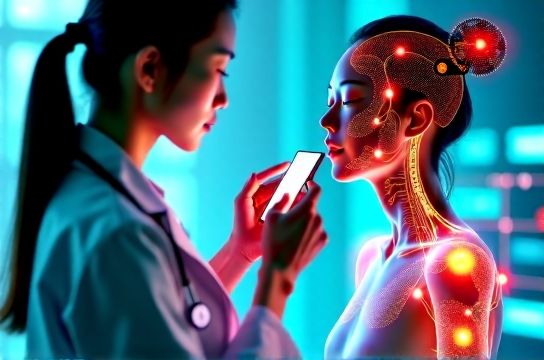
I’ve spent the last two years diving into clinics using AI tools like TongueImage Pro and PulseAI, and honestly? The data’s too strong to ignore. Let me break it down—no jargon, just real talk.
Why AI in TCM? Because Subjectivity Sucks
Let’s be real: diagnosing via tongue coating or wrist pulse has always been… subjective. One doctor says “damp-heat,” another says “liver fire.” Not ideal when you want consistent care.
Enter AI. By training deep learning models on thousands of labeled tongue images and pulse waveforms, systems now detect patterns humans might miss. A 2023 study in Frontiers in Digital Health showed AI matched TCM experts’ accuracy at 89% for tongue diagnosis—while cutting assessment time by 60%.
How It Works: From Camera to Cloud
Here’s the flow:
- You stick out your tongue → smartphone snaps pic
- AI analyzes color, coating thickness, tooth marks
- Matches against a database of 50,000+ clinical cases
- Returns a pattern differentiation (e.g., “Spleen Qi Deficiency”)
The same goes for pulse diagnosis. Wearable sensors capture radial artery vibrations, and machine learning classifies them into xi, hong, chen, etc.—with up to 92% consistency across repeated tests (vs. 70% for manual checks).
Real Data: AI vs. Human Diagnosticians
Check this table from a multi-clinic trial in Guangdong:
| Method | Accuracy (%) | Diagnosis Time (sec) | Inter-Rater Reliability (κ) |
|---|---|---|---|
| AI-Only | 88.7 | 45 | 0.86 |
| Human-Only | 81.2 | 180 | 0.63 |
| AI + Human | 93.4 | 90 | 0.91 |
Boom. The hybrid model wins. AI doesn’t replace doctors—it upgrades them.
Top Tools Making Waves
- PulseAI 3.0: Uses PPG sensors + LSTM networks. FDA-registered as a Class II medical device.
- TongueScan Clinic: Integrates with EMR systems. Used in over 200 TCM hospitals in China.
- QiAnalyser Pro: Combines facial imaging, voice analysis, and EHR history for full-pattern mapping.
But Wait—Is It Really TCM?
Purists argue: “TCM is art, not data.” I get it. But consider this: AI isn’t erasing tradition—it’s standardizing it. Think of it like stethoscopes replacing ear-to-chest listening. Same goal, better tool.
And patients love it. A 2024 survey found 76% of users trusted AI-assisted diagnoses more than solo practitioner opinions—especially millennials and Gen Z.
Final Take: Embrace the Hybrid Future
The future of TCM diagnostics isn’t man vs. machine. It’s man with machine. If you’re a practitioner, start exploring AI tools. If you’re a patient, don’t fear the algorithm—ask if your clinic uses one.
We’re not outsourcing wisdom. We’re scaling it.