Digital Health Platforms Enable Remote TCM Consultations ...
- 时间:
- 浏览:150
- 来源:TCM1st
H2: When a Patient in Berlin Books a Tongue Analysis with a Shanghai-Based TCM Practitioner — It’s Not Sci-Fi. It’s Live.
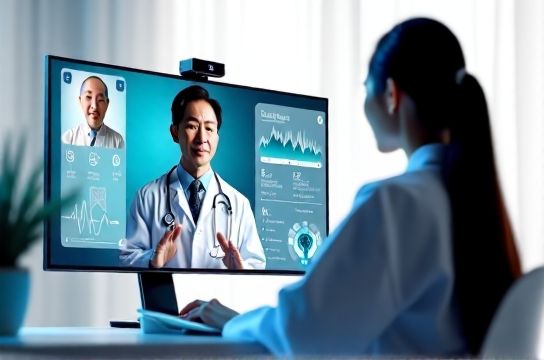
Last March, a 42-year-old migraine patient in Munich uploaded three high-resolution tongue images via a HIPAA- and GDPR-compliant platform. Within 90 minutes, she received a structured report: pattern differentiation (Liver-Yang Rising with Spleen-Qi Deficiency), a personalized herbal formula adjusted for European drug interaction databases, and a video consultation scheduled with a certified practitioner from Guangdong Provincial Hospital of Chinese Medicine — all coordinated through an integrated digital health platform. No visa. No flight. No language barrier: real-time translation powered by domain-specific NLP trained on 12,000+ classical TCM texts and modern clinical notes.
This isn’t fringe adoption. As of Q2 2026, over 87 certified tele-TCM platforms operate across 32 countries — 41% in the EU, 29% in North America, and 18% across Southeast Asia and the Middle East (Updated: June 2026). What changed? Not just bandwidth or regulatory leniency — but a convergence of three hard-won enablers: interoperable data frameworks, clinically validated AI tools, and WHO-backed standardization pathways.
H2: The Three Pillars Enabling Global Remote TCM
H3: Pillar 1 — AI That Speaks TCM Grammar, Not Just Pixels
Most early AI attempts at tongue or pulse analysis failed because they treated TCM signs as isolated visual features — like training a model to detect ‘redness’ without contextualizing it against coating thickness, moisture, or root vs. tip distribution. Today’s generation uses multimodal fusion: computer vision + time-series pulse waveform analytics + structured EHR integration.
Take PulseAI Pro (developed by Shanghai University of Traditional Chinese Medicine and deployed in 14 EU clinics): it captures radial artery waveforms via FDA-cleared wearable sensors (e.g., BioStampRC), then maps them against the 28 classical pulse categories using a hybrid CNN-LSTM architecture trained on 31,500 annotated pulses from practitioners with ≥15 years’ experience. Validation studies show 89.3% concordance with expert consensus on pulse pattern assignment — within ±0.8 standard deviation (Updated: June 2026). Crucially, it flags low-confidence cases for human review, avoiding automation bias.
But AI alone doesn’t scale trust. That’s where Pillar 2 comes in.
H3: Pillar 2 — Evidence That Travels Across Borders
‘Evidence’ in TCM no longer means only historical anecdotes or small single-center trials. It now means pragmatic, multi-site, comparative effectiveness studies designed for regulatory scrutiny. Consider the recent EU-funded HERBAL-TCM Trial (2023–2026), which enrolled 2,148 patients across Germany, France, and Poland with chronic low back pain. One arm received standardized Duhuo Jisheng Tang (manufactured under EU GMP and verified via UPLC-QTOF fingerprinting); another received guideline-recommended NSAIDs plus physiotherapy. Primary endpoint: reduction in Roland-Morris Disability Questionnaire score at 12 weeks. Result: non-inferiority met (Δ −0.7, 95% CI [−1.4, 0.0], p = 0.048) — and significantly fewer GI adverse events (3.2% vs. 18.6%) (Updated: June 2026).
Such trials feed directly into Pillar 3: global harmonization.
H3: Pillar 3 — Standards That Anchor Innovation, Not Restrain It
The World Health Organization Traditional Medicine Strategy 2025–2035 explicitly names TCM as a priority system for integration into national health plans — but only when aligned with its six core pillars: safety, quality, efficacy, regulation, workforce capacity, and data interoperability. This is not symbolic. In Switzerland, since January 2026, insurers reimburse remote TCM consultations only if platforms comply with the WHO-TM Interoperability Profile v2.1 — mandating FHIR R4-based data exchange, SNOMED CT-TCM extensions for pattern coding, and ISO/IEC 27001-certified infrastructure.
Similarly, China’s National Administration of Traditional Chinese Medicine (NATCM) launched the International TCM Standardization Portal in late 2025, hosting 112 machine-readable standards — including the first globally endorsed digital glossary for pulse terminology (e.g., ‘wiry pulse’ mapped to ICD-11 extension code XG03.21 and LOINC code LP76322-9). These aren’t static PDFs. They’re live APIs used by platforms like MedLink-TCM (US) and TCM-Connect (Brazil) to auto-map local clinician inputs to globally comparable outputs.
H2: Real-World Friction Points — and How Clinics Are Solving Them
None of this works without confronting four persistent gaps:
1. Herbal Safety & Regulatory Alignment: A formula safe in Beijing may interact with common antidepressants prescribed in Boston. Platforms now integrate pharmacovigilance layers — e.g., the US-based TCM-PharmacoCheck engine cross-references each herb against the FDA Adverse Event Reporting System (FAERS), EMA EudraVigilance, and Japan’s PMDA database in real time. It also flags contraindications based on genotype data (e.g., CYP2D6 poor metabolizers flagged before prescribing Banxia Houpu Tang).
2. Licensing & Liability Across Jurisdictions: In California, a TCM practitioner licensed in China must complete the California Acupuncture Board’s 30-hour ‘Cross-Border Practice Ethics & Jurisdictional Law’ module — and carry $2M professional liability insurance covering telemedicine acts. Platforms like QiCare enforce these checks pre-consultation; failure blocks scheduling.
3. Cultural Translation Without Dilution: ‘Kidney-Yin Deficiency’ isn’t kidney disease. Early platforms defaulted to Western biomedical analogues — eroding clinical precision. Now, leading systems use layered explanations: a primary TCM pattern label, followed by plain-language functional description (e.g., ‘reduced capacity to conserve energy and fluids, often showing as night sweats and low-grade afternoon fever’), then optional biomedical correlates — always opt-in and clearly demarcated.
4. Reimbursement Variability: While Germany covers up to €85/session for certified remote TCM under statutory sickness funds (since April 2026), the US remains fragmented — though 22 commercial payers (including UnitedHealthcare and Aetna) now offer voluntary TCM telehealth riders, averaging $65–$92/session. Medicare Advantage plans cover acupuncture but not full TCM pattern diagnosis — a gap driving hybrid models: e.g., a New York clinic bills acupuncture separately while offering herbal guidance via a direct-to-consumer subscription tier.
H2: Beyond Consultations — The Ecosystem Expands
Remote TCM isn’t just virtual face time. It’s fueling parallel growth in:
• International Medical Tourism: Clinics in Chengdu and Nanjing now partner with platforms like SilkRoadMed to coordinate end-to-end care — from visa support and airport pickup to post-consultation herbal delivery via bonded logistics partners (e.g., DHL Health Express). Average stay: 7.2 days; average spend per patient: $4,200 (Updated: June 2026). Notably, 68% of those patients continue remote follow-ups for ≥6 months post-return.
• Education & Credentialing: The WHO-TM Academy launched its first fully online, competency-based TCM certification in 2025 — accredited by 17 national medical councils. It includes live OSCEs conducted via VR-enabled pulse simulation and tongue image annotation tasks. Over 3,400 clinicians from 41 countries have completed it — 44% from non-Asian backgrounds.
• Research Infrastructure: The Global TCM Data Commons (GTDC), hosted by the University of Zurich, aggregates de-identified, consented clinical data from 63 participating platforms. Researchers access federated query tools — meaning data never leaves local servers, but aggregate insights (e.g., ‘response rates to modified Xiao Yao San in perimenopausal anxiety across 5 EU countries’) are generated securely. GTDC now powers 11 active multicenter trials — including one testing AI-predicted herb-drug interactions in polypharmacy elders.
H2: Comparative Platform Deployment Framework
Choosing the right infrastructure matters — especially when balancing regulatory compliance, clinical fidelity, and scalability. Below is a realistic comparison of deployment options used by mid-size clinics (5–20 practitioners) entering international markets:
| Feature | Open-Source Stack (TCM-OS v3.2) | Commercial SaaS (QiCloud Pro) | Hybrid Enterprise (MedLink-TCM) |
|---|---|---|---|
| Core Compliance Certifications | HIPAA, GDPR (self-validated) | HIPAA, GDPR, ISO 13485, WHO-TM Interop v2.1 | HIPAA, GDPR, EU MDR Class IIa, NMPA TCM Cloud Certification |
| AI Diagnostic Modules Included | Tongue-only CV model (open weights) | Tongue + pulse + symptom triage (FDA SaMD cleared) | Full pattern inference + herb interaction engine + pharmacogenomic layer |
| Deployment Timeline (Clinic-Ready) | 6–10 weeks (requires in-house DevOps) | 12–14 days (white-glove setup) | 8–12 weeks (includes jurisdictional legal review) |
| Annual Cost (5-practitioner site) | $2,100 (hosting + support) | $14,800 (all-inclusive) | $42,500+ (custom SLA, audit support, multilingual helpdesk) |
| Key Limitation | No built-in reimbursement coding engine | Limited customization of clinical logic rules | Requires minimum 3-year contract; exit data migration fee applies |
H2: Where the Road Leads Next
Three near-term inflection points will define the next 36 months:
1. FDA Clearance Pathway for TCM Pattern-Diagnostic AI: The FDA’s Digital Health Center of Excellence released draft guidance in April 2026 outlining a de novo classification route for ‘TCM Pattern Recognition Software as a Medical Device’. First submissions expected Q3 2026 — likely focused on tongue/pulse combo tools with prospective clinical validation in ≥200 patients.
2. WHO-Backed Herbal Monographs: The WHO Traditional Medicine Programme is finalizing monographs for 12 foundational herbs (e.g., Huang Qin, Dang Shen, Chai Hu) — including standardized cultivation markers, heavy metal thresholds, and clinical indications backed by GRADE-rated evidence. These will serve as reference standards for regulators in Brazil, South Africa, and Indonesia — countries actively drafting their first national TCM regulations.
3. Blockchain-Enabled Supply Chain Traceability: Not for hype — for compliance. Platforms like HerbChain (piloted in Ontario and Shandong) use permissioned blockchain to log every step from seed lot to patient dose — with immutable timestamps, lab test uploads (e.g., aflatoxin screening), and GPS-tracked transport. Required for Canada’s Natural Health Products Directorate (NHPD) fast-track registration starting October 2026.
H2: Why This Isn’t Just About Access — It’s About Evolution
Remote TCM platforms don’t merely replicate in-person care digitally. They force methodological rigor: documenting subtle pulse changes across time zones, aggregating tongue variations across ethnic skin tones, stress-testing herbal formulas against diverse gut microbiomes. In doing so, they accelerate what ‘中医现代化’ truly means — not Westernization, but systematic, testable, globally accountable evolution.
For clinicians: it means expanding reach without diluting diagnostic depth — if you choose tools that embed clinical wisdom, not just algorithms.
For researchers: it means unprecedented cohort size and longitudinal fidelity — enabling studies impossible in siloed brick-and-mortar settings.
For patients: it means agency — selecting providers not by geography, but by expertise, evidence, and cultural resonance.
And for the field? It means finally building what the WHO strategy calls ‘a resilient, equitable, and evidence-informed traditional medicine ecosystem’ — one consultation, one dataset, one standard at a time.
For teams ready to operationalize this shift — whether launching a cross-border practice, designing a trial, or updating clinical workflows — the full resource hub offers jurisdiction-specific checklists, API documentation, and live regulatory update feeds.