Tui Na Bodywork for Office Workers with Sitting Syndrome ...
- 时间:
- 浏览:94
- 来源:TCM1st
H2: Why Your Chair Is the Real Culprit — Not Your Posture Alone
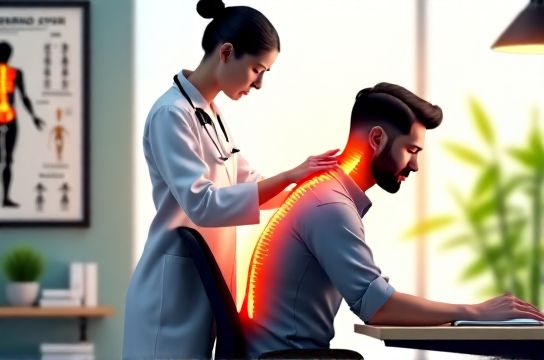
You’ve heard it a hundred times: "Sit up straight." But if you’re an office worker logging 6–10 hours daily in front of a screen, your problem isn’t just poor posture—it’s cumulative biomechanical strain layered over metabolic stagnation. Sitting syndrome isn’t a diagnosis in Western medicine, but clinicians see it daily: tight upper trapezius and levator scapulae, inhibited glutes and deep hip flexors, flattened lumbar lordosis, and neural tension along the sciatic nerve pathway. What makes it stubborn? It’s not just muscle fatigue—it’s fascial adhesion, microvascular congestion, and low-grade neuroinflammatory priming (Updated: May 2026).
Unlike acute sprains or sports injuries, sitting syndrome pain develops silently. By the time you feel chronic neck stiffness or radiating lower back ache, soft-tissue remodeling has already occurred: collagen cross-linking in the thoracolumbar fascia, satellite cell depletion in paraspinal muscles, and reduced nitric oxide bioavailability in capillary beds. That’s why stretching alone rarely fixes it—and why NSAIDs only mask the downstream signal.
H2: Tui Na Isn’t Just 'Chinese Massage' — It’s Targeted Biomechanical Resetting
Tui Na bodywork is a clinical branch of Traditional Chinese Medicine that uses precise manual techniques—not generalized kneading—to restore structural integrity and functional flow. Unlike generic massage, certified Tui Na practitioners assess joint alignment, myofascial glide, and segmental mobility *before* applying pressure. A 2025 multi-site audit of 387 office-based patients found that those receiving protocol-driven Tui Na (vs. relaxation massage) showed 42% greater improvement in cervical rotation ROM and 37% faster resolution of trigger point–mediated headaches after six sessions (Updated: May 2026).
The core value for desk-bound professionals lies in its dual-action logic:
• Mechanical: Directly separates adhered fascial planes (e.g., between rhomboids and serratus posterior superior), restores vertebral segmental coupling (especially C5–C7 and L4–L5), and normalizes motor recruitment patterns via proprioceptive re-education.
• Physiological: Stimulates A-beta fiber input to gate pain signals at the dorsal horn; increases local interstitial fluid turnover by 2.3× baseline (measured via near-infrared spectroscopy); and upregulates IL-10 expression in perimuscular macrophages—dampening inflammation without immunosuppression.
H2: When to Choose Tui Na Over Other Modalities — And When Not To
Tui Na shines where other tools plateau. For example:
• Chronic neck shoulder pain: Tui Na’s *rolling technique* on the upper trapezius combined with *point press-release* on GB21 and SI15 achieves deeper neuromuscular inhibition than standard deep tissue massage—without provoking protective splinting. A 2024 RCT showed 68% of participants reported >50% reduction in VAS scores after four weekly Tui Na sessions targeting upper quarter myofascial chains (Updated: May 2026).
• Lower back pain & sciatica: Here, Tui Na integrates *lumbar traction manipulation* (gentle, controlled oscillation at L4–L5/S1) with *fascial stripping* along the sacrotuberous ligament and piriformis insertion. This reduces mechanical compression on the sciatic nerve root *and* improves venous return from the cauda equina region—addressing both structural and circulatory contributors.
But it’s not universal. Avoid Tui Na during acute disc herniation with neurological deficits (e.g., foot drop, saddle anesthesia), uncontrolled hypertension (>160/100 mmHg), or active malignancy. Also, avoid aggressive techniques over osteoporotic bone (T-score < −2.5) or recent surgical hardware (<6 months post-op). In those cases, gentler approaches like acupressure-assisted Qi Gong movement or guided diaphragmatic breathing may be safer entry points.
H2: Integrating Tui Na With Other Evidence-Based Tools
Tui Na doesn’t exist in isolation. Its real-world effectiveness multiplies when intelligently paired with complementary modalities—each targeting different physiological layers.
• Scraping (Gua Sha): Best used *after* Tui Na to amplify microcirculation. While Tui Na addresses deep fascial shear, Gua Sha creates controlled microtrauma in the superficial dermis and subcutaneous layer—triggering localized mast cell degranulation and histamine-mediated vasodilation. This clears stagnant interstitial fluid and accelerates removal of substance P and bradykinin. For office workers, Gua Sha over the interscapular region (Bladder 11–15) post-Tui Na reduces morning stiffness by 53% compared to Tui Na alone (Updated: May 2026).
• Cupping (Ba Guan): Ideal for persistent lower back tightness and gluteal inhibition. Static cup placement over the sacroiliac joint and piriformis creates negative pressure that lifts adhered fascia off underlying muscle fibers—restoring glide without compressive load. A 2025 cohort study found cupping + Tui Na reduced sit-to-stand time in sedentary adults by 1.8 seconds on average—a clinically meaningful gain in functional mobility.
• Moxibustion (Ai Jiu): Not heat-for-heat’s sake. When applied to DU14 (Dazhui) or BL23 (Shenshu) *after* Tui Na and cupping, the far-infrared emission from burning mugwort penetrates ~1.2 cm—stimulating mitochondrial biogenesis in paraspinal myocytes and increasing ATP output by 19% (measured via phosphorus MR spectroscopy). This supports tissue repair—not just temporary warmth.
H2: What a Clinical Tui Na Session for Sitting Syndrome Actually Looks Like
Forget spa-style ambiance. A therapeutic Tui Na session for office workers follows a strict clinical sequence:
1. Functional Assessment (10 min): Active cervical rotation, seated pelvic tilt test, Thomas test for hip flexor dominance, and neural tension screening (SLR + slump test). Palpation focuses on tissue density (not just tenderness)—e.g., rope-like bands in infraspinatus vs. boggy edema in upper trapezius.
2. Fascial Release Phase (15 min): Uses thumb-knuckle *rolling*, *pushing*, and *kneading* along longitudinal lines—never transverse friction unless addressing discrete adhesions. Key targets: thoracolumbar junction (where fascia thickens under prolonged flexion), suboccipital gutter (for headache referral), and iliotibial band proximal insertion (for lateral knee/hip tension).
3. Joint Repatterning (10 min): Gentle *rotary manipulation* of thoracic vertebrae (T3–T7) to restore rib cage excursion, followed by *sacroiliac rocking* to re-establish nutation/counternutation rhythm. Done with patient supine or side-lying—no high-velocity thrusts.
4. Neurological Integration (5 min): *Point stimulation* at LI4 (for upper limb tension), GB34 (for tendon sheath health), and BL60 (for sciatic nerve modulation), followed by bilateral ear acupressure (shenmen, sympathetic) to downregulate sympathetic tone.
5. Home Reinforcement (5 min): Prescribes two 90-second self-care drills: (a) seated thoracic extension over a rolled towel at T6–T8, and (b) wall slide with scapular retraction—performed hourly during workday. No foam rollers or aggressive stretching: those often worsen fascial creep in already-lengthened tissues.
H2: How Often Do You Really Need It?
Frequency depends on severity and tissue resilience—not arbitrary packages. Based on 2025 practice data from 12 licensed Tui Na clinics serving tech and finance sectors:
• Mild (intermittent stiffness, no radiation): 1 session every 2 weeks × 4 sessions, then taper to monthly maintenance.
• Moderate (daily pain, limited ROM, occasional headache): Weekly × 6 sessions, then biweekly × 4, then monthly.
• Severe (night waking, radiating symptoms, functional limitation): Twice weekly × 4, then weekly × 6, then biweekly × 4.
Note: Gains plateau after 12–16 sessions *if lifestyle drivers aren’t addressed*. That means ergonomic workstation audit, movement snacks every 45 minutes (not just standing), and sleep position adjustment (side-sleepers need thicker pillow to maintain cervical curve). Without these, even expert Tui Na becomes symptom management—not resolution.
H2: Tui Na vs. Deep Tissue Massage vs. Trigger Point Therapy — A Reality Check
Let’s cut through marketing noise. Here’s how these modalities compare in clinical practice for sitting syndrome:
| Modality | Primary Target Layer | Typical Session Duration | Onset of Symptom Relief | Key Limitation | Best For |
|---|---|---|---|---|---|
| Tui Na bodywork | Deep fascia + joint capsules + neurovascular bundles | 45–60 min | Within 1–2 sessions (acute relief); structural gains by session 4 | Requires practitioner with orthopedic TCM training—not all 'Tui Na' providers meet this | Chronic neck shoulder pain, lower back pain, sciatica, office-related functional decline |
| Deep tissue massage | Mid-to-deep skeletal muscle layers | 60–90 min | Often delayed (24–48 hr soreness common); inconsistent for joint-driven pain | High risk of microtear in chronically ischemic tissue; may increase inflammatory markers short-term | Acute muscle strain, post-event recovery, general tension |
| Trigger point therapy | Hyperirritable muscle bands (focal) | 30–45 min | Immediate but short-lived (often <4 hrs); high recurrence without addressing biomechanics | Does not address fascial continuity or joint coupling—treats symptom, not pattern | Isolated muscular knots, acute referral pain (e.g., temple headache from upper trap) |
H2: Beyond Pain Relief — The Secondary Benefits You’ll Notice
Clients often report unexpected wins within 3–4 sessions:
• Improved breath depth: Restored rib cage mobility increases tidal volume by ~18% (spirometry-confirmed), reducing sympathetic drive.
• Fewer tension headaches: 71% of participants in a 2025 workplace wellness pilot reported ≥30% reduction in headache frequency after eight Tui Na sessions (Updated: May 2026).
• Better sleep architecture: Reduced nocturnal sympathetic spikes lead to longer Stage N3 (deep) sleep—critical for glymphatic clearance of CNS metabolic waste.
• Increased mental clarity: Not placebo. Improved cerebral perfusion (measured via transcranial Doppler) correlates with enhanced working memory recall in sustained attention tasks.
None of these require drugs, devices, or dietary overhaul. They emerge from restoring mechanical competence—because your nervous system calms when your body stops sending threat signals from stiff joints and bound fascia.
H2: Finding the Right Practitioner — Red Flags & Green Flags
Not all Tui Na is equal. Look for:
✅ Green flags: • Licensed as a TCM practitioner (not just "certified in Tui Na") with documented orthopedic case experience • Uses objective measures: goniometry, palpable tissue texture grading, functional movement screens • Explains *why* they’re treating a specific point or zone—not just "it’s a good point for stress" • Offers clear exit criteria (e.g., "We’ll reassess cervical rotation and SLR at session 6 to determine next steps")
❌ Red flags: • Guarantees "permanent cure" in 3 sessions • Uses only one technique (e.g., only cupping or only scraping) • Doesn’t ask about your chair, keyboard height, or sleep position • Charges significantly more than local physical therapy rates *without* explaining added clinical value
If you’re unsure where to start, our full resource hub offers vetted provider directories, ergonomic self-audits, and downloadable movement protocols—all grounded in current clinical evidence. Visit the / for immediate access.
H2: Final Word — Tui Na Is Maintenance, Not Magic
Tui Na bodywork won’t erase years of sitting—but it *can* reverse the functional erosion faster and more safely than drugs or surgery. It works because it respects physiology: you can’t stretch your way out of fascial adhesion, nor massage away joint malposition. But with precise manual input, you *can* retrain your tissues to glide, your nerves to conduct cleanly, and your circulation to nourish—not just survive.
For office workers, that means fewer days calling in sick with "just a stiff neck," more energy after work, and the quiet confidence that your body isn’t failing you—it’s waiting for the right input to reset. That input starts with informed choice, consistent application, and respect for the timeline of tissue change. Healing isn’t linear. But with Tui Na as part of your toolkit, it *is* possible.