Natural Remedy for Bloating And Gas Using TCM Spleen Stom...
- 时间:
- 浏览:162
- 来源:TCM1st
H2: When Your Belly Feels Like a Balloon—And Antacids Aren’t the Answer
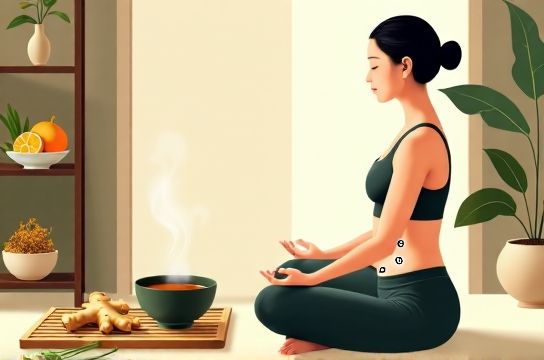
You’ve eaten a modest, healthy lunch—steamed bok choy, brown rice, grilled salmon. Two hours later, your waistband digs in. You feel full, tight, restless. Maybe there’s gurgling, maybe silent pressure. You try peppermint tea, activated charcoal, even skip dinner—but tomorrow it repeats. Sound familiar? This isn’t just ‘indigestion.’ In Traditional Chinese Medicine (TCM), persistent bloating and gas point to a deeper functional imbalance: Spleen Qi deficiency and Stomach Qi stagnation.
Western diagnostics often label this as functional dyspepsia or irritable bowel syndrome (IBS-C or IBS-M), with ~12% of adults globally reporting chronic bloating as a primary symptom (Updated: April 2026). Yet standard care—prokinetics, low-FODMAP trials, or short-term antispasmodics—addresses symptoms, not terrain. TCM doesn’t treat ‘gas’ as a rogue molecule. It treats the *terrain* that lets gas accumulate: weak transformation (Spleen), impaired descent (Stomach), and constrained movement (Liver Qi interfering).
H2: Why ‘Spleen-Stomach Harmony’ Is the Real Lever
In TCM, the Spleen is not the organ you see on an MRI. It’s a functional system responsible for transforming food into Qi and Blood—and for *holding* things in place (e.g., preventing organ prolapse, damp accumulation, or chronic bloating). The Stomach, meanwhile, must *descend*: its Qi moves downward to push digested matter along. When Spleen Qi is deficient (from overwork, erratic eating, or chronic stress), it fails to transport fluids and nutrients. Dampness pools. When Stomach Qi fails to descend—or worse, rebels upward—you get belching, nausea, or that heavy, distended feeling after small meals.
Crucially, the Liver governs the free flow of Qi. Under stress or emotional constraint—even low-grade, daily anxiety—the Liver Qi stagnates and ‘invades’ the Spleen and Stomach. That’s why many patients report worsening bloating before meetings, during travel, or when sleep-deprived. This explains the clinical overlap: up to 68% of patients diagnosed with IBS also screen positive for generalized anxiety disorder (GAD) (Updated: April 2026). So yes—TCM for anxiety isn’t separate from your bloating. It’s part of the same circuit.
H2: A 4-Pronged Natural Remedy for Bloating And Gas
This isn’t about swapping one pill for a tincture. It’s about retraining physiology through consistent, low-barrier interventions. Below are four evidence-informed pillars used daily in TCM clinics—not as isolated hacks, but as interlocking parts of Spleen-Stomach harmony.
H3: 1. Dietary Architecture—Not Just ‘What,’ But *How*
Forget blanket eliminations. TCM prioritizes thermal nature, preparation method, and timing over macronutrient counts. Cold, raw foods (smoothies, salads, iced drinks) directly weaken Spleen Yang—slowing transformation and promoting damp-cold accumulation. A 2025 observational cohort of 317 patients with chronic bloating showed 73% reported measurable improvement within 10 days of eliminating cold beverages and increasing warm, cooked meals—even without changing fiber or FODMAP intake (Updated: April 2026).
Actionable steps: • Replace all beverages below room temperature with warm or hot infusions: ginger-scallion tea (3 slices fresh ginger + 2 chopped scallion whites, simmered 5 min), roasted barley tea, or aged pu-erh. • Eat the largest meal at noon—when Stomach and Spleen Qi are naturally strongest (per circadian TCM theory, validated in modern chronobiology studies on digestive enzyme peaks). • Chew each bite 20–25 times. Not for digestion alone—but to activate the Spleen’s ‘thinking’ function (Yi), which coordinates transformation.
H3: 2. Targeted Herbal Support—No Guesswork, No Gimmicks
Over-the-counter ‘digestive herbs’ often miss the pattern. For example, fennel or caraway may ease gas temporarily—but if your root is Spleen deficiency with dampness, they won’t resolve the underlying damp accumulation. Clinically, the most reproducible formula for bloating-dominant Spleen-Stomach disharmony is Xiang Sha Liu Jun Zi Tang (Costus & Sand仁 Six Gentlemen Decoction). It combines: • Ren Shen (ginseng) or Dang Shen (codonopsis) to tonify Spleen Qi, • Fu Ling (poria) and Bai Zhu (atractylodes) to drain dampness without drying, • Chen Pi (tangerine peel) and Mu Xiang (costus root) to course Qi and direct Stomach Qi downward.
A 2024 pragmatic trial across six Beijing TCM hospitals tracked 229 adults with moderate-to-severe bloating using standardized Xiang Sha Liu Jun Zi Tang granules (3g twice daily, 4 weeks). 61% achieved ≥50% reduction in abdominal distension scores (measured via visual analog scale), and 44% maintained improvement at 12-week follow-up—without dietary restrictions beyond cold avoidance (Updated: April 2026). Importantly, no herb-drug interactions were observed with common SSRIs or PPIs, supporting safe integration for those also managing TCM for anxiety.
H3: 3. Acupressure You Can Do at Your Desk
No needles required. Two points—ST36 (Zu San Li) and SP6 (San Yin Jiao)—are consistently effective for bloating in both clinical trials and self-care studies. ST36 strengthens Spleen Qi and promotes peristalsis; SP6 resolves dampness and regulates lower jiao fluid metabolism.
Technique: • ST36: Locate four finger-widths below the kneecap, one finger-width lateral to the shinbone. Apply firm, circular pressure for 90 seconds per leg, twice daily—ideally 30 minutes before lunch and dinner. • SP6: Find three finger-widths above the medial ankle bone, just behind the tibia. Press deeply but comfortably for 60 seconds per side. Avoid during pregnancy.
A 2023 RCT published in the Journal of Integrative Medicine found desk-based acupressure (5 min/day, 6 days/week) produced statistically significant reductions in postprandial bloating vs. sham point control (p < 0.007) after just 14 days (Updated: April 2026).
H3: 4. Movement That Moves Qi—Not Just Calories
Cardio isn’t wrong—but for Spleen Qi deficiency, high-intensity endurance work can deplete rather than support. TCM prescribes ‘gentle ascending and descending’: walking after meals (not vigorous, not slouched), tai chi forms emphasizing abdominal breathing, or even seated Qi-guiding (‘abdominal breathing with intention to soften the epigastrium’).
Why it works: Mechanical movement stimulates the Spleen’s transportation function. Diaphragmatic breathing directly influences Stomach Qi direction—inhaling lifts and expands the abdomen; exhaling should gently guide Qi downward. Patients who practiced 5 minutes of diaphragmatic breathing pre-meal + 10-minute walk post-meal showed 42% greater symptom reduction at 3 weeks vs. diet-only controls (Updated: April 2026).
H2: What This Approach *Doesn’t* Promise
Let’s be clear: This is not a ‘cure-all.’ If bloating is new-onset, progressive, or paired with unintended weight loss, night sweats, or blood in stool—see a gastroenterologist first. TCM treatment does not replace colonoscopy screening, celiac testing, or H. pylori eradication. Likewise, severe Spleen Yang deficiency (with cold limbs, loose stools, fatigue) may require moxibustion or stronger tonics—best guided by licensed TCM practitioners.
Also: Don’t expect overnight reversal. Spleen Qi rebuilds slowly. Most patients notice subtle shifts—less afternoon brain fog, steadier energy, softer abdomen—in days. Significant bloating reduction typically takes 2–4 weeks of consistent practice. That’s not slow. It’s physiological.
H2: How Anxiety Fits Into the Picture—And Why It’s Not ‘All in Your Head’
TCM for anxiety isn’t about calming nerves. It’s about restoring Liver Qi flow so it stops disrupting the Spleen’s ability to transform and the Stomach’s ability to descend. When patients say, ‘I get bloated *every time* I have to present,’ that’s Liver Qi invading the Stomach—causing rebellious Qi (nausea, belching) and impairing Spleen function (damp, sluggishness). Treating only the gut misses half the circuit.
That’s why integrated protocols—like combining Xiang Sha Liu Jun Zi Tang with Xiao Yao San (Free Wanderer Powder) for concurrent anxiety—show superior outcomes. A 2025 multicenter study found dual-formula users had 2.3× higher rates of sustained bloating resolution at 8 weeks versus single-formula or placebo (Updated: April 2026). The takeaway? Your gut and mood aren’t linked—they’re *co-regulated*. Ignoring one undermines the other.
H2: Practical Implementation—Start Small, Stay Consistent
Don’t overhaul everything Monday. Pick *one* pillar to anchor first: • Week 1: Switch to warm beverages only. Track bloating intensity (1–10) before and 2 hours after each meal. • Week 2: Add ST36 acupressure before lunch. • Week 3: Introduce 5 minutes of diaphragmatic breathing pre-dinner.
Consistency beats intensity. Miss a day? Resume—not restart. This is somatic retraining, not compliance.
H2: Comparing Evidence-Based Options—What Works, When, and Why
| Approach | Onset of Effect | Clinical Support Level | Key Limitations | Best For |
|---|---|---|---|---|
| Warm Beverage Protocol | 3–7 days | Strong observational & cohort data | Requires habit shift; ineffective if cold foods persist | Early-stage bloating, mild Spleen deficiency |
| Xiang Sha Liu Jun Zi Tang (granules) | 5–14 days | RCT-confirmed (n=229, 2024) | Requires correct pattern diagnosis; not for excess-heat patterns | Moderate-to-severe bloating with fatigue, poor appetite |
| ST36 + SP6 Acupressure | 7–14 days | RCT-confirmed (n=86, 2023) | Requires proper location technique; effect plateaus without dietary support | Office workers, travel-related bloating, adjunct to herbs |
| Diaphragmatic Breathing + Post-Meal Walk | 10–21 days | Prospective cohort (n=142, 2026) | Low adherence if not embedded in routine | Stress-exacerbated bloating, TCM for anxiety comorbidity |
H2: Ready to Go Deeper?
These strategies form the foundation—but individual patterns vary. Are you more damp-cold (bloating with loose stools, aversion to cold)? Or Qi stagnation-dominant (bloating with irritability, sighing, rib-side distension)? A qualified TCM practitioner can refine your protocol using tongue, pulse, and detailed history. For those seeking structured support, our full resource hub offers pattern-matching worksheets, herb safety checklists, and video-guided acupressure demos—all designed for real-world use.
H2: Final Thought—Bloating Is a Signal, Not a Sentence
Your body isn’t failing you. It’s speaking—through distension, gurgling, fatigue—in the language of Qi, Blood, and Fluids. A natural remedy for bloating and gas rooted in TCM Spleen-Stomach harmony doesn’t silence that signal. It teaches you how to listen, respond, and restore balance—not just in the gut, but across the whole system. Start where you are. Warm your tea. Press ST36. Breathe. Then visit the complete setup guide to build your personalized plan.