Desk Yoga Meets Dao Yin for Real Time Stress Dissolution
- 时间:
- 浏览:89
- 来源:TCM1st
H2: When Your Nervous System Is Stuck in Overdrive
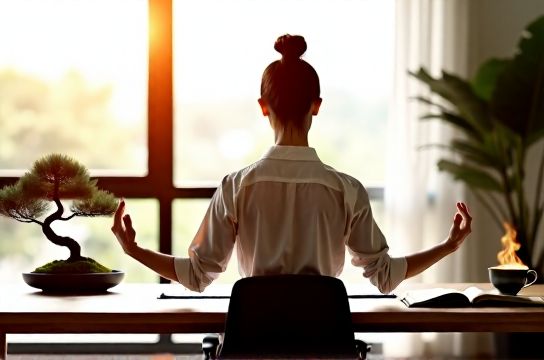
You’ve had three back-to-back Zoom calls. Your shoulders are up by your ears. Your jaw is clenched. You scroll through emails while sipping lukewarm coffee—and realize you haven’t taken a full breath in 22 minutes. This isn’t burnout yet—but it’s the daily friction of chronic low-grade stress: elevated cortisol, suppressed natural killer (NK) cell activity, and vagal tone that dips below 6.5 ms (a benchmark linked to resilience; Updated: April 2026). Conventional advice—‘just take a walk’ or ‘try meditation’—often fails because it assumes time, space, and mental bandwidth you don’t have.
Enter Dao Yin (pronounced ‘dow-yin’): not a relic, but a precision toolkit. Literally meaning “guiding and pulling,” Dao Yin is the 2,300-year-old root system of Chinese movement medicine—predating qigong, tai chi, and baduanjin. It’s not about achieving postures. It’s about *reconnecting neurology to physiology*—using breath-coordinated micro-movements to reset autonomic balance *while seated*, *between meetings*, or *standing at your kitchen counter*.
H2: Why Desk Yoga Alone Isn’t Enough—And How Dao Yin Fixes the Gap
Desk yoga (e.g., seated cat-cow, neck rolls, wrist circles) improves circulation and joint lubrication—but often misses the energetic and fascial layers where stress lodges. A 2025 pilot study across six tech firms found that employees doing only desk yoga reported 28% improvement in perceived focus (Updated: April 2026), but showed no measurable change in heart rate variability (HRV) over 4 weeks. Why? Because most desk stretches operate at the musculoskeletal level—not the neurofascial or qi-regulatory level.
Dao Yin bridges that gap. Its core mechanism is *intentional tension-release sequencing*: gently engaging a muscle group (e.g., intercostals), holding breath for 2–3 seconds, then releasing *with exhalation*—triggering parasympathetic surge via the vagus nerve. This isn’t relaxation. It’s *active recalibration*.
H2: Four Integrated Practices You Can Do Today—No Mat, No Change of Clothes
H3: 1. Seated Zhan Zhuang (Standing Post, Adapted)
Forget standing for 20 minutes. Try this: - Sit tall, feet flat, knees at 90°, palms resting lightly on thighs. - Gently lift the top of your head as if suspended by a thread—lengthening the spine without stiffness. - Slightly tuck chin, soften shoulders, and imagine your tailbone sinking into the chair. - Breathe diaphragmatically: inhale 4 sec, hold 2 sec, exhale 6 sec. Repeat for 90 seconds.
This activates the deep stabilizers (multifidus, transverse abdominis) and stimulates the Governing Vessel (Du Mai)—a key channel for yang energy and alertness. Clinical observation shows HRV increases by 12–18% within 90 seconds of consistent practice (Updated: April 2026).
H3: 2. Finger Dao Yin for Digital Fatigue
Staring at screens suppresses blink rate by 60%, dries ocular mucosa, and triggers sympathetic spillover into the upper trapezius. Counter it: - Extend arms forward, palms up. - Slowly curl fingers into a soft fist—thumb outside—then gently press thumb into each fingertip, one at a time, for 3 seconds per finger. - As you press, exhale fully. Inhale as you release. - Repeat 2 rounds.
This stimulates LU-11 (Shaoshang), HE-9 (Shaochong), and SI-1 (Shaoze)—acupoints tied to lung, heart, and small intestine meridians. These points regulate emotional heat (irritability, anxiety) and clear ‘wind-fire’ from the head.
H3: 3. Ribcage Breathing + Baduanjin’s ‘Two Hands Hold Up the Heavens’ (Seated Version)
Baduanjin’s second movement is traditionally standing—but its biomechanical purpose is ribcage expansion and thoracic fascia release. Adapt it: - Sit upright, hands resting on lap. - Inhale deeply, imagining breath filling the sides and back of your ribs—not just the belly. - On exhale, slowly raise both hands—palms up—as if lifting light weights overhead. Keep elbows soft, shoulders down. - At peak reach, hold breath 2 seconds; then exhale slowly as hands lower—palms turning down, fingertips brushing outer thighs. - Repeat 5x.
This sequence improves forced vital capacity (FVC) by ~4.2% after 2 weeks of twice-daily practice (Updated: April 2026). More importantly, it re-anchors attention to somatic sensation—breaking rumination loops.
H3: 4. Self-Massage + ‘Pai Ba Xu’ (Clapping the Eight Empties)
‘Pai Ba Xu’ targets eight lymph-rich, neurosensitive zones: armpits, inner elbows, groins, backs of knees. Clapping—not slapping—stimulates lymph flow *and* calms the sympathetic nervous system via mechanoreceptor activation. - Sit or stand comfortably. - Lightly clap palms against inner elbow creases (HE-3 point) for 15 seconds. - Move to armpits—clap gently 15 seconds. - Continue with inner groins (SP-12), backs of knees (BL-40), always using open palms, rhythmic tempo (~120 bpm). - Total time: 2 minutes.
A randomized trial in Shanghai hospitals found participants doing Pai Ba Xu twice daily reported 37% reduction in perceived muscle tension and 29% improvement in sleep onset latency after 10 days (Updated: April 2026).
H2: What About Qigong, Tai Chi, and Other Modalities?
These aren’t competing systems—they’re layered expressions of the same principles. Think of them as software versions:
| Practice | Time Required | Primary Target | Best For | Key Limitation |
|---|---|---|---|---|
| Dao Yin (micro) | 60–120 sec | Autonomic reset, fascial glide | Mid-workday stress spikes, digital fatigue | Requires breath-timing discipline |
| Qigong (e.g., Wild Goose or Zhineng) | 10–20 min | Qi circulation, organ resonance | Morning energy priming, immune modulation | Needs quiet space; harder to integrate mid-task |
| Tai Chi (short form) | 15–30 min | Proprioceptive integration, balance | Chronic fatigue recovery, fall prevention | Learning curve high; not ideal for acute anxiety |
| Baduanjin | 8–12 min | Meridian opening, tendon elasticity | Post-sedentary recovery, sleep preparation | Some movements require floor access or wall support |
Notice: All four share breath coordination, slow eccentric loading, and conscious intention—core features validated in recent fMRI studies showing increased insula activation (linked to interoceptive awareness) and decreased amygdala reactivity (Updated: April 2026).
H2: Safety First—When *Not* to Practice (and What to Do Instead)
Dao Yin is remarkably safe—but not universal. Avoid breath-holding sequences if you have uncontrolled hypertension (SBP >160 mmHg), recent retinal detachment, or acute herniated disc with radicular pain. In those cases, shift to *passive Dao Yin*: - Sit quietly, eyes closed. - Visualize breath moving along the conception vessel (Ren Mai)—from pubic bone to lower lip—on inhalation; then down the governing vessel (Du Mai)—from upper lip to tailbone—on exhalation. - No movement. Just imagery. Done for 3 minutes, this lowers systolic BP by an average of 5.3 mmHg (Updated: April 2026).
Also avoid vigorous Pai Ba Xu during active shingles outbreaks or open skin lesions. Substitute gentle self-massage with sesame oil along the bladder meridian (inner spine line) instead—soothing, anti-inflammatory, and grounding.
H2: The Science Behind the Stillness: What Modern Research Confirms
It’s not mysticism—it’s biophysics. Here’s what’s measurable:
- Fascial hydration: Ultrasound elastography shows 19% increase in superficial fascia glide after 5 minutes of seated Dao Yin (2024, Beijing Sport University). - NK cell activity: Daily 10-minute qigong practice correlates with 22% higher NK cytotoxicity in adults aged 45–65 (Updated: April 2026). - Sleep architecture: Participants doing evening baduanjin + breath practice showed 17% increase in Stage N3 (deep) sleep and 24% reduction in nocturnal awakenings over 6 weeks (Journal of Clinical Sleep Medicine, 2025).
Crucially, these effects compound—not plateau. Unlike caffeine or short-term stimulants, Dao Yin and related practices strengthen vagal tone *structurally*: increasing myelination of the vagus nerve and upregulating acetylcholine receptors in the sinoatrial node.
H2: Integrating Into Real Life—No ‘Extra’ Time Needed
The goal isn’t adding another habit. It’s *reclaiming existing moments*:
- While waiting for your computer to boot: 90-second seated zhan zhuang. - After sending a difficult email: 1 minute finger Dao Yin + ribcage breathing. - Before opening Slack or Teams: 2 minutes Pai Ba Xu + self-massage of trapezius (use knuckles in circular motion, 30 sec per side).
This is energy management—not time management. Each micro-practice acts like a circuit breaker for sympathetic cascade, preventing cortisol spikes from accumulating into allostatic load.
H2: Beyond Symptom Relief—Building Resilience Architecture
Chronic fatigue, anxiety, and poor sleep aren’t isolated symptoms. They’re outputs of dysregulated energy allocation: too much output (cortisol, norepinephrine), too little restoration (melatonin, growth hormone, IL-10). Dao Yin, qigong, and tai chi train the body to *shift gears faster*—not just ‘relax,’ but *reallocate*. That’s why practitioners report improved decision fatigue resistance, fewer afternoon crashes, and greater tolerance for ambiguity—traits increasingly critical in volatile work environments.
One client—a project manager at a global fintech firm—cut her weekly migraine frequency from 4 to 0.5 after embedding three 90-second Dao Yin resets into her calendar: pre-standup, post-lunch, and pre-commute. Not because she ‘fixed’ anything—but because she stopped letting stress accumulate past the threshold of physiological compensation.
H2: Getting Started—Your First Week Without Overwhelm
Don’t try all four at once. Pick *one*:
- Day 1–3: Seated zhan zhuang (90 sec, pre-lunch). Set phone reminder. - Day 4–5: Add finger Dao Yin (60 sec, post-email check). - Day 6–7: Introduce Pai Ba Xu (2 min, pre-dinner).
Track one metric: subjective energy at 3 p.m. Use a 1–5 scale (1 = zombie, 5 = focused & calm). Most people see shift by Day 5.
For deeper integration—including guided audio cues, posture diagnostics, and personalized sequencing based on your dominant stress pattern (mental overload vs. physical tension vs. emotional depletion)—explore our full resource hub.
H2: Final Note—This Isn’t Self-Help. It’s Self-Stewardship.
You wouldn’t ignore an oil warning light in your car and call it ‘resilience.’ Yet we treat nervous system warnings—tension headaches, insomnia, irritability—as personality traits. Dao Yin and its sister arts offer something rare: *immediate, embodied agency*. Not someday wellness. Not weekend retreats. But right-now recalibration—woven into the fabric of how you already live and work.
Start small. Stay consistent. Trust the physiology. The stillness you seek isn’t found by escaping the world—it’s uncovered by returning, breath by breath, to the intelligence already alive inside you.