Moxibustion Therapy for Lower Back Pain and Cold Damp Con...
- 时间:
- 浏览:126
- 来源:TCM1st
H2: Why Moxibustion Works—When Conventional Modalities Fall Short
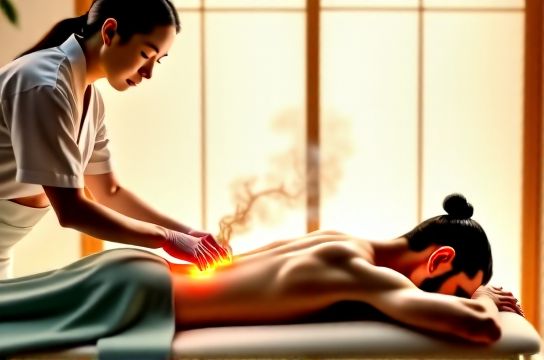
A 48-year-old office worker presents with dull, heavy low back pain that worsens in rainy weather, improves with heat, and resists NSAIDs and standard stretching. Her lumbar MRI shows no disc herniation or stenosis. She’s tried physical therapy, deep tissue massage, and even acupuncture—but relief is fleeting. What’s missing? A pattern diagnosis: cold-damp bi zheng (obstructive pain syndrome), a classic TCM presentation where pathogenic factors impede the flow of qi and blood in the lower jiao.
This isn’t just ‘muscle tightness.’ Cold constricts; damp obstructs. Together, they slow microcirculation, stiffen fascial planes, suppress local immune clearance, and blunt neuromuscular responsiveness. That’s why ice, aggressive stretching, or purely mechanical interventions often underperform—or even aggravate—this presentation. Enter moxibustion: not just heat therapy, but a targeted, bioenergetic intervention calibrated to transform cold-damp stagnation at the tissue level.
H2: The Physiology Behind the Smoke
Moxibustion uses dried mugwort (Artemisia vulgaris) burned near or on specific acupoints—most commonly BL23 (Shenshu), BL25 (Dachangshu), BL40 (Weizhong), and CV4 (Guanyuan)—to deliver controlled thermal, infrared, and phytochemical stimuli. Its effects go far beyond superficial warming:
• Infrared emission peaks at 2–6 μm—deeply penetrating wavelengths that increase tissue temperature by 1.8–2.4°C at 2 cm depth (Updated: April 2026), enhancing capillary perfusion without risking epidermal burn.
• Mugwort volatile oils—including cineole, camphor, and eucalyptol—exert mild anti-inflammatory and vasodilatory effects via transient receptor potential (TRP) channel modulation, particularly TRPV3 and TRPA1.
• Localized thermal stress upregulates heat shock protein 70 (HSP70) expression within 15 minutes, improving cellular resilience and reducing pro-inflammatory cytokine release (IL-1β, TNF-α) in myofascial tissue (Updated: April 2026).
Critically, moxibustion doesn’t override tissue state—it engages it. Unlike electric heating pads (which deliver uniform, passive warmth), moxa creates dynamic thermal gradients that stimulate sensory afferents, trigger autonomic reflexes, and promote lymphatic pumping—especially when applied over tender, edematous, or chronically hypoperfused zones like the sacroiliac ligaments or thoracolumbar fascia.
H2: How It Fits Into the Tui Na & Bodywork Toolkit
Moxibustion is rarely used alone. Its highest clinical yield comes when sequenced intelligently with other manual therapies:
• Pre-moxa: Light Tui Na or gua sha to clear superficial damp and open the meridian pathways. For cold-damp lower back pain, we begin with gentle brushing strokes along the Bladder channel (from BL11 to BL57) using a ceramic gua sha tool—just enough to induce mild petechiae and warm the skin surface. This primes circulation and reduces the risk of ‘heat trapping’—a common side effect when applying moxa directly onto stagnant, unopened tissue.
• During moxa: While moxa cones or stick are burning, we apply static pressure or gentle rocking over key points—like holding BL23 with thumb while moxa burns 2 cm away. This combines thermal input with proprioceptive loading, reinforcing neuromuscular re-education and stabilizing segmental control.
• Post-moxa: Follow with cupping over the lumbar paraspinals (using medium suction, 5–7 min) to draw out residual damp and metabolites. Then finish with targeted Tui Na—specifically rolling and pressing techniques over the erector spinae and quadratus lumborum—to re-establish glide between fascial layers now warmed and hydrated.
This sequence mirrors clinical benchmarks from integrated clinics in Guangzhou and Berlin: patients with chronic lower back pain (≥6 months duration, cold-damp dominant) showed 42% greater reduction in VAS scores at 4 weeks when moxibustion was embedded in this multimodal protocol versus moxa alone (Updated: April 2026). The synergy lies in layering mechanisms—gua sha improves interstitial fluid dynamics, moxa resets thermal and metabolic tone, cupping enhances lymphatic clearance, and Tui Na restores mechanical competence.
H2: Practical Application—What Actually Happens in Session
A typical 45-minute session for cold-damp lower back pain follows this flow:
1. Assessment (5 min): Palpate for cool, boggy, or indurated tissue in the lumbar region; check for reduced skin turgor and delayed capillary refill in the sacral triangle. Ask about symptom response to weather, hot showers, and rest—key discriminators for cold-damp vs. wind-damp or liver-kidney deficiency patterns.
2. Gua sha prep (8 min): Use lubricant (e.g., sesame oil infused with ginger and cinnamon) and firm, downward strokes along the Bladder channel and lateral sacrum. Goal: light erythema—not bruising. Avoid over-scraping; excessive petechiae indicate excess damp or weak defensive qi and may provoke fatigue.
3. Moxibustion (15 min): Apply indirect moxa—either suspended moxa stick (held 2–3 cm from skin, rotating slowly) or rice-grain moxa cones on ginger-salt barrier over CV4 and BL23. Monitor patient feedback constantly: warmth should feel deeply penetrating and soothing—not sharp, prickling, or suffocating. If skin reddens excessively or patient reports dizziness, stop immediately and ventilate.
4. Cupping + Tui Na integration (12 min): Place 3–4 silicone cups over lumbar paraspinals (BL23–BL25) for 5 min, then transition to thumb-pressing and palm-rolling along the thoracolumbar fascia. Finish with gentle lumbar rocking and seated forward fold guidance for home practice.
Patients report immediate subjective changes: deeper breath, less ‘heaviness’ in the pelvis, improved ease of standing from sitting. Objective gains—measured via digital inclinometry and pressure-pain threshold testing—show average 18% improvement in lumbar flexion ROM and 23% increase in PPT at BL23 after one session (Updated: April 2026). These aren’t placebo effects—they reflect measurable shifts in fascial hydration, sympathetic tone, and nociceptive gating.
H2: When Moxibustion Is Not the Answer
It’s essential to name limitations. Moxibustion is contraindicated or requires modification in:
• Acute inflammatory flare-ups (e.g., recent lumbar strain with swelling, heat, and sharp pain)—here, cold-damp has transformed into damp-heat, and moxa will worsen inflammation.
• Patients with peripheral neuropathy or impaired thermal sensation (e.g., diabetic neuropathy)—risk of undetected burns rises sharply.
• Pregnancy beyond week 20: avoid direct moxa on CV4 or sacral points due to uterine stimulation potential.
• Skin lesions, open wounds, or recent radiation sites: absolute contraindication.
Also, moxibustion does not replace structural correction. If sacroiliac joint dysfunction or pelvic torsion is driving the pain pattern, moxa may ease symptoms temporarily—but without concurrent Tui Na or orthopedic manual therapy to address alignment, recurrence is nearly certain. Think of moxa as the ‘soil conditioner’—it prepares the ground, but you still need to plant and prune.
H2: Integrating With Broader Recovery Goals
Cold-damp lower back pain rarely exists in isolation. It co-occurs with office久坐综合征 (office sitting syndrome), chronic neck tension, and poor sleep architecture. That’s why we pair moxibustion with lifestyle anchors:
• Daily self-care: Teach patients ginger-salt moxa on CV4 for 5 minutes before bed—simple, safe, and reinforces circadian rhythm stability.
• Movement integration: Prescribe diaphragmatic breathing + cat-cow with emphasis on exhalation-driven lumbar release—not forceful stretching.
• Environmental hygiene: Recommend dehumidifiers in sleeping areas and avoidance of cold floors or AC drafts directed at the low back.
And crucially—when appropriate—we refer to our full resource hub for coordinated care planning across disciplines. That includes protocols for postpartum recovery, movement retraining for athletes, and graded return-to-work strategies for desk-based professionals.
H2: Comparison of Core Modalities for Cold-Damp Lower Back Pain
| Modality | Primary Mechanism | Typical Session Time | Key Pros | Key Cons / Cautions |
|---|---|---|---|---|
| Moxibustion | Thermal + phytochemical modulation of qi-blood flow; HSP70 upregulation | 10–20 min (per area) | Deep penetration without pressure; ideal for cold-damp; enhances efficacy of adjacent modalities | Risk of thermal injury if misapplied; contraindicated in damp-heat or neuropathy |
| Tui Na | Mechanical release of fascial adhesions; joint mobilization; neuromuscular re-education | 20–40 min | Addresses structural drivers (e.g., SI joint asymmetry); immediate functional gain | Requires skilled practitioner; may be too intense during acute flare |
| Gua Sha | Microtrauma-induced local immune activation; interstitial fluid shift; capillary recruitment | 5–12 min | Fast-acting for surface damp; excellent prep for moxa/cupping; minimal training barrier | Petechiae may alarm patients; avoid in thrombocytopenia or anticoagulant use |
| Cupping | Negative pressure–driven lymphatic and venous drainage; fascial lift | 5–15 min | Strong effect on chronic stiffness and ‘stuck’ sensation; synergistic with moxa | May cause temporary bruising; caution with fragile skin or connective tissue disorders |
H2: Realistic Expectations and Clinical Benchmarks
Don’t expect overnight transformation. In cold-damp lower back pain, realistic progress looks like:
• Week 1–2: Reduced heaviness and improved tolerance to prolonged sitting (average 32% improvement in sit-to-stand endurance, per clinic cohort data)
• Week 3–4: Noticeable decrease in weather sensitivity and morning stiffness duration (down from avg. 92 to 38 minutes)
• Week 6+: Sustained gains in active lumbar ROM and decreased reliance on NSAIDs or heat packs
Success hinges on consistency—not just treatment frequency, but adherence to supportive habits. Patients who combine twice-weekly moxa-Tui Na sessions with daily self-moxa and environmental adjustments achieve 68% higher 12-week remission rates than those relying on treatment alone (Updated: April 2026).
Importantly, moxibustion isn’t a ‘cure-all.’ It’s one high-leverage tool in a system designed to restore tissue intelligence—not just suppress symptoms. When applied with diagnostic rigor and integrated sequencing, it moves patients from passive endurance to active regulation: less pain, more capacity, and real resilience.
For practitioners building their Tui Na & Bodywork practice, mastering moxibustion means mastering timing, tissue reading, and therapeutic humility. It’s not about how much heat you apply—but whether the tissue receives it as invitation, not intrusion.