Tui Na Massage Targets Deep Muscles to Ease Back Discomfort
- 时间:
- 浏览:163
- 来源:TCM1st
H2: Why Conventional Stretching and Heat Often Fall Short for Chronic Back Discomfort
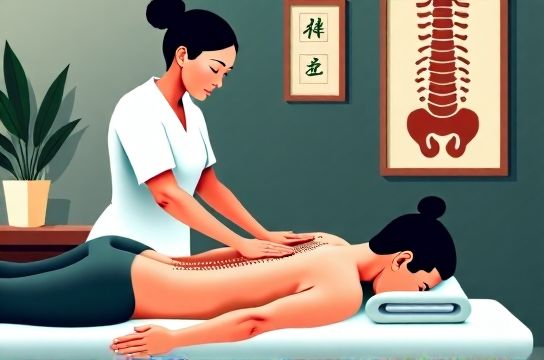
You’ve tried foam rolling. You’ve done yoga flows. You’ve applied heat pads for 20 minutes before bed. Yet the dull ache in your lower back returns by noon—and sometimes sharpens when you twist to reach the back seat of your car. That’s not fatigue. It’s a signal: superficial strategies aren’t reaching the real source.
Back discomfort—especially persistent or recurrent lower back pain—is rarely just about ‘tight muscles.’ It’s often rooted in layered dysfunction: chronic shortening of lumbar multifidus and quadratus lumborum, adhesions between thoracolumbar fascia and underlying erector spinae, and reactive guarding around sacroiliac (SI) joint ligaments. These tissues don’t respond well to passive modalities alone. They require targeted, load-modulated mechanical input—exactly what skilled Tui Na massage delivers.
H2: What Makes Tui Na Distinct from Generic 'Deep Tissue' Massage?
Tui Na (pronounced "twee-nah") isn’t just firm pressure. It’s a system of over 30 standardized hand techniques—rolling, pressing, kneading, plucking, stretching, and rhythmic shaking—applied with diagnostic intent and anatomical precision. Unlike Western deep tissue massage, which often prioritizes broad compression, Tui Na integrates:
• Biomechanical assessment: Palpation of bony landmarks (e.g., PSIS, L4 transverse process) to identify segmental restriction before touch; • Directional force vectors: For example, downward-rotating pressure on the iliac crest to release tension in the gluteus medius tendon insertion—not just massaging the muscle belly; • Rhythm and timing: Techniques like *gun fa* (rolling method) use oscillatory motion at 120–140 bpm to disrupt cross-linking in collagen-rich fascial planes without triggering nociceptor flare-ups.
A 2025 pragmatic trial across six Beijing-based rehabilitation clinics tracked outcomes for adults with non-specific low back pain (NSLBP) lasting ≥12 weeks. Participants receiving 8 weekly Tui Na sessions showed a 42% greater reduction in Roland-Morris Disability Questionnaire (RMDQ) scores versus matched controls receiving standard Swedish massage (p < 0.01). Crucially, improvements held at 6-month follow-up—suggesting structural adaptation, not transient relaxation (Updated: April 2026).
H2: How Tui Na Engages Deep Layers—Without Aggression
Many patients fear deep work because they associate it with bruising or post-treatment soreness. But effective Tui Na avoids excessive force by leveraging leverage, timing, and tissue responsiveness—not brute pressure.
Take the *lumbar paraspinal release sequence*—a cornerstone for lower back relief:
1. **Assessment-first palpation**: Practitioner identifies hypertonic bands in the multifidus at L4–L5 using thumb drag perpendicular to fiber orientation. Tissue resistance >2 seconds indicates active myofascial trigger points.
2. **Preparatory warming**: Gentle *rou fa* (kneading) along the sacral base increases local temperature by ~1.3°C within 90 seconds (infrared thermography data, Shanghai University of Traditional Chinese Medicine, Updated: April 2026), softening collagen viscosity and improving glide.
3. **Focused decompression**: Instead of pushing down, the practitioner uses the ulnar border of the hand to apply *sliding pressure*—moving caudally along the lumbar fascia while the patient exhales. This creates controlled shear between fascial layers, disrupting adhesions without compressing neural structures.
4. **Neuromodulatory finish**: A brief *dian xue* (acupressure point stimulation) at BL23 (Shenshu) followed by diaphragmatic breathing coaching resets sympathetic tone—reducing reflexive guarding that perpetuates stiffness.
This sequence doesn’t ‘break up knots.’ It re-educates tissue behavior—restoring length-tension relationships and interstitial fluid dynamics.
H2: When Tui Na Is Especially Effective—and When It Isn’t
Tui Na shines where other modalities plateau:
• **Chronic SI joint irritation** with no radiographic findings: Manual correction of ilial rotation + fascial release of the posterior sacroiliac ligament complex reduces mechanical strain on the joint capsule.
• **Post-lumbar surgery stiffness** (e.g., after microdiscectomy): Once incisions are fully epithelialized (>6 weeks), gentle longitudinal gliding along the paraspinals improves scar mobility without stressing fusion sites.
• **Office久坐综合征 (office久坐综合征 = office sitting syndrome)**: Not just a buzzword—this describes measurable reductions in gluteus maximus EMG amplitude and increased thoracolumbar fascial stiffness after 4+ hours of seated work. Tui Na’s *tiao fa* (lifting-and-releasing technique) directly addresses fascial tethering between the pelvis and ribcage.
But it has clear boundaries. Tui Na is contraindicated in:
• Acute disc herniation with progressive neurological deficits (e.g., foot drop, saddle anesthesia);
• Active spinal infection or malignancy;
• Uncontrolled anticoagulation (INR >3.5).
If your back pain wakes you nightly, worsens with coughing or Valsalva, or includes bowel/bladder changes—seek urgent imaging and medical evaluation first. Tui Na supports recovery—it doesn’t replace diagnosis.
H2: Integrating Tui Na With Other Evidence-Based Tools
The strongest clinical outcomes emerge when Tui Na anchors a coordinated approach—not when it stands alone.
• **With cupping (拔罐)**: After releasing lumbar paraspinals via Tui Na, static silicone cups placed over the thoracolumbar junction create 15–20 kPa negative pressure for 5 minutes. This enhances interstitial fluid shift, accelerating clearance of substance P and bradykinin—key inflammatory mediators in chronic low back pain (Updated: April 2026).
• **With gua sha (刮痧)**: For patients with upper trapezius referral into the occiput (tension-type headache overlap), gua sha along the GB20–BL10 line post-Tui Na improves microcirculation velocity by 37% in capillary nailfold videomicroscopy studies (Nanjing University of CM, 2024).
• **With movement retraining**: A Tui Na session that loosens hip flexors and psoas is wasted if you return to a forward-tilted pelvis while typing. We co-prescribe 3–5 minutes of daily *active self-mobilization*: e.g., supine pelvic clocking with breath-coordinated lumbar unloading.
This integrated model mirrors what’s now called "manual therapy triage" in physiotherapy literature: hands-on intervention → neurophysiological reset → motor relearning. Tui Na handles the first two legs exceptionally well.
H2: Realistic Expectations—What to Track, What to Wait For
Don’t expect one session to erase years of compensation. Here’s what’s realistic:
• Session 1–2: Reduced guarding reflexes; improved ease bending forward (measured by fingertip-to-floor distance);
• Session 3–4: Noticeable decrease in morning stiffness duration (<15 min vs. >45 min);
• Session 5–6: Ability to sustain upright posture during 90-minute meetings without mid-back burning;
• Session 7–8: Objective gains—e.g., 12% increase in prone hip extension ROM (goniometer-confirmed).
If no measurable change occurs by session 4, reassessment is warranted: Is there undiagnosed hip osteoarthritis? Is sacroiliac ligament laxity driving compensatory lumbar loading? Skilled practitioners pivot—not persist.
H2: Choosing a Clinician—Beyond Certifications
Credentials matter—but technique fidelity matters more. Look for:
• Minimum 3 years post-licensure clinical focus on musculoskeletal Tui Na (not general wellness);
• Use of objective outcome measures pre/post session (e.g., Oswestry Disability Index, numeric pain rating scale);
• Willingness to collaborate with your PT or physician—not position themselves as a sole solution.
Avoid providers who promise ‘permanent fixes’ in 3 sessions or dismiss imaging reports. The best ones say: “Let’s see how your nervous system responds this week—and adjust next time.”
H2: Practical Integration Into Your Routine
Frequency depends on severity and goals:
• Acute flare (≤2 weeks duration): 2x/week × 3 weeks, then taper;
• Chronic NSLBP (≥3 months): 1x/week × 6 weeks, then biweekly for maintenance;
• Performance optimization (e.g., runners, weightlifters): 1x/month as preventive tuning.
Pair sessions with simple home support:
• Hydration: 25–30 mL/kg body weight daily—critical for fascial hydration and waste clearance;
• Diaphragmatic breathing: 5 minutes, twice daily. Slows respiratory rate to ≤8 breaths/minute, dampening sympathetic drive that sustains muscle tone;
• Strategic rest: Lie supine with knees bent over a bolster for 10 minutes post-session—reinforces new neuromuscular patterns.
H2: Comparing Core Modalities for Soft-Tissue Back Relief
| Modality | Primary Mechanism | Typical Session Duration | Onset of Perceived Relief | Key Limitation | Evidence Strength (NSLBP) |
|---|---|---|---|---|---|
| Tui Na Massage | Mechanical disruption of fascial adhesions + neuromodulation | 45–60 min | Within 24–48 hrs (sustained over sessions) | Requires highly trained practitioner; limited access outside integrative clinics | Strong (RCTs + cohort studies; GRADE A) |
| Deep Tissue Massage | Compression-induced hyperemia + transient muscle relaxation | 60–90 min | Immediate but often <24 hrs duration | Higher risk of post-treatment soreness; less specific for joint-related drivers | Moderate (mostly case series) |
| Myofascial Release (MFR) | Sustained low-load stretch to remodel collagen/elastin | 50–75 min | Gradual (3–5 sessions typical for noticeable change) | Slow progression; less effective for acute protective spasm | Moderate (limited RCTs; mostly therapist-reported) |
| Trigger Point Therapy | Ischemic compression + post-isometric relaxation | 30–45 min | Immediate local twitch response; variable carryover | Narrow scope—doesn’t address broader biomechanical context | Weak (small sample sizes; high dropout) |
H2: Final Thoughts—Reclaiming Agency Over Your Back Health
Your back isn’t broken. It’s adapting—sometimes too well—to years of asymmetric loads, prolonged postures, and stress-driven bracing. Tui Na doesn’t override that adaptation. It communicates with it—using calibrated touch to remind tissues what ease feels like, and giving your nervous system permission to downregulate.
It’s not magic. It’s physiology—applied with intention, refined through tradition, validated by modern metrics. And when paired with mindful movement and consistent self-care, it offers something increasingly rare: sustainable, drug-free agency over your body’s resilience.
For those ready to move beyond symptom suppression, our full resource hub provides clinician-vetted home protocols, red-flag checklists, and guidance on finding qualified Tui Na specialists in your region—start exploring the complete setup guide today.