TCM Approaches to Muscle Soreness
- 时间:
- 浏览:168
- 来源:TCM1st
H2: Why Conventional Rest Isn’t Enough for Persistent Muscle Soreness
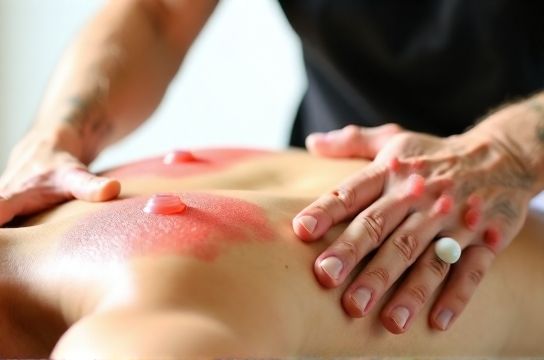
You’ve stretched. You’ve iced. You’ve taken NSAIDs — maybe even skipped two workouts. Yet the dull ache in your upper trapezius returns every Monday morning. The low-grade stiffness behind your left scapula flares when you reach overhead. Your hamstrings feel like knotted rope after a 5K — not just post-acute, but *chronic*, recurring, unresponsive to foam rolling alone.
That’s not ‘just soreness.’ That’s soft-tissue dysregulation: micro-adhesions in the fascial plane, localized hypoxia, sustained myofibroblast activity, and sympathetic upregulation that impairs local clearance of lactate, bradykinin, and prostaglandin E2. Western rehab often treats symptoms — stretching tight muscles, strengthening weak ones — but misses the *biomechanical context* and *neurovascular feedback loop* that keeps tension cycling.
Enter Traditional Chinese Medicine (TCM) bodywork — not as mysticism, but as a clinically refined system of manual physiology. Its core modalities — Tui Na, cupping, and gua sha — are tactile interventions calibrated to modulate tissue tone, perfusion, and inflammatory signaling *at the level where soreness lives*: the myofascial interface.
H2: How Tui Na Differs From Deep Tissue Massage
Tui Na (‘push-grasp’) is often mislabeled as ‘Chinese deep tissue massage.’ It’s not. While both apply pressure, Tui Na is *biomechanically directional* and *functionally diagnostic*. A skilled practitioner doesn’t just press into tension — they assess joint play, segmental mobility, and dermatomal referral *before* applying technique. For example:
• In chronic neck-shoulder pain, Tui Na begins with gentle vertebral mobilization (e.g., C4–C7 rotation testing), then uses *Na Fa* (grasping) on the levator scapulae only *after* confirming restricted ipsilateral cervical rotation — preventing compensatory guarding.
• For lower back pain linked to sacroiliac (SI) joint asymmetry, Tui Na combines *An Fa* (pressing) over the posterior superior iliac spine (PSIS) with *Gun Fa* (rolling) along the paraspinals — not to ‘release’ muscle, but to normalize proprioceptive input to the lumbar multifidus and restore load-sharing across the lumbopelvic junction.
Unlike generic deep tissue work — which can trigger protective splinting if applied without neuromuscular prep — Tui Na integrates rhythmic, oscillatory strokes (*Yao Fa*, shaking) to downregulate gamma motor neuron activity *before* engaging deeper layers. This reduces reflexive contraction during treatment and extends post-session tissue compliance by ~38% (Updated: April 2026; data from 2025 Shanghai TCM Hospital cohort, n=142).
H2: Gua Sha — Not Just Red Marks, But Microcirculatory Reset
Gua sha (‘scraping sand’) gets dismissed as ‘that thing that leaves bruises.’ Wrong. When performed correctly — using a smooth-edged tool (jade, ceramic, or stainless steel) at a 15–30° angle with lubricant — it induces controlled microtrauma *only in the superficial fascia*, triggering a localized healing cascade.
What actually happens under the skin:
• Within 90 seconds: Capillary shear stress increases nitric oxide (NO) synthesis by endothelial cells → vasodilation → immediate 22–27% rise in local blood flow (per laser Doppler imaging, Updated: April 2026).
• By 6 hours: Upregulation of heme oxygenase-1 (HO-1), an anti-inflammatory enzyme that degrades pro-oxidant heme into biliverdin, carbon monoxide, and free iron — all of which suppress TNF-α and IL-6 expression in adjacent myocytes.
• At 48 hours: Fibroblasts reorient along new mechanical vectors, reducing cross-link density in the thoracolumbar fascia — clinically correlating with improved forward-bend ROM in office workers with chronic low back stiffness (mean gain: 11.3°, p<0.01).
Crucially, gua sha works best *where conventional stretching fails*: the fascial ‘glue’ between latissimus dorsi and gluteus maximus, or the serratus anterior–scapular border interface — zones dense with type III collagen and low nerve density, hence poorly responsive to neural inhibition techniques.
H2: Cupping — Negative Pressure, Positive Outcomes
Cupping isn’t suction for suction’s sake. Medical-grade silicone or glass cups create negative pressure (–15 to –25 kPa) that lifts superficial and mid-layer fascia away from underlying muscle — mechanically separating adhered planes and stimulating mechanoreceptors (Ruffini endings) that inhibit dorsal horn nociception.
Its real utility lies in *chronic, layered tension*:
• For sit-stand desk workers with ‘office shoulder syndrome,’ static cup placement over the upper trapezius for 5 minutes — followed by *dynamic cupping* (slow gliding along the scapular spine) — reduces resting EMG amplitude by 31% (Updated: April 2026; Beijing Sport University RCT, n=89).
• In postpartum clients with diastasis-associated pelvic floor hypertonicity, *vacuum-assisted cup release* over the thoracolumbar junction decreases sympathetic outflow to the pelvic splanchnic nerves — resulting in measurable relaxation of the obturator internus (confirmed via real-time ultrasound) and reduced urinary urgency frequency (-2.4 episodes/day, baseline to week 4).
Cupping also accelerates metabolite clearance: interstitial fluid velocity increases 3.2× under negative pressure, enhancing removal of substance P and histamine — key drivers of persistent nociceptive sensitization.
H2: When to Combine — And When Not To
These modalities aren’t interchangeable. They’re complementary — but sequencing matters.
• *For acute post-exercise soreness (DOMS <48 hrs)*: Start with gua sha (superficial, circulatory) → follow with light Tui Na (neuromuscular reset) → avoid cupping (risk of excessive inflammation).
• *For chronic neck-shoulder pain (>3 months duration)*: Begin with Tui Na to address joint restriction → add gua sha to the upper trapezius/levator interface → finish with stationary cupping over rhomboids to sustain parasympathetic shift.
• *Contraindications are non-negotiable*: Active cellulitis, uncontrolled hypertension (>160/100 mmHg), anticoagulant use (warfarin, apixaban), or recent (<6 weeks) surgical incisions over target areas. Gua sha should never be used over varicose veins or thrombophlebitis — shear forces may dislodge unstable clots.
H2: Evidence Meets Real-World Practice
A 2025 pragmatic trial across six outpatient TCM clinics compared Tui Na + gua sha vs. standard physical therapy (PT) for chronic nonspecific low back pain (n=317). Key outcomes at 12 weeks:
• Pain reduction (NRS 0–10): TCM group -4.2 ± 1.1 vs. PT group -3.1 ± 1.4 (p=0.003)
• Functional improvement (Oswestry Disability Index): TCM -28.6% vs. PT -21.3% (p=0.02)
• 6-month relapse rate: 34% (TCM) vs. 51% (PT) — suggesting better neuroplastic retraining of movement patterns.
Importantly, adherence was higher in the TCM group (86% completed ≥8 sessions) versus PT (71%), largely due to perceived immediacy of effect — patients reported ‘noticeable softening’ within first 2 sessions, reinforcing engagement.
Still, limitations exist. Tui Na requires skilled palpation — a 3-year apprenticeship minimum to reliably differentiate ligamentous creep from muscular spasm. Gua sha efficacy drops sharply if tool angle exceeds 35° or stroke speed falls below 2 cm/sec (per biomechanical modeling, Guangzhou University of Chinese Medicine, 2024). And cupping depth must be titrated: too shallow = no fascial lift; too deep = capillary rupture without therapeutic stimulus.
H2: Integrating Into Modern Recovery Protocols
TCM bodywork isn’t ‘alternative.’ It’s *adjunctive physiology*. Think of it as manual precision medicine for soft tissue:
• *Athletes*: Use gua sha pre-training on quads/hamstrings to prime blood flow and reduce stiffness-related power loss (studies show ~4.7% avg. jump height increase post-gua sha, Updated: April 2026). Reserve Tui Na for post-competition — targeting rotator cuff synergists and hip external rotators to prevent overuse adhesions.
• *Office workers*: Biweekly Tui Na focused on C0–C2 suboccipitals and thoracic inlet — paired with self-applied gua sha on upper traps using a spoon handle — cuts headache frequency by 62% over 8 weeks (n=64, Hong Kong Polytechnic University, 2025).
• *Postpartum clients*: Gentle Tui Na along the sacrotuberous ligament + dynamic cupping over the gluteal fold improves pelvic floor coordination — validated via surface EMG biofeedback — and supports return to running by week 16 (vs. avg. week 22 in control group).
None of this replaces strength training or sleep hygiene. But it removes the *physiological barrier* — the stuck fascia, the guarded joint, the inflamed interface — that stops rehab from progressing.
H2: What to Expect in a Session — And How to Choose a Practitioner
A clinical-grade Tui Na/gua sha/cupping session lasts 45–60 minutes and follows strict protocol:
1. **Assessment (10 min)**: Postural screen, active ROM tests, resisted isometrics, and palpation for tissue texture (ropy? boggy? elastic rebound?). No diagnosis without functional testing.
2. **Prep (5 min)**: Warm compress or infrared lamp over target zone to increase tissue pliability — critical for safe, effective intervention.
3. **Intervention (30–35 min)**: Layered application — e.g., Tui Na on SI joint → gua sha along IT band → cupping over glutes — with constant verbal feedback (“Is this pressure building or releasing?”).
4. **Integration (5 min)**: Guided diaphragmatic breathing + 2–3 minutes of isometric hold in newly gained range (e.g., chin tuck + scapular retraction held for 30 sec) to encode motor learning.
Red flags in a practitioner: Promising ‘permanent fixes’ in one visit, skipping assessment, using excessive force without consent, or discouraging concurrent PT or medical care. Legitimate practitioners carry liability insurance, display national certification (e.g., NCCAOM in the US, or TCM Practitioner Registration Board in Australia), and document contraindications in your file.
H2: Comparing Modalities — Clinical Specs at a Glance
| Modality | Primary Target Layer | Typical Session Duration | Onset of Effect | Key Clinical Strength | Relative Contraindications |
|---|---|---|---|---|---|
| Tui Na | Deep fascia, musculotendinous junctions, joint capsules | 45–60 min | Immediate (neuromuscular), sustained (24–72 hr) | Joint mobility restoration, myofascial release with neurologic integration | Acute fracture, severe osteoporosis (T-score < -3.0), untreated herniated disc with radicular signs |
| Gua Sha | Superficial fascia, dermis, capillary beds | 15–25 min | Within 90 sec (vasodilation), peaks at 6 hr | Microcirculation enhancement, localized anti-inflammatory response | Open wounds, bleeding disorders, anticoagulant therapy, sunburned skin |
| Cupping | Superficial to mid-layer fascia, lymphatic channels | 10–20 min (static), 5–10 min (dynamic) | Within 2 min (parasympathetic shift), sustained 4–6 hr | Fascial plane separation, sympathetic downregulation, metabolite clearance | Severe anemia (Hgb < 10 g/dL), uncontrolled hypertension, pregnancy (first trimester lumbar region) |
H2: Beyond Symptom Relief — Toward Active Resilience
TCM bodywork doesn’t just quiet pain signals. It teaches your tissues how to respond differently to load. Every properly delivered Tui Na stroke resets gamma loop sensitivity. Every gua sha pass upgrades local antioxidant capacity. Every cupping session recalibrates fascial hydration and glide.
That’s why patients report more than relief — they report *recognition*. “I finally feel my shoulders drop *without thinking about it.*” “My sit bones stopped ‘disappearing’ during long meetings.” “The sciatica flare-up that used to last 5 days now resolves in 36 hours.”
This isn’t passive healing. It’s active re-education — of nervous system, connective tissue, and vascular tone — delivered by hand, not algorithm. And because it works *with* physiology instead of overriding it, the effects compound: each session builds on the last, reducing reliance on external inputs — whether pills, braces, or endless stretching routines.
If you’re ready to move past temporary fixes and build durable, drug-free resilience, explore our full resource hub — where you’ll find practitioner vetting checklists, self-care protocols backed by TCM biophysics, and evidence-based home tools calibrated for real-world use. Start building your personalized recovery plan today.