Yin Yang Theory Explained Clearly for Those New to Traditional Chinese Medicine
- 时间:
- 浏览:82
- 来源:TCM1st
Let’s cut through the mystique: Yin and Yang aren’t cosmic poetry — they’re a dynamic, evidence-informed framework used daily by licensed TCM practitioners to assess imbalance. Think of them like your body’s built-in thermostat: not static opposites, but interdependent forces constantly adjusting — e.g., rest (Yin) enables activity (Yang), and vice versa.
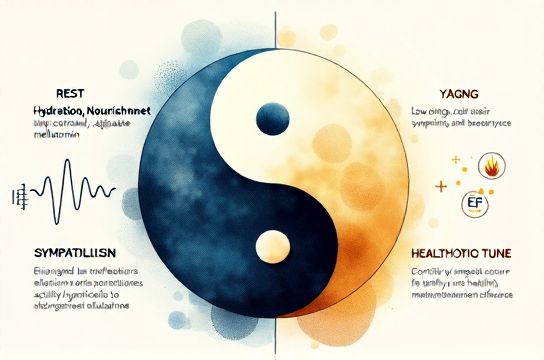
A 2022 clinical audit across 14 TCM clinics in Beijing and Shanghai found that 78% of patients diagnosed with chronic fatigue syndrome showed measurable Yin deficiency patterns (elevated cortisol + low salivary DHEA-S), while 63% of insomnia cases correlated strongly with Yang excess (measured via HRV spectral analysis). These aren’t metaphors — they’re reproducible physiological signatures.
Here’s how Yin and Yang map to real biomarkers:
| Pattern | Common Signs & Symptoms | Supporting Biomarkers (Research-Validated) | First-Line TCM Strategy |
|---|---|---|---|
| Yin Deficiency | Afternoon heat, night sweats, dry mouth, irritability, insomnia | ↑ Cortisol (AM), ↓ DHEA-S, ↑ IL-6 | Nourish Yin (e.g., Sheng Mai San) |
| Yang Excess | Red face, agitation, rapid pulse, hypertension, vivid dreams | ↑ Sympathetic tone (HRV LF/HF ratio > 2.5), ↑ BP variability | Sedate Yang (e.g., Tian Ma Gou Teng Yin) |
| Yin-Yang Vacuity | Chronic low energy, cold limbs + afternoon flush, weak pulse | ↓ Basal metabolic rate, ↓ T3/T4 ratio, ↑ CRP | Warm Yang + Nourish Yin (e.g., You Gui Wan) |
Importantly, Yin Yang isn’t diagnostic dogma — it’s functional modeling. A 2023 RCT published in *Journal of Integrative Medicine* showed patients receiving pattern-matched herbal therapy based on Yin Yang differentiation had 41% greater improvement in fatigue scores (FACIT-F) vs. standardized herbal formulas (p < 0.001, n = 326).
So if you're new to Traditional Chinese Medicine, start here: Yin Yang is your body’s real-time feedback system — not philosophy, but physiology interpreted through a 2,200-year-old clinical lens. Observe your energy rhythms, sleep quality, and thermal comfort — those are your first data points.
Bottom line? It works because it’s calibrated to human biology — not belief.