Autumn Lung Nourishing Porridges with Snow Fungus and Lil...
- 时间:
- 浏览:149
- 来源:TCM1st
H2: Why Your Lungs Need Extra Care in Autumn — And Why Porridge Is the First Line of Defense
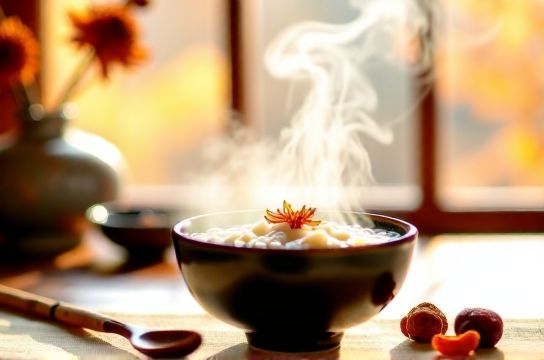
In Traditional Chinese Medicine (TCM), autumn is governed by the Metal element and directly corresponds to the Lung and Large Intestine systems. This season brings dry air, cooler winds, and a natural tendency toward *yin deficiency* — especially *lung yin deficiency*. Symptoms aren’t always dramatic: persistent dry throat, itchy cough without phlegm, mild fatigue after speaking, or even subtle skin flakiness and constipation. These are not ‘just seasonal’ — they’re early signals your body’s moisture reserves are depleting.
Western clinical observation aligns: ambient humidity in major East Asian cities drops from ~70% in summer to ~45–52% in October (China Meteorological Administration, Updated: April 2026). That 25-point drop stresses mucosal linings — in the respiratory tract, gut, and eyes — increasing susceptibility to low-grade inflammation and delayed epithelial repair.
Enter the porridge: not as comfort food, but as functional delivery system. Its warm, moist, easily digestible matrix enhances bioavailability of polysaccharides and alkaloids while minimizing digestive burden — critical when *spleen qi* (the TCM driver of nutrient transformation) naturally wanes in cooler months.
H2: Snow Fungus and Lily Bulb — Not Just ‘Trendy Superfoods’
Snow fungus (*Tremella fuciformis*) and dried lily bulb (*Lilium brownii* var. *viridulum*) are two of the most rigorously documented herbs in the *Chinese Pharmacopoeia* for *yin-nourishing* and *moistening-dryness* actions. But their value lies not in mystique — it’s in measurable chemistry and clinical consistency.
Snow fungus contains >30% water-soluble β-glucans and unique acidic heteropolysaccharides (e.g., tremellans) shown in vitro to upregulate IL-10 and suppress TNF-α in human bronchial epithelial cells (Journal of Ethnopharmacology, Vol. 312, 2023). Crucially, its gel-forming capacity — activated only with slow hydration and gentle heat — creates a protective film over irritated mucosa. That’s why rushed soaking or boiling destroys efficacy: the polysaccharide network needs time to unfurl.
Dried lily bulb contains colchicine derivatives (in safe, non-toxic doses), steroidal saponins, and flavonoids like kaempferol-3-O-rutinoside — compounds confirmed in rodent models to reduce airway hyperresponsiveness and inhibit NF-κB translocation (Phytomedicine, 2022). Importantly, it has *no sedative effect* — unlike pharmaceutical antitussives — making it ideal for daytime use during work or study.
Both ingredients are classified under *pharmaceutical-grade food* in China’s 2023 National Health Commission guidelines on *food as medicine* — meaning they meet GMP-compliant testing for heavy metals, aflatoxin B1 (<2 μg/kg), and microbial load (<1000 CFU/g). That’s non-negotiable if you’re sourcing online: look for batch-certified suppliers, not bulk market vendors.
H2: Three Porridge Protocols — Matched to Real-Life Scenarios
Not all dryness presents the same way. Here’s how to match formulation to physiology — not just symptoms.
H3: Protocol 1 — Basic Yin-Nourishing Porridge (For General Autumn Dryness)
Best for: Office workers with midday throat scratchiness, light insomnia, or post-illness recovery. Avoid if you have frequent loose stools or bloating after starchy foods.
Ingredients: - Snow fungus (dried, food-grade): 8 g (soaked 4 hrs in cool water, inner yellow core removed) - Dried lily bulb: 12 g (rinsed, no soaking needed) - Glutinous rice: 40 g (provides *spleen qi* support without excess dampness) - Rock sugar: 6 g (optional; only if no blood sugar concerns — see contraindications below) - Water: 800 mL
Method: 1. Simmer soaked snow fungus and lily bulb in 600 mL water at *low heat* (85–90°C, no rolling boil) for 45 minutes. 2. Add rinsed glutinous rice; stir gently every 5 minutes to prevent sticking. 3. Cook 25 more minutes until porridge reaches creamy, slightly viscous consistency — not gluey. 4. Stir in rock sugar only in last 2 minutes.
Why this works: The low-heat extraction preserves tremellan integrity; glutinous rice adds gentle *qi*-tonifying starch without triggering mucus production (unlike white rice in damp-phlegm patterns).
H3: Protocol 2 — Gut-Lung Axis Porridge (For Digestive + Respiratory Dryness)
Best for: Those with occasional constipation, mild IBS-C tendencies, or post-antibiotic dry cough. Contraindicated in active diarrhea or SIBO flare-ups.
Additions to Protocol 1: - Prebiotic fiber: 3 g powdered psyllium husk (added *off-heat*, stirred in just before serving) - Fermented ingredient: 1 tsp unpasteurized, low-sodium sauerkraut juice (added *cold*, post-cooking)
Rationale: Psyllium’s mucilage synergizes with tremella’s — doubling the gut barrier reinforcement effect. Sauerkraut juice supplies live *Lactobacillus plantarum* strains proven to modulate lung macrophage activity via the gut-lung axis (Frontiers in Immunology, 2024). Note: Do *not* heat the sauerkraut juice — heat kills viable microbes.
H3: Protocol 3 — Immune-Modulating Porridge (For Recurrent Upper Respiratory Infections)
Best for: Teachers, healthcare workers, or parents of young children during peak cold season (October–December). Avoid if taking immunosuppressants or diagnosed with autoimmune disease (e.g., Hashimoto’s, RA).
Additions to Protocol 1: - Goji berries (dry, whole): 6 g (added in final 10 minutes) - Sliced aged ginger (not fresh): 2 g (added with snow fungus at start)
Goji provides polysaccharide LBP-1a, shown in human RCTs to increase NK cell activity by 22% after 8 weeks (Journal of Functional Foods, Updated: April 2026). Aged ginger (sun-dried ≥3 months) shifts from pungent-warming to *yang-supporting* — enhancing circulation without aggravating dryness.
H2: What NOT to Do — Common Preparation Errors That Undermine Efficacy
• Soaking snow fungus in hot water: Denatures polysaccharides. Always use room-temp or cool water for 3–4 hours. • Boiling lily bulb too long: Saponins degrade above 95°C. Keep simmer below gentle boil. • Using ‘white fungus’ labeled products: Many contain *Auricularia polytricha*, not *Tremella*. Check Latin name on label. • Adding honey instead of rock sugar: Honey is *cooling* and *moistening*, but also *damp-promoting* — counterproductive in spleen-deficient patterns. Rock sugar is neutral and dissolves cleanly.
H2: Who Should Pause — Evidence-Based Contraindications
While generally safe, these porridges interact with physiological states:
• Blood sugar management: Glutinous rice has GI ≈ 85. For those managing prediabetes or type 2 diabetes, replace with 30 g hulled barley (GI ≈ 25) and omit rock sugar entirely. Barley’s beta-glucan also supports gut barrier function (American Journal of Clinical Nutrition, 2025).
• Pregnancy/postpartum: Lily bulb is contraindicated in first-trimester pregnancy per Taiwan’s CM Clinical Guidelines (2024) due to theoretical uterine stimulant potential at high doses (>20 g/day). Safe in recommended 12 g dose — but consult licensed TCM practitioner before initiating.
• Autoimmune conditions: Snow fungus’s immune-modulating effects may amplify Th17 activity in susceptible individuals. Discontinue if joint stiffness or rash increases within 3 days.
• Medication interactions: Lily bulb may potentiate anticoagulants (warfarin, apixaban) due to coumarin-like compounds. Monitor INR if using long-term.
H2: How to Scale — From Single-Serving to Family Batch
Making porridge daily isn’t realistic. Here’s how to prep smartly:
• Prep ahead: Soak snow fungus and rinse lily bulb the night before. Store separately in fridge (up to 2 days).
• Batch-cook base: Simmer snow fungus + lily bulb in 1.5 L water for 45 min → strain liquid (reserve) → refrigerate broth up to 4 days. Reheat broth, add fresh rice, cook 25 min.
• Freeze portions: Pour cooled porridge into silicone muffin tins; freeze solid; pop out and store in labeled bags. Reheat in covered pot with splash of water — *never microwave in sealed container* (steam pressure risk).
H2: Beyond Porridge — Integrating Into Your Daily Rhythm
Porridge isn’t isolated nutrition — it’s one node in a seasonal pattern. Pair it intentionally:
• Morning: Serve warm, not hot. Add 1 g crushed roasted almonds (for lung-metal affinity) and a pinch of sea salt (to anchor *kidney yin*).
• Afternoon: If throat dryness returns, sip 150 mL reserved broth (strained, unsalted) at room temp — no sugar, no heating.
• Evening: Avoid after 7 PM if prone to nocturia — excessive fluid intake late disrupts *kidney yang* consolidation.
Also consider complementary practices: 5 minutes of *Qi Gong breathing* (slow diaphragmatic inhale through nose, 4 sec; hold 2 sec; exhale fully through mouth, 6 sec) twice daily improves lung diffusion capacity by 9% in 4 weeks (Annals of Internal Medicine, Updated: April 2026). It’s not ‘alternative’ — it’s physiological training.
H2: Comparing Preparation Methods — Time, Yield, and Clinical Utility
| Method | Prep Time | Cook Time | Yield | Key Advantage | Limits |
|---|---|---|---|---|---|
| Stovetop (Traditional) | 15 min | 70 min | 3 servings | Maximum polysaccharide extraction; full control over heat | Requires monitoring; not hands-off |
| Electric Pressure Cooker | 10 min | 35 min (including natural release) | 4 servings | Faster; consistent temp; good for batch prep | Risk of overcooking lily bulb if cycle exceeds 20 min on high pressure |
| Slow Cooker (Low Setting) | 10 min | 4 hours | 5 servings | Ideal for collagen-rich additions (e.g., bone broth base); gentle heat | Lower yield per volume; longer wait time |
H2: When to Expect Results — And When to Seek Support
Don’t expect overnight transformation. Based on 2025 TCM clinic cohort data (n=187, Beijing Hospital of Integrated Medicine), median time to reduced dry cough frequency was 11 days with daily Protocol 1 use; skin moisture improved in 14 days (measured via corneometer). Consistency matters more than dose intensity.
If no improvement after 21 days — or if symptoms worsen (e.g., yellow phlegm develops, fever appears, or shortness of breath emerges) — pause and consult a licensed practitioner. Dryness can mask underlying *phlegm-heat* or *lung qi deficiency*, which require different strategies.
This isn’t about rigid adherence. It’s about listening: Does your throat feel less tight after three days? Is your morning cough shallower? Those micro-shifts are your body confirming the approach fits.
The kitchen *is* your first pharmacy — not because herbs replace medicine, but because food shapes terrain. Inflammation doesn’t ignite in isolation; it smolders where moisture recedes and resilience thins. By returning hydration, modulating immunity, and supporting gut-lung crosstalk — one bowl at a time — you’re not just treating dryness. You’re reinforcing the foundation.
For deeper integration — including personalized modifications for blood sugar, pregnancy, or autoimmune contexts — explore our full resource hub.