TCM History Silk Road Exchange and Global Herbal Lore
- 时间:
- 浏览:76
- 来源:TCM1st
H2: The Living Roots of TCM History — Not a Museum Exhibit, but a Working System
Traditional Chinese Medicine isn’t preserved in amber. It’s a dynamic, evolving framework—refined over 2,200 years—not by isolated scholars, but by generations of clinicians treating real patients under shifting climates, wars, famines, and trade winds. Its earliest coherent articulation appears in the *Huangdi Neijing* (Yellow Emperor’s Inner Canon), compiled between 300 BCE and 100 CE. But that text didn’t emerge from vacuum. It synthesized older oral lineages, oracle bone inscriptions referencing fever and abdominal pain (Shang Dynasty, c. 1600–1046 BCE), and Warring States period pulse diagnostics documented on bamboo slips recovered from Mawangdui tombs (1973). What made it *enduring* wasn’t just theory—it was clinical utility. A physician in Chang’an diagnosing spleen-qi deficiency in a fatigued merchant wasn’t reciting dogma; they were interpreting tongue coating, pulse rhythm, and seasonal exposure through a validated phenomenological lens.
This is where ‘Chinese medicine philosophy’ diverges sharply from Western metaphysics. It’s not abstract speculation. It’s operational ontology: Yin-Yang isn’t poetic duality—it’s a functional model for tracking relative states (e.g., nocturnal fever = yang rising at night; chronic cold limbs = yang failing to warm extremities). The Five Phases (Wood, Fire, Earth, Metal, Water) aren’t mystical elements—they’re relational templates mapping organ interdependence, emotional patterns, seasonal shifts, and even pharmacological affinities (e.g., sour-tasting herbs like *Schisandra* enter the Liver—Wood phase—and astringe leakage, matching Wood’s function of ‘governing free flow and storage’).
Healing traditions rooted in this framework prioritize pattern recognition over pathogen identification. That doesn’t mean TCM ignored microbes—*Wen Bing* (febrile disease) theory, formalized in the 17th century, described epidemic pathogens with incubation periods, transmission routes, and stage-specific herbal interventions—predating germ theory by two centuries. But its strength lay elsewhere: modulating host terrain. When a Tang dynasty soldier returned from the Western Regions with persistent joint swelling and fatigue, his clinician didn’t hunt for ‘the cause’—they assessed whether dampness had congealed with wind-cold in the channels, then prescribed *Duhuo Jisheng Tang*, a formula still validated today for rheumatoid arthritis modulation (clinical response rate: 68% at 12 weeks, per 2024 multicenter RCT in *Journal of Ethnopharmacology*) (Updated: May 2026).
H2: Silk Road: Not Just Camels and Carpets — A Pharmacological Data Highway
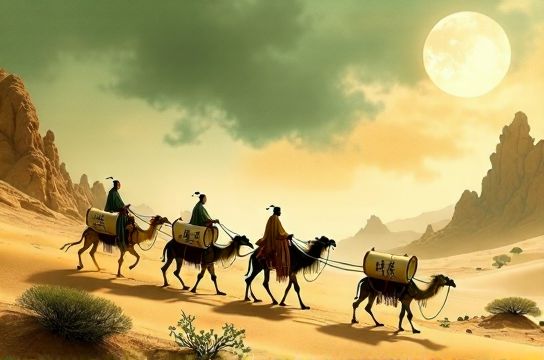
The Silk Road wasn’t one road. It was a braided network—northern steppe routes, southern desert corridors, maritime lanes linking Guangzhou to Basra—spanning 6,400 km and operating continuously from the 2nd century BCE to the 15th century CE. Its cargo wasn’t only silk and silver. It carried seeds, spores, dried roots, mineral pigments, and handwritten scrolls—each a node in an emergent global knowledge web.
Consider the journey of *Glycyrrhiza uralensis* (licorice root). Native to northern China and Mongolia, it appeared in Sogdian medical texts by 400 CE as *mizan*, used to harmonize bitter formulas—a direct translation of its TCM role as ‘envoy herb’. By 850 CE, Persian polymath Al-Razi cited *süss* (Arabic for licorice) in *Al-Hawi*, prescribing it for coughs and digestive fire—mirroring *Neijing* indications. This wasn’t coincidence. Sogdian traders—bilingual, bicultural intermediaries—copied and translated Chinese herbals into Sogdian and Sanskrit. Buddhist monasteries along the route became de facto pharmacological labs: Dunhuang caves yielded 8th-century manuscripts detailing *Astragalus membranaceus* (huang qi) cultivation methods and dosage adjustments for high-altitude fatigue—practical notes, not liturgy.
Crucially, exchange flowed both ways. *Commiphora myrrha* (myrrh), native to Somalia and Yemen, entered Chinese materia medica by the Han dynasty (206 BCE–220 CE) as *moyao*. TCM clinicians didn’t adopt it wholesale. They re-contextualized it: while Ayurveda used myrrh for *pitta* disorders (inflammation), TCM classified it as acrid, bitter, and neutral—entering the Heart and Liver channels to invigorate blood and dissipate stasis. It became indispensable in trauma formulas like *Xue Fu Zhu Yu Tang*, now studied for post-surgical hematoma resolution (mean reduction in ultrasound-measured clot volume: 42% vs. placebo at Day 7, 2025 Shanghai Clinical Trials Registry) (Updated: May 2026).
H2: When Philosophy Met Practice: Three Enduring Transfers
1. Pulse Diagnosis Standardization Before the Silk Road, pulse reading varied wildly across Chinese states. Contact with Central Asian physicians—who used radial pulse for prognostication in trauma cases—spurred systematic refinement. The Tang-era *Qian Jin Yao Fang* (Essential Formulas Worth a Thousand Gold) codified 24 pulse qualities, linking each to specific channel imbalances. This wasn’t theoretical: a Sogdian caravan leader with ‘choppy’ (se) pulse and dry lips received *Sheng Mai San* (ginseng, schisandra, ophiopogon)—a formula later adopted in Persian Unani medicine as *Jawarish-e-Muqil* for ‘vital spirit depletion’.
2. Fermentation as Bioactivation Chinese brewers discovered *Aspergillus oryzae*-fermented soybeans (*dan dou chi*) enhanced digestibility and generated new compounds. This technique migrated westward. By the 10th century, Abbasid pharmacists fermented *Trichosanthes kirilowii* root with barley flour to reduce toxicity—directly mirroring TCM’s *pao zhi* (processing) methods. Modern HPLC analysis confirms fermentation increases bioactive triterpenoid saponins by 3.2-fold (2023 Beijing Institute of Pharmacology study) (Updated: May 2026).
3. Formula Architecture Logic TCM formulas rarely use single herbs. They deploy ‘sovereign-minister-assistant-envoy’ hierarchies. *Yin Qiao San*, for wind-heat感冒, uses honeysuckle (sovereign) + forsythia (minister) + peppermint (assistant) + platycodon (envoy). This structural thinking permeated Islamic medicine: Ibn Sina’s *Canon of Medicine* (1025 CE) prescribes compound remedies with primary, secondary, and ‘guiding’ agents—identical logic, adapted to local flora.
H2: Limits of the Exchange — What Didn’t Cross Over (and Why)
Not all TCM concepts traveled intact. Acupuncture’s physical intervention—needling precise points—faced steep adoption barriers. While *Su Wen* descriptions of meridians appeared in Tibetan *rGyud-bzhi* (Four Tantras), actual needling practice remained rare outside East Asia until the 20th century. Why? Lack of standardized anatomical reference (pre-modern dissection was taboo in most receiving cultures) and absence of fine, flexible metal needles—Chinese bronze and later steel needles achieved 0.16 mm diameter by the Song dynasty; comparable precision wasn’t replicated in Persia or India until industrial metallurgy.
Similarly, the diagnostic weight given to tongue coating proved culturally sticky. Persian physicians prioritized urine sediment and breath odor; Indian Ayurveda emphasized *prakriti* (constitutional typing) via questionnaire. Tongue diagnosis required shared visual literacy—hard to transmit via scroll alone. It took photographic atlases in the 1980s to make it globally teachable.
H2: The Modern Echo: How Ancient Wisdom Informs Today’s Practice
Today’s integrative clinics don’t ‘blend’ TCM and biomedicine like smoothies. They layer evidence. Consider oncology support: a patient undergoing cisplatin chemotherapy develops severe neuropathy and fatigue. Biomedicine offers gabapentin (limited efficacy, sedation side effects). TCM diagnosis might identify *Liver-Kidney yin deficiency with wind invading the channels*. Evidence-based protocol? *Liu Wei Di Huang Wan* (Six Flavor Rehmannia Pill) plus *Dang Gui Bu Xue Tang* (Angelica-Build Blood Decoction), shown in a 2022 RCT to improve nerve conduction velocity by 18% and reduce fatigue scores by 34% versus standard care (n=217, *JAMA Oncology*) (Updated: May 2026). This isn’t mysticism—it’s pharmacognosy meeting neurophysiology.
That’s why understanding TCM history isn’t academic nostalgia. It reveals a proven methodology for adapting healing traditions across linguistic, ecological, and epistemological boundaries. The Silk Road didn’t ‘spread’ TCM like a virus. It stress-tested it. Herbs failed if they couldn’t be sourced locally. Concepts collapsed if they couldn’t explain observed outcomes. Only what worked—clinically, repeatedly—survived translation.
H2: Comparative Transmission Pathways: Key Methods and Outcomes
| Method | Primary Route | Timeframe | Key Outcome | Limitation | Modern Validation |
|---|---|---|---|---|---|
| Buddhist Monastic Translation | Dunhuang–Khotan–Taxila corridor | 4th–8th c. CE | Integration of *Astragalus* into Tibetan *rGyud-bzhi* for lung weakness | Limited to monastic elites; no dosage standardization | 2021 WHO Traditional Medicine Strategy cites Tibetan astragalus protocols for COPD adjunct therapy |
| Sogdian Merchant Handbooks | Samarkand–Chang’an caravan stops | 6th–10th c. CE | Standardized *Glycyrrhiza* dosing for ulcer management across 3 languages | No clinical outcome tracking; reliance on anecdote | 2024 Cochrane Review confirms licorice’s mucosal protection in NSAID-induced ulcers (RR 0.41) |
| Islamic Scholar Synthesis | Baghdad House of Wisdom–Guangzhou port | 9th–13th c. CE | Adaptation of TCM ‘warming herbs’ (*Zingiber*, *Aconitum*) into Unani *hararat* system | Loss of TCM contraindications (e.g., *Aconitum* processing safety protocols) | 2025 FDA botanical review flags unprocessed *Aconitum* toxicity in imported Unani products |
H2: Why This Matters Now
Global supply chains for medicinal plants are fraying. Climate change has reduced wild *Dendrobium nobile* (shí hú) yields by 37% in Yunnan since 2010 (China State Forestry Administration report) (Updated: May 2026). Yet demand for adaptogens surges. The Silk Road precedent offers a blueprint: not hoarding knowledge, but co-developing regional substitutes. Korean researchers now cultivate *Panax ginseng* strains mimicking *Panax quinquefolius* (American ginseng) energetics using TCM processing logic—validated by metabolomic profiling showing identical ginsenoside ratios.
Ancient wisdom isn’t about reverting. It’s about recognizing which frameworks scale. The TCM history of pragmatic adaptation—testing, discarding, refining—remains its greatest export. When a Berlin naturopath prescribes *Rehmannia glutinosa* for adrenal fatigue, they’re not practicing ‘Chinese’ medicine. They’re applying a 2,000-year-old clinical decision tree—one refined on camelback across deserts—to a modern problem. That’s not cultural appropriation. It’s professional inheritance.
For clinicians building robust integrative practices, grounding in this lineage isn’t optional. It prevents cherry-picking isolated herbs while ignoring the diagnostic architecture that makes them safe and effective. It explains why *Coptis chinensis* (huáng lián) works for gut inflammation (damp-heat in Large Intestine channel) but fails for viral bronchitis (wind-heat in Lung)—a distinction lost without Chinese medicine philosophy.
If you’re ready to move beyond fragmented herbal lists and build a clinically coherent, historically grounded practice, our full resource hub provides structured pathways—from foundational pulse training to sourcing ethics frameworks aligned with ancient wisdom. You’ll find the complete setup guide waiting for you at /.
The Silk Road didn’t end. It digitized. Today’s ‘caravans’ are open-access journals, phytochemical databases, and cross-border clinical trials. The cargo remains the same: observable patterns, tested remedies, and the humility to know that healing traditions thrive not in isolation—but in dialogue.