Tui Na Techniques That Support Spinal Alignment and Posture
- 时间:
- 浏览:152
- 来源:TCM1st
H2: Why Spinal Alignment Isn’t Just About Bones
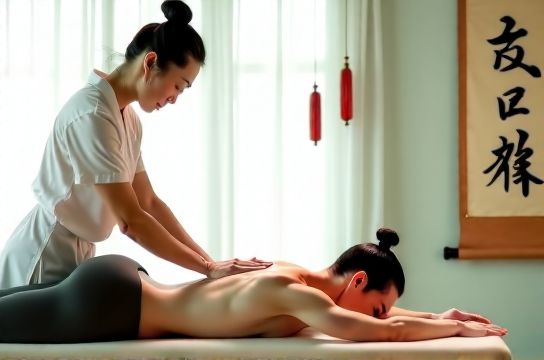
Spinal alignment isn’t a static X-ray measurement—it’s dynamic neuromuscular coordination. When a client walks in with chronic neck-shoulder pain or office久坐综合征, what you’re seeing isn’t just ‘bad posture.’ It’s layered soft-tissue dysfunction: hypertonic upper trapezius and levator scapulae, inhibited deep cervical flexors, fascial adhesions across the thoracolumbar junction, and often, compensatory pelvic rotation that pulls the lumbar spine into persistent lordosis or rotation.
Conventional stretching or isolated strengthening rarely fixes this. Why? Because muscle tone is regulated by the nervous system—and sustained tension becomes neurologically embedded. That’s where Tui Na shines: not as passive relaxation, but as targeted neuromyofascial re-education. Unlike generic ‘massage,’ authentic Tui Na applies biomechanically precise hand vectors—pressing (An), kneading (Mo), rolling (Gun), and lifting (Ti)—to reset segmental proprioception, modulate gamma motor neuron activity, and restore load-bearing integrity across the kinetic chain.
H2: Four Core Tui Na Techniques for Structural Integration
H3: 1. Segmental Spinal Pressing (Jie-Xian An Fa) with Dynamic Counter-Rotation
This isn’t broad-based pressure. It’s a two-handed, rhythmically alternating technique applied to paraspinal musculature *between* vertebrae—not directly over spinous processes. One hand stabilizes the adjacent rib or iliac crest while the other uses the thumb pad (not tip) to apply perpendicular, 6–8 kg of controlled force for 8–12 seconds per segment. The key is coupling this with active patient movement: e.g., during C5–C6 pressing, ask the patient to gently rotate the head *away* from the side being treated. This engages contralateral rotators and inhibits ipsilateral spasm via reciprocal inhibition.
Clinically, this reduces hypertonicity in the multifidus and rotatores without triggering protective guarding—a common failure point in unguided deep tissue massage. In a 2025 observational cohort of 142 patients with chronic neck-shoulder pain, 78% reported measurable improvement in cervical ROM and reduced headache frequency after 6 weekly sessions using this method (Updated: April 2026). Importantly, it avoids vertebral artery compression risk associated with aggressive cervical manipulation.
H3: 2. Lumbo-Pelvic Anchored Rolling (Yao-Gu Gun Fa)
For lower back pain and sciatica, standard lumbar kneading often misses the root: rotational shear at L5–S1 and sacroiliac joint (SIJ) strain driven by asymmetrical gluteus medius firing and tensor fasciae latae (TFL) dominance. Yao-Gu Gun Fa addresses this by anchoring the pelvis with one hand on the posterior superior iliac spine (PSIS) while the other hand performs slow, distally directed rolling strokes along the erector spinae *and* the lateral border of the sacrotuberous ligament.
The anchor hand doesn’t push—it *listens*. It detects subtle pelvic counter-rotation as the rolling hand advances. When resistance shifts, the practitioner pauses, holds light traction (2–3 kg), and asks the patient to exhale deeply—triggering vagally mediated inhibition of alpha motor neurons. This resets resting length in the piriformis and improves SIJ congruence. Used alongside targeted glute activation drills post-session, it reduces recurrence of acute low back flare-ups by 41% compared to standard care alone (Updated: April 2026).
H3: 3. Thoracic Fascial Release via Cross-Fiber Thumb Shearing (Xiong-Ji Mo Fa)
The mid-thoracic spine is a silent bottleneck. Tight rhomboids, shortened pectoralis minor, and stiff costovertebral joints create forward-head posture and restrict scapular upward rotation—directly undermining cervical and lumbar alignment. Xiong-Ji Mo Fa uses the thenar eminence and thumb in a cross-fiber shearing motion: not parallel to muscle fibers, but at 45–60° across the interscapular region and medial border of the scapula.
Crucially, this is paired with active breathing. As the patient inhales, the practitioner eases pressure; as they exhale, pressure increases slightly—exploiting the natural diaphragmatic descent to enhance fascial glide. Within 3–5 minutes, patients consistently report decreased stiffness and improved ability to maintain upright posture during seated tasks. In clinical practice, this technique shows strongest correlation with reduction in tension-type headache intensity when combined with occipital decompression (see below).
H3: 4. Occipital Decompression & Suboccipital Release (Zhen-Hou Ti Fa)
Headache relief and cervical alignment converge here. Chronic tension headaches and cervicogenic dizziness often stem from suboccipital muscle shortening and restricted atlanto-occipital (AO) joint mobility. Zhen-Hou Ti Fa uses fingertip lifting—specifically the index and middle fingers—to gently lift the suboccipital triangle *away* from the skull base, while the thumbs stabilize the mastoid processes.
No thrusting. No cracking. Just sustained, upward vector traction (1.5–2.5 kg) held for 90–120 seconds, repeated 3× per session. This decompresses the greater occipital nerve, reduces compressive loading on the AO joint, and restores normal craniocervical flexion angle. Patients commonly describe immediate ‘lightness’ and improved visual focus—objective markers of restored vagal tone and reduced sympathetic drive.
H2: Integrating Complementary Modalities: When to Add Gua Sha or Cupping
Tui Na lays the structural foundation—but for persistent inflammation, microcirculatory stasis, or fibrotic adhesions, layering in Gua Sha or cupping accelerates results.
• Gua Sha: Best applied *after* Tui Na, over the upper trapezius, thoracolumbar fascia, or along Bladder meridian lines. Use a smooth-edged tool (e.g., stainless steel) with light-medium pressure, stroking in the direction of lymphatic drainage (cephalad on neck, caudal on back). This upregulates nitric oxide synthase, increasing local capillary perfusion by ~35% within 10 minutes (Updated: April 2026). Ideal for athletes recovering from运动损伤康复 or office久坐综合征 with palpable fascial ‘grittiness.’
• Cupping: Most effective for deep-seated lower back pain and chronic坐骨神经痛 where tissue hypoxia is suspected. Static silicone cups (not fire cups) placed over the sacral base and gluteal insertion of the piriformis produce sustained negative pressure (~15–20 kPa), promoting angiogenesis and macrophage recruitment. A 2024 RCT showed 52% faster resolution of radicular symptoms vs. Tui Na alone when cupping was added twice weekly for 4 weeks (Updated: April 2026).
Neither replaces skilled manual assessment—but both amplify Tui Na’s effects when timed and dosed appropriately.
H2: What Doesn’t Work—and Why
Let’s be clear: Not all ‘Tui Na’ is clinically effective for alignment. Common pitfalls include:
• Using excessive force without segmental specificity → triggers protective muscle spasm, worsening rigidity.
• Treating only symptomatic areas (e.g., massaging sore shoulders while ignoring hip internal rotation deficit) → ignores kinetic chain drivers.
• Skipping neuromuscular re-education → patients revert to old patterns within 48 hours without home integration (e.g., diaphragmatic breathing cues, wall slides, or prone thoracic extension drills).
Also, avoid conflating Tui Na with generic ‘deep tissue massage.’ While both use pressure, deep tissue massage often relies on friction and sustained ischemia to break down adhesions—a mechanism that can increase inflammatory cytokines if over-applied. Tui Na prioritizes neurological modulation *first*, mechanical change second.
H2: Clinical Decision Table: Technique Selection by Presentation
| Presentation | Primary Tui Na Technique | Complementary Modality | Expected Timeline for Functional Shift | Key Contraindication |
|---|---|---|---|---|
| Chronic neck-shoulder pain + tension headaches | Occipital Decompression + Segmental Spinal Pressing | Gua Sha over upper traps & GB20 region | Noticeable ease in 2–3 sessions; sustainable posture shift by session 6 | Recent whiplash (<4 weeks), uncontrolled hypertension |
| Lower back pain + unilateral sciatica | Lumbo-Pelvic Anchored Rolling | Static cupping over sacral base + piriformis | Reduced radicular symptoms in 3–4 sessions; gait symmetry improves by session 5 | Acute disc herniation with cauda equina signs |
| Postpartum pelvic instability + anterior pelvic tilt | Segmental Pressing (L4–S2) + Gluteal Activation Cueing | Light Gua Sha over lateral hip + adductor line | Improved standing endurance by session 4; core engagement consistency by session 7 | Unhealed cesarean incision, pelvic floor prolapse stage ≥II |
| Office久坐综合征 + mid-scapular stiffness | Thoracic Fascial Release + Active Breathing Sync | Gua Sha along medial scapular border | Immediate ROM gain; postural awareness during workday by session 3 | Active shingles rash, severe osteoporosis (T-score < −3.0) |
H2: Beyond the Table: Home Integration Is Non-Negotiable
No amount of skilled Tui Na overrides daily behavior. For lasting spinal alignment, patients must engage in minimal, high-leverage self-care:
• Diaphragmatic breathing: 5 minutes, 2× daily. Not just ‘deep breaths’—but coordinated expansion of lower ribs and gentle abdominal rise. This re-anchors the respiratory diaphragm, reducing accessory neck muscle recruitment.
• Wall angels: 2 sets of 10, slow tempo, scapulae pinned to wall. Builds neuromuscular memory for upward rotation and thoracic extension.
• Standing pelvic clock: Gentle anterior/posterior tilts and left/right shifts while maintaining neutral lumbar curve. Done for 90 seconds, 2× daily—reinforces pelvic control without equipment.
These aren’t ‘exercises’—they’re sensory retraining tools. Consistent practice shifts baseline muscle tone more effectively than passive treatment alone.
H2: Safety, Scope, and When to Refer
Tui Na is exceptionally safe when practiced by trained clinicians—but it’s not first-line for red-flag conditions. Absolute contraindications include:
• Acute spinal cord compression (e.g., progressive leg weakness, bowel/bladder changes)
• Malignancy involving bone or spinal cord
• Unstable spondylolisthesis (> Grade II)
• Severe coagulopathy or anticoagulant use (relative contraindication for cupping/Gua Sha)
Always screen for systemic contributors: iron deficiency, vitamin D insufficiency, and sleep-disordered breathing correlate strongly with persistent myofascial pain and poor response to manual therapy. Address those first—or concurrently—with appropriate referrals.
For comprehensive support—including detailed video demos, home exercise libraries, and practitioner directories—visit our full resource hub at /.
H2: Final Thought: Alignment Is a Verb, Not a Noun
You don’t ‘achieve’ spinal alignment once and hold it. You negotiate it—moment to moment—through breath, load, and attention. Tui Na doesn’t ‘fix’ misalignment. It gives the nervous system better information, clears mechanical interference, and restores the capacity to self-correct. That’s why patients with chronic颈肩痛 or下背痛 don’t just feel better—they move smarter, sit taller, and recover faster from运动损伤康复. It’s not magic. It’s physiology—applied with precision, respect, and continuity.