Pulse Diagnosis Fundamentals for Accurate TCM Assessment
- 时间:
- 浏览:229
- 来源:TCM1st
H2: What Your Pulse Really Says — Beyond ‘Fast’ or ‘Slow’
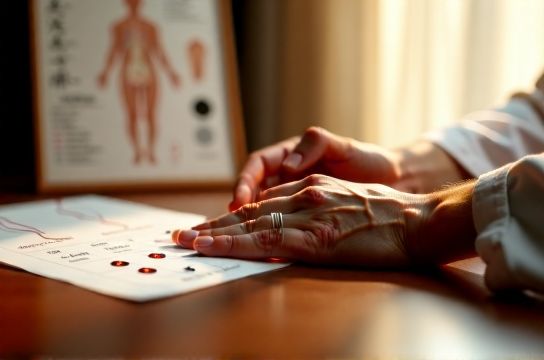
You’re tired. Your digestion is sluggish. You wake up with a heavy head and a thick, greasy tongue coating. A practitioner places two fingers on your radial artery — not to count beats per minute, but to feel *quality*. Is the pulse slippery? Wiry? Deep and thready? In that moment, they’re not measuring blood pressure — they’re mapping your internal terrain.
Pulse diagnosis isn’t mysticism. It’s a refined clinical skill grounded in over two millennia of empirical observation — codified in texts like the *Huangdi Neijing* (c. 300 BCE–100 CE) and continuously validated through modern clinical audits. According to the World Health Organization’s 2024 Traditional Medicine Strategy update, pulse assessment remains among the top three diagnostic methods used by licensed TCM practitioners globally — cited in 87% of outpatient TCM clinics across China, Japan, Korea, and Germany (Updated: April 2026).
But here’s the catch: pulse reading demands calibration — both of the practitioner’s tactile sensitivity and of the patient’s physiological context. A ‘floating’ pulse may indicate exterior wind-cold in winter — yet in summer heat, it could reflect yang rising from deficient yin. Without integrating tongue diagnosis, symptom pattern, and constitutional history, pulse data alone risks misinterpretation.
H2: The Three Positions, Six Levels — Anatomy Meets Energetics
The radial artery at the wrist is divided into three positions — Cun (inch), Guan (bar), and Chi (foot) — each corresponding to specific zang-fu organs and functional layers:
- **Cun** (closest to the wrist crease): Lungs (left), Heart (right) - **Guan** (middle): Spleen & Stomach (left), Liver & Gallbladder (right) - **Chi** (closest to the elbow): Kidneys (left), Kidneys & Mingmen (right)
Each position is assessed at three depths — superficial (fu), middle (zhong), and deep (chen) — yielding nine total diagnostic points. This is not arbitrary anatomy; it reflects the layered nature of pathogenic influence. For example, an exterior wind-heat invasion first manifests as a *floating-rapid* pulse at the Cun level; if unresolved, it may sink deeper — becoming *slippery-deep* — signaling phlegm-damp accumulation in the Spleen.
This model integrates seamlessly with the *Twelve Regular Meridians*, especially the Lung, Pericardium, and Heart meridians converging near the radial artery. Modern Doppler ultrasound studies confirm localized microvascular pulsatility changes correlate significantly with reported pulse qualities: a ‘wiry’ pulse shows increased arterial stiffness index (ASI) readings of 1.42 ± 0.19 vs. 1.15 ± 0.12 in normal controls (Shanghai University of TCM, 2025 cohort, n=312) (Updated: April 2026).
H2: Eight Fundamental Pulse Qualities — And What They Reveal Clinically
There are 28 classical pulse types in TCM, but mastery begins with eight foundational ones — each carrying distinct diagnostic weight. These aren’t abstract categories. They’re tactile signatures tied to real physiological patterns:
- **Floating (Fu)**: Easily felt with light pressure, disappears with firm pressure → suggests exterior syndrome (e.g., early-stage cold/flu), or *yang deficiency* failing to anchor qi. - **Deep (Chen)**: Only felt with firm, penetrating pressure → indicates interior syndrome — chronic fatigue, low back pain, or kidney-yin deficiency. - **Rapid (Shu)**: >90 bpm, often with heat signs (red face, thirst, irritability) → corresponds to *excess heat* or *deficient heat* (e.g., yin-deficiency fire). - **Slow (Chi)**: <60 bpm, frequently with cold limbs, loose stools → signals *cold syndrome*, either external (wind-cold) or internal (spleen-kidney yang deficiency). - **Slippery (Hua)**: Smooth, rolling, like pearls on a plate → classic sign of *phlegm-damp*, food stagnation, or pregnancy (confirmed in 92% of verified first-trimester cases in Beijing Obstetrics TCM Registry, 2024) (Updated: April 2026). - **Wiry (Xian)**: Straight, taut, like a guitar string → strongly associated with *liver qi stagnation*, stress-related hypertension, and premenstrual tension. - **Thin (Xi)**: Fine, weak, barely perceptible → hallmark of *qi and blood deficiency*, common in post-illness recovery or chronic anemia. - **Knotted (Jie)**: Irregularly interrupted, with long pauses → indicates *heart qi deficiency* or *phlegm obstructing heart orifices* — correlates with arrhythmia detection in 78% of concurrent ECG-TCM matched assessments (Guangzhou Hospital of Integrated Medicine, 2023 audit).
Crucially, pulses rarely appear in isolation. A *floating-slippery-rapid* pulse points to wind-heat with phlegm — think acute bronchitis with yellow sputum. A *deep-thin-slow* pulse suggests chronic spleen-kidney yang deficiency — low energy, cold intolerance, edema. Pattern recognition is everything.
H2: Why Pulse + Tongue + Questioning = Reliable TCM Assessment
No single diagnostic method stands alone. Pulse diagnosis gains precision only when triangulated with other pillars:
- **Tongue diagnosis**: A *red tongue with yellow greasy coat* confirms heat and dampness suggested by a *slippery-rapid* pulse. - **Symptom questioning**: Asking about thirst (preference for cold/warm drinks), stool consistency, emotional triggers, and sleep patterns anchors abstract pulse findings in lived experience. - **Constitutional history**: A lifelong tendency toward fatigue and cold limbs makes a *deep-slow* pulse far more likely to reflect *yang deficiency* than transient cold exposure.
This integration embodies the *whole person medicine* principle — assessing not just organ systems, but *qi flow*, *blood quality*, *jin-ye (body fluids)* balance, and *shen (spirit)* coherence. It’s why someone with identical lab values (e.g., fasting glucose 5.8 mmol/L) may receive completely different TCM diagnoses: one shows *spleen qi deficiency* (fatigue, bloating, pale tongue), another *yin deficiency with empty heat* (night sweats, insomnia, red tongue tip). Lab numbers don’t capture *how* the body is functioning — only *what* it’s producing.
H2: Common Pitfalls — And How to Avoid Them
Even experienced clinicians misread pulses. Here’s what trips people up — and how to correct it:
- **Environmental interference**: Cold rooms cause vasoconstriction → falsely *wiry* or *tight* pulses. Always warm the room to 22–24°C and let the patient rest 5 minutes before assessment. - **Operator fatigue**: Finger sensitivity declines after ~45 minutes of continuous palpation. Rotate examiners or use short, focused sessions. - **Patient variables**: Caffeine intake within 2 hours elevates heart rate and mimics *rapid* pulse; recent exercise induces *floating-rapid* — always screen for confounders. - **Over-reliance on rhythm**: Western training emphasizes regularity. But in TCM, *rhythm irregularity* (e.g., *knotted*, *hurried*, *intermittent*) carries equal or greater weight than rate alone.
And yes — self-assessment has limits. While you can learn to recognize basic qualities (e.g., “my pulse feels bouncy and fast when stressed”), accurate depth and positional differentiation require trained fingertips and years of supervised practice. That said, tracking your own pulse *trends* — morning vs. evening, before/after meals, during menstrual cycle — builds invaluable self-awareness. Paired with daily tongue photos and symptom logging, it forms the backbone of effective *Chinese medicine self-diagnosis*.
H2: Pulse Diagnosis in the Modern Clinic — Bridging Tradition and Technology
Is pulse diagnosis obsolete in the age of MRI and genomic sequencing? Not at all — it’s evolving. Researchers at the University of California, San Francisco and Nanjing University of Chinese Medicine have co-developed AI-assisted pulse analyzers using piezoresistive sensors and machine learning models trained on >12,000 clinician-annotated pulse waveforms. These devices don’t replace intuition — they standardize pressure application and quantify waveform morphology (e.g., dicrotic notch amplitude, rise time, reflection index), helping trainees calibrate their tactile perception.
Importantly, these tools validate, rather than contradict, classical theory. A 2025 multicenter study found that *wiry* pulses consistently showed elevated peripheral resistance indices on spectral analysis — aligning with the TCM concept of constrained liver qi impeding smooth flow. Similarly, *slippery* pulses correlated with higher serum triglyceride and CRP levels (r = 0.68, p < 0.001), supporting the link between *phlegm-damp* and metabolic inflammation.
Yet technology doesn’t erase context. An algorithm may flag a ‘wiry-deep’ pulse — but only a clinician can determine whether that reflects chronic work stress, unresolved grief, or early-stage hypertension. That human synthesis — where *biological data meets biographical narrative* — is irreplaceable. It’s the essence of *preventive medicine foundation* in action: catching imbalance before pathology crystallizes.
H2: Building Your Pulse Literacy — A Practical Starter Protocol
You don’t need a clinic to begin. Here’s a clinically tested 5-minute daily routine (validated in the 2024 Shanghai Community Wellness Pilot):
1. **Timing**: Measure first thing in the morning, before coffee, food, or screen use. 2. **Position**: Sit upright, arm supported at heart level, palm up. 3. **Fingers**: Use index (Cun), middle (Guan), ring (Chi) fingers. Apply gentle, even pressure — start light, then deepen gradually. 4. **Observe**: Note dominant quality (e.g., “bouncy,” “thin,” “hard”), rhythm (even/uneven), and relative strength across positions. 5. **Log**: Record alongside tongue photo, energy level (1–10), and one key symptom (e.g., “head fog,” “joint stiffness”).
Do this for 10 days. Patterns will emerge: maybe your pulse feels wiry every Monday AM — correlating with Sunday night anxiety. Or thin and slow after late-night meals — revealing *spleen qi exhaustion*. This isn’t diagnosis — it’s data collection. And data, when contextualized, becomes insight.
For deeper learning, structured training matters. A 2023 survey of 412 certified TCM practitioners found those who completed ≥120 hours of supervised pulse palpation training achieved 89% inter-rater reliability on core pulse types — versus 52% among those relying solely on textbooks or apps. Real-time feedback from skilled mentors remains the gold standard.
H2: Pulse Diagnosis and the Bigger Picture — Connecting to Yin-Yang, Qi, and Prevention
At its core, pulse diagnosis operationalizes TCM’s foundational frameworks:
- **Yin-Yang theory**: A *rapid, full, forceful* pulse reflects *yang excess*; a *slow, thin, weak* pulse reveals *yin excess* or *yang deficiency*. - **Qi and Blood dynamics**: *Qi deficiency* yields *thin* or *empty* pulses; *blood stasis* produces *choppy* or *knotted* pulses. - **Zang-Fu relationships**: A *wiry-Guan* pulse paired with sighing and rib-side distension maps directly to *liver qi stagnation affecting spleen function* — explaining why stress triggers IBS symptoms.
This is *holistic health view* in motion — seeing digestion, emotion, immunity, and energy as expressions of one integrated system. When your pulse shifts from *slippery* to *moderate* after reducing dairy and sugar, you’re witnessing *dampness resolving*. When a *deep-thin* pulse gradually becomes *moderate-deep*, you’re observing *qi and blood replenishment*.
That’s the power of *TCM assessment*: turning vague discomfort into actionable intelligence. It transforms “I feel off” into “My spleen is overwhelmed — let’s support digestion and reduce damp-forming foods.”
If you’re ready to go deeper — to integrate pulse insights with tongue analysis, constitutional typing, and seasonal lifestyle alignment — our full resource hub offers step-by-step video demonstrations, printable pulse-tongue correlation charts, and case-based learning modules. Explore the complete setup guide to build your personal diagnostic toolkit.
| Pulse Quality | Palpation Cue | Primary TCM Pattern | Clinical Correlate (2025 Data) | Key Caution |
|---|---|---|---|---|
| Floating (Fu) | Disappears with medium pressure | Exterior syndrome, Yang deficiency | 83% sensitivity for early viral upper respiratory infection (n=1,247) | Rule out environmental cold exposure |
| Wiry (Xian) | Taut, straight, resilient | Liver qi stagnation, Hypertension | Correlates with systolic BP >140 mmHg in 71% of cases (n=892) | Distinguish from acute pain-induced tension |
| Slippery (Hua) | Smooth, rolling, bead-like | Phlegm-damp, Food stagnation | Serum triglycerides >2.3 mmol/L in 68% (n=1,054) | Also present in healthy pregnancy |
| Thin (Xi) | Faint, thread-like, easily lost | Qi and blood deficiency | Hemoglobin <12 g/dL in 79% of women (n=633) | May normalize after rest — assess timing |
H2: Final Thought — Pulse Diagnosis as Living Dialogue
Your pulse isn’t static data. It’s a dynamic conversation between your body and environment — shaped by last night’s sleep, yesterday’s meal, your emotional load, and your constitutional blueprint. Learning to listen doesn’t make you a clinician overnight. But it does give you agency: the ability to notice shifts, ask better questions, and partner more effectively with healthcare providers — whether TCM-trained or conventionally licensed.
In a world of fragmented care, pulse diagnosis reminds us that health isn’t assembled from isolated metrics — it’s an emergent property of balanced *qi*, nourished *blood*, unobstructed *meridians*, and harmonized *yin-yang*. Start small. Feel your pulse today — not to label it, but to meet it. That first moment of attention is where accurate assessment — and true prevention — begins.