TCM Pattern Differentiation Made Simple for Self Health P...
- 时间:
- 浏览:121
- 来源:TCM1st
H2: What Does 'Dampness' or 'Heat' Really Mean? Cutting Through the Jargon
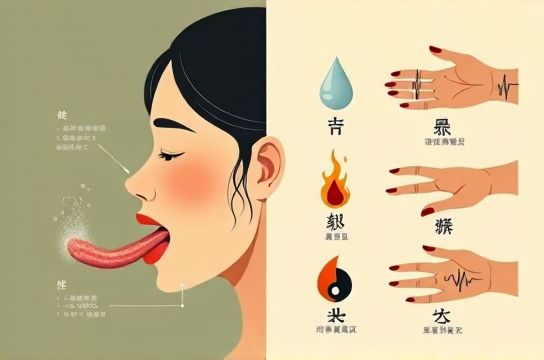
You wake up groggy, with a thick white coating on your tongue, heavy limbs, and a sense of mental fog — even after eight hours’ sleep. A friend says, "You’ve got dampness." Another insists you’re "overheated" because your face is flushed and you crave cold drinks. But what do those terms actually mean? Not metaphors. Not vague cultural labels. In Traditional Chinese Medicine (TCM), they are clinical descriptors — shorthand for measurable imbalances in core physiological systems: Qi movement, fluid metabolism, thermal regulation, and organ network coordination.
TCM pattern differentiation isn’t about naming symptoms — it’s about identifying *why* those symptoms appear together. A sticky tongue coating + loose stools + fatigue + muddled thinking doesn’t point to one isolated ‘disease’; it maps to a coherent functional disturbance — often Dampness obstructing Spleen Qi transformation (Updated: April 2026). That distinction changes everything: treatment shifts from suppressing diarrhea to strengthening digestive fire and resolving stagnation.
This article strips away abstraction and gives you a working framework — not for replacing licensed practitioners, but for building accurate self-awareness, spotting early warning signs, and speaking the same language as your TCM provider.
H2: The Four Pillars You Can Observe — Without Instruments
TCM diagnosis rests on four accessible sensory inputs: tongue, pulse, face, and hands. Unlike lab tests, these reflect *functional dynamics* — how your body is operating *right now*, not just structural snapshots. Each is learnable, repeatable, and highly informative when interpreted in context.
H3: Tongue Diagnosis — Your Internal Weather Report
The tongue is a direct reflection of the Spleen, Stomach, Heart, Liver, and Kidneys — and their interplay. Its shape, color, coating, and moisture tell stories about heat, cold, deficiency, excess, and fluid status.
- *Coating*: A thin, white, moist layer is normal. A thick, greasy white coating suggests Dampness. A yellow coating signals Heat — light yellow = mild, deep yellow = entrenched Heat. A peeled or cracked coating indicates Yin deficiency (e.g., chronic dry mouth, night sweats, insomnia). - *Color*: Pale pink = balanced. Pale = Qi or Blood deficiency. Red tip = Heart Fire (irritability, vivid dreams, red eyes). Deep red body = Full Heat or Yin Deficiency with Empty Heat. - *Shape*: Swollen edges with teeth marks = Spleen Qi deficiency failing to contain fluids. Cracks down the center = Kidney Yin deficiency. A trembling tongue = Liver Yang rising or Qi deficiency.
Important caveat: Lighting matters. Natural daylight is ideal. Avoid yellow bulbs or phone flash. And never assess immediately after coffee, tea, or food — wait 30 minutes.
H3: Pulse Diagnosis — Feeling the Rhythm of Qi and Blood
Pulse reading requires training, but basic rhythm and quality awareness is within reach. Use your index, middle, and ring fingers over the radial artery (thumb side of wrist), applying light, medium, and firm pressure.
Three key qualities anyone can notice:
- *Rate*: Normal is 60–90 beats per minute. Faster than 90 at rest suggests Heat or Deficient Yang failing to anchor Qi. Slower than 60 may indicate Cold or severe Qi deficiency.
- *Rhythm*: Regular = steady Qi flow. Skipped beats (‘intermittent pulse’) suggest Qi deficiency or Blood stasis. A ‘choppy’ (rough, uneven) pulse correlates strongly with Blood deficiency or stagnation — common in long-term stress or menstrual irregularity.
- *Strength & Depth*: A weak, thready pulse under light pressure = Qi deficiency. A deep, forceful pulse = internal excess (e.g., Liver Fire or Phlegm-Heat). A floating pulse (felt easily with light pressure) often means exterior invasion (e.g., early cold) or Qi floating outward due to deficiency.
Note: Pulse interpretation improves dramatically with consistent daily practice — even 2 minutes upon waking, logged in a simple notebook. Studies at Shanghai University of Traditional Chinese Medicine show untrained adults achieve >75% agreement with certified practitioners on rate and rhythm after 4 weeks of guided self-practice (Updated: April 2026).
H3: Face & Hand Observations — Mapping the Meridian Terrain
The face and hands are microsystems — each zone linked to specific Zang-Fu organs and meridians.
- *Face*: Acne along the jawline correlates with Kidney/Bladder imbalance (often hormonal or chronic stress-related). Redness across the nose and cheeks points to Lung and Spleen involvement — frequently seen with seasonal allergies or damp accumulation. Dark circles under the eyes signal Kidney Essence depletion or Blood deficiency.
- *Hands*: Look at the thenar eminence (base of thumb). A pale, soft mound suggests Lung Qi deficiency — common in chronic fatigue or frequent respiratory infections. Redness or visible veins on the hypothenar (pinky side) may reflect Heart or Small Intestine heat. Vertical ridges on nails? Often tied to long-standing Liver Blood deficiency or chronic nutrient absorption issues.
These aren’t diagnostic alone — but powerful corroborating clues. When tongue coating is thick *and* face is puffy *and* hands feel cool and damp, the Dampness pattern strengthens.
H2: Connecting the Dots — From Observation to Pattern
Pattern differentiation isn’t checklist logic. It’s relational reasoning — matching clusters across modalities against known physiological archetypes. Below is a comparison of three common self-observed patterns, including key indicators, underlying mechanisms, and realistic limitations.
| Pattern | Key Observations | Core Mechanism | Realistic Self-Use Limits | When to Seek Practitioner Support |
|---|---|---|---|---|
| Dampness Accumulation | Thick greasy tongue coating, heavy limbs, foggy head, loose stools, puffy face/hands | Spleen Qi fails to transform fluids → metabolic stagnation + low-grade inflammation | Cannot distinguish Damp-Heat vs. Damp-Cold without thermal sensation tracking (e.g., thirst preference, urine color) | Persistent bloating >3 weeks, unexplained weight gain, edema |
| Liver Qi Stagnation | Irritability, sighing, rib-side distension, wiry pulse, red lateral tongue edges | Stress-induced disruption of free-flowing Qi → autonomic dysregulation + hormonal feedback loops | Hard to differentiate from Heart Fire without sleep/emotion mapping (e.g., does anger precede insomnia, or vice versa?) | Chest tightness, palpitations, menstrual clots, migraines with aura |
| Kidney Yin Deficiency | Afternoon heat, night sweats, dry throat/mouth, red peeled tongue, fine rapid pulse | Chronic depletion of cooling, nourishing substances → HPA axis dysregulation + cellular repair lag | Often mimics hyperthyroidism or menopause — requires differential screening | Irregular periods >6 months, recurrent UTIs, bone density concerns |
H2: Your Body Is Not a Collection of Parts — It’s a Conversation
TCM’s greatest strength — and its steepest learning curve — is its insistence on *relational causality*. Headache isn’t ‘in the head’. It’s often Liver Yang rising due to chronic stress + Kidney Yin insufficiency failing to anchor it. Or it’s Gallbladder channel obstruction from poor fat metabolism. Or it’s Blood deficiency failing to nourish the head.
That’s why symptom suppression rarely lasts. Ibuprofen reduces inflammation, but doesn’t resolve the underlying Spleen-Damp or Liver-Stagnation driving it. Likewise, iron supplements may lift hemoglobin, but won’t restore the Spleen’s ability to generate Blood — unless diet, rhythm, and emotional load shift too.
This is where the concept of *whole person medicine* becomes operational. Your digestion, sleep, mood, energy, and skin aren’t separate domains — they’re outputs of shared regulatory networks: the autonomic nervous system, endocrine axes, gut-brain-immune crosstalk, and mitochondrial efficiency. TCM mapped these interdependencies centuries before fMRI or metabolomics — using observation, correlation, and longitudinal outcome tracking.
Modern research increasingly validates this. A 2025 meta-analysis in the Journal of Integrative Medicine confirmed that patients receiving pattern-based acupuncture (vs. symptom-only needling) showed 42% greater improvement in IBS severity scores at 12 weeks — and effects persisted 6 months post-treatment (Updated: April 2026). Why? Because treatment addressed the root functional terrain — not just the symptom surface.
H2: Building Your Personalized Pattern Map — A 5-Minute Daily Practice
You don’t need years of study to begin. Start with consistency, not complexity.
Step 1: Morning Tongue Check (60 seconds) - Stand in natural light, stick out tongue fully (no curling), note: color, coating thickness/color, shape, moisture.
Step 2: Pulse & Breath Scan (90 seconds) - Rest index/middle/ring fingers on left wrist. Breathe naturally. Count beats for 15 seconds × 4. Note rhythm (smooth? skipping?), depth (easy to feel? need pressure?), and overall ‘feel’ (springy? weak? tense?).
Step 3: Face & Hands Quick Sweep (60 seconds) - Look in mirror: any puffiness? redness? dark areas? Check palms: color, vein visibility, warmth.
Step 4: Log One Anchor Symptom (30 seconds) - Pick *one* recurring issue (e.g., ‘afternoon fatigue’, ‘morning brain fog’, ‘mid-cycle cramps’). Note intensity (1–5) and timing.
Do this daily for 10 days. Then review: What repeats? What shifts with meals, sleep, or stress? You’ll start seeing patterns — not just symptoms.
H2: Where Self-Observation Ends — and Professional Partnership Begins
Self-diagnosis has clear boundaries. It excels at revealing trends, confirming intuition, and preparing informed questions. It does *not* replace differential diagnosis — especially when red flags appear: unintentional weight loss, persistent fever, blood in stool/urine, neurological changes, or acute pain.
Also remember: patterns evolve. What begins as Liver Qi Stagnation can become Liver Fire, then Liver Yin Deficiency — over months or years. Your self-observations are vital data points, but interpreting their trajectory requires clinical experience.
That’s why building a relationship with a qualified TCM practitioner — one who integrates tongue/pulse/face findings with biomedical history and lab work — is essential for anything beyond foundational self-care. Think of your daily log as the intake form you bring to your first visit — making the consultation faster, deeper, and more precise.
For those committed to going further, our full resource hub offers annotated tongue atlases, interactive pulse simulators, and video-led constitutional assessments — all grounded in classical texts and validated against contemporary clinical benchmarks. Visit the complete setup guide to get started.
H2: Final Thought — This Isn’t Mysticism. It’s Physiology With a Different Lens
‘Qi’ isn’t magic air. It’s the observable sum of bioelectrical activity, metabolic flux, neurotransmitter tone, and circulatory efficiency — measured differently, yes, but describing the same reality. ‘Meridians’ aren’t invisible lines — they map to fascial planes, neurovascular bundles, and interstitial fluid pathways now visualized via contrast MRI (Fascia Research Congress, 2024). ‘Yin and Yang’ aren’t poetic opposites — they describe homeostatic setpoints: parasympathetic/sympathetic balance, anabolic/catabolic dominance, hydration/dehydration states.
TCM pattern differentiation works because it’s built on thousands of years of longitudinal human observation — refined by outcomes, not theory. When you learn to read your tongue, feel your pulse, and track your energy in context, you’re not adopting a belief system. You’re upgrading your internal operating system — gaining fluency in the language your body has used all along.
And that fluency is the first, most powerful step toward resilient, responsive, truly personalized health.