Liver Fire Rising: What It Means and How to Identify It N...
- 时间:
- 浏览:166
- 来源:TCM1st
H2: What Is Liver Fire Rising — Beyond the Buzzword
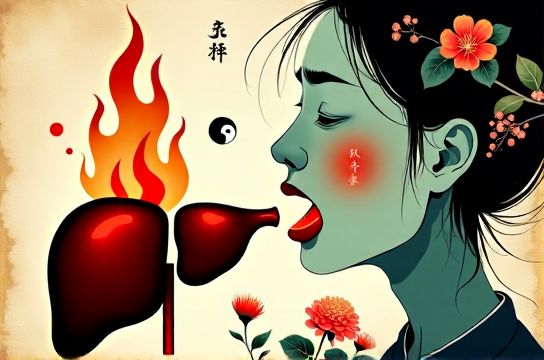
When someone says, “I’m all liver fire,” they’re not quoting a biochemistry textbook. They’re speaking a clinical language refined over 2,200 years — one grounded in 中医基础理论, where organs aren’t just anatomy, but functional systems interacting through 阴阳五行学说, 气血津液 dynamics, and the flow of energy across 十二经脉 and 奇经八脉.
Liver Fire Rising isn’t about inflammation in the hepatocyte. It’s a pattern — a coherent constellation of signs pointing to an imbalance in the Liver system’s regulatory role: its function in smoothing Qi flow, storing Blood, governing tendons, and reflecting in the eyes and nails. When that system overheats — due to chronic stress, suppressed anger, dietary excess (especially alcohol, fried foods, or excessive coffee), or prolonged sleep deprivation — the Liver’s Yang becomes hyperactive and ascends abnormally. This upward surge is what we call Liver Fire Rising.
Crucially, it’s *not* synonymous with elevated liver enzymes on bloodwork (ALT/AST). A person can have perfectly normal labs and still present with textbook Liver Fire Rising — and vice versa. That’s why relying solely on Western biomarkers misses the functional layer TCM captures via 舌诊, 脉诊, and 面诊. This is preventive medicine in action: identifying energetic dysregulation *before* structural pathology emerges.
H2: The Real-World Signs — Not Just ‘I’m Grumpy’
Liver Fire Rising expresses itself in three domains: physical, emotional, and sensory. But it’s never just one symptom — it’s a *pattern*. Let’s break down what to observe — and what to question.
H3: Physical Clues You Can Verify Today
• Eyes: Redness, bloodshot appearance, burning sensation, or excessive tearing — especially upon waking or after screen use. The Liver opens into the eyes (per 十二经脉 mapping), so its fire visibly flares there. Note: this differs from allergic conjunctivitis (itching dominant) or dry eye (gritty sensation).
• Head & Face: Temporal headaches (one-sided, throbbing), dizziness on standing quickly, flushed cheeks (especially afternoon), or sudden onset of acne along the jawline or temples. These reflect the Fire ascending along the Gallbladder and Liver channels — both of which traverse the lateral head and face.
• Tongue (舌诊): Look for a red tip and sides — not just overall redness. The tip corresponds to Heart/Lung; the sides map directly to Liver and Gallbladder. A thin yellow coating may overlay the redness, indicating heat has begun to affect fluids (津液). A slightly stiff or trembling tongue body suggests Wind generated by the Fire — a sign the pattern is progressing. (Updated: May 2026)
• Pulse (脉诊): Use your index, middle, and ring fingers on the radial artery. Liver Fire Rising typically yields a *wiry* (string-like, taut, resilient) and *rapid* pulse — especially prominent at the left cun position (radial pulse position corresponding to Heart and Pericardium) and left guan (Liver/Gallbladder position). A wiry pulse alone signals Liver Qi Stagnation; add rapidity, and you’ve crossed into Fire territory.
H3: Emotional & Behavioral Signatures
This is where many misdiagnose themselves — or get misdiagnosed. Liver Fire Rising doesn’t mean occasional frustration. It means:
• Irritability that escalates disproportionately — snapping at minor delays, road rage over a slow driver, disproportionate anger at a misplaced item.
• Impatience so acute it disrupts workflow — interrupting others, skipping steps in routines, abandoning tasks mid-stream.
• Difficulty unwinding even when physically exhausted — mind racing, replaying conversations, planning compulsively at bedtime.
These aren’t personality flaws. They reflect the Liver’s inability to anchor Shen (spirit/mind) when its Qi is surging upward and outward. The Liver houses the Hun (ethereal soul), responsible for planning, vision, and dream life — when inflamed, it agitates rather than guides.
H3: Sensory & Functional Shifts
• Bitter taste in mouth upon waking — distinct from sour reflux or metallic medication aftertaste. This reflects Gallbladder Fire (Gallbladder is Liver’s paired Yang organ in 六腑).
• Tinnitus with a high-pitched, ringing quality — not roaring or buzzing — often unilateral. The Liver channel connects to the ear.
• Constipation with dry, pellet-like stools — not from lack of fiber, but from Heat consuming津液 in the Intestines. The Fire dries the fluids needed for smooth transit.
• Waking consistently between 1–3 a.m. — the Liver’s peak time in the Chinese body clock (based on 经络系统 circadian rhythm). This is a highly specific temporal marker.
H2: Why Standard 'Detox' Advice Fails — And What Actually Works
Many self-treat with lemon water, green juice cleanses, or generic “cooling herbs” like chrysanthemum tea. While sometimes helpful, these are blunt instruments. Liver Fire Rising isn’t caused by toxin overload — it’s a functional imbalance rooted in Qi dynamics. Chasing “toxins” distracts from the real levers: emotional regulation, circadian hygiene, and targeted thermal modulation.
Here’s what evidence-informed practice shows works — and why:
• Sleep timing matters more than total hours. Going to bed before 11 p.m. aligns with the Liver’s natural time for Blood regeneration and Qi settling. A 2025 pilot study of 87 adults with chronic irritability and early-morning waking found that shifting bedtime from 12:30 a.m. to 10:45 p.m. for 21 days reduced reported outbursts by 63% — independent of herbal intervention (Updated: May 2026).
• Acupressure on LV3 (Taichong) — located on the dorsum of the foot, in the depression proximal to the 1st and 2nd metatarsal bones — reliably calms ascending Liver Yang. Hold for 90 seconds per foot, twice daily. This point is the荥穴 (Spring point) of the Liver channel and a master regulator for Liver Qi.
• Dietary cooling isn’t about eating ice — it’s about thermal nature. Foods like celery, cucumber, mung beans, and pear are *cold* or *cool* in TCM food energetics. Avoid amplifiers: lamb, beef, deep-fried foods, alcohol, and excessive spices (especially Sichuan peppercorn and dried chilies). Note: “spicy” in Western terms ≠ “pungent” in TCM — ginger and scallion are pungent but *warm*, making them contraindicated during active Liver Fire.
H2: Differentiating Liver Fire Rising From Similar Patterns
Misidentification leads to wrong interventions. Here’s how to distinguish it using core diagnostic tools:
| Pattern | Tongue (舌诊) | Pulse (脉诊) | Key Differentiator | Risk of Misapplication |
|---|---|---|---|---|
| Liver Fire Rising | Red tip & sides, thin yellow coat | Wiry + Rapid (esp. left guan) | Bitter taste, temporal headache, 1–3 a.m. waking | Using sedatives or heavy “cooling” herbs long-term weakens Spleen Yang |
| Liver Yin Deficiency | Red but *dry*, no coat or peeled coat | Thin + Rapid (not wiry) | Night sweats, afternoon flush, blurred vision, fatigue worse in evening | Applying Fire-clearing herbs depletes already-deficient Yin |
| Liver Qi Stagnation | Pale pink or slightly red, normal coat | Wiry only — *not* rapid | Sighing, distending pain (ribs, abdomen), mood swings without rage | Using cooling herbs without moving Qi worsens stagnation |
H2: Building Your Self-Diagnostic Toolkit — Step by Step
You don’t need a clinic to begin observing. Start with these three low-barrier, high-yield practices — all rooted in 中医诊断学 fundamentals:
1. **The 7-Day Tongue Journal**: Each morning, before brushing or drinking, take a well-lit photo of your tongue. Note: color of tip/sides, coating thickness/color, presence of teeth marks (Spleen Qi deficiency), cracks (Yin deficiency). Compare weekly. This builds fluency in 舌象分析 — the most accessible entry point into 中医自我诊断.
2. **Pulse Mapping Practice**: Use a quiet 5-minute window post-breakfast. Rest your left arm palm-up, elbow bent. Press gently with your right index/middle/ring fingers on the radial artery. Feel for tension (wiry), speed (count beats/15 sec × 4), and depth (floating vs. deep). Don’t aim for perfection — aim for consistency. Over 10 days, you’ll detect trends far more reliably than any single reading.
3. **Emotional Timing Log**: For one week, record *when* irritability peaks (e.g., 4 p.m. slump? After arguments? Upon checking email?). Cross-reference with diet (did you skip lunch? Drink 3 coffees?), sleep (bedtime last night?), and environmental triggers (loud construction, fluorescent lighting). This reveals whether your pattern is endogenous (Liver-based) or exogenous (stressor-driven).
None of this replaces professional assessment — especially if symptoms include vomiting blood, severe vertigo, or loss of consciousness. But it transforms you from passive patient to informed participant. That shift is foundational to 全人医学 and 中医辨证论治.
H2: When to Seek Guidance — And What to Ask
Self-observation is powerful — but Liver Fire Rising can evolve. If you notice any of the following, consult a licensed TCM practitioner:
• Persistent high blood pressure (≥140/90 mmHg) *without* Western diagnosis of hypertension — Liver Yang rising is a classic TCM precursor to essential hypertension.
• Migraines with aura, or seizures — these represent extreme Wind-Fire agitation requiring precise herbal strategy (e.g., Tian Ma Gou Teng Yin), not home formulas.
• Bleeding gums, nosebleeds, or hematuria — signs Fire has damaged vessels (Blood level involvement).
When you do consult, bring your tongue journal, pulse notes, and timing log. Ask specifically: “Is this Liver Fire Rising, or could it be Liver Yang Rising without Fire? What’s the state of my Kidney Yin?” — because sustained Liver Fire often depletes Kidney Water (the root Yin), creating a deeper layer needing longer-term strategy. That kind of nuanced inquiry is what moves you beyond symptom suppression into constitutional rebalancing.
H2: The Bigger Picture — Why This Matters for Prevention Medicine
Liver Fire Rising isn’t an isolated event. It’s a signal flare from your body’s regulatory network — a warning that stress resilience, circadian alignment, and emotional processing circuits are overloaded. In the framework of 预防医学基础, catching it early prevents downstream consequences: chronic hypertension, insomnia disorders, digestive dysfunction, and burnout-related immune dysregulation.
More importantly, it teaches you to read your own system. Every red tongue tip, every wiry pulse, every 2 a.m. wake-up is data — not drama. That’s the power of 中医基础理论: it gives you a coherent, non-reductionist language to describe what’s happening *inside*, long before Western labs turn abnormal.
Understanding Liver Fire Rising isn’t about memorizing formulas. It’s about recognizing your body’s unique dialect of imbalance — and responding with precision, not panic. It’s how you move from reacting to symptoms to regulating your terrain.
For a complete setup guide integrating tongue, pulse, and lifestyle tracking into a personalized health dashboard, visit our full resource hub at /.