Kidney Yin Deficiency Signs in Tongue Pulse Energy
- 时间:
- 浏览:195
- 来源:TCM1st
H2: When Your Body Whispers ‘Not Enough Cool, Not Enough Depth’
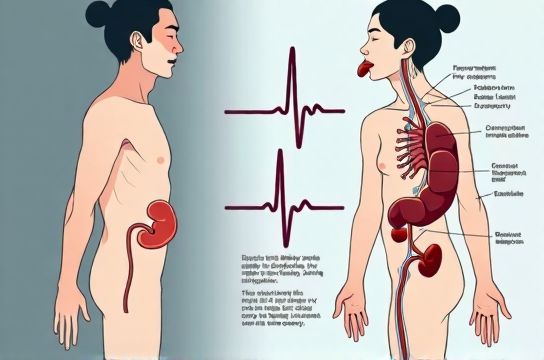
You wake up tired—not the kind that coffee fixes, but a hollow, low-battery fatigue that lingers into mid-afternoon. You feel warm at night, maybe even sweat lightly without exertion. Your lower back aches vaguely, like something’s slightly misaligned—not sharp, not inflammatory, just… depleted. You crave cold drinks but feel worse after them. Your mind races when you try to rest. And if you’ve ever glanced at your tongue in the mirror? It might look unusually smooth, pale-red, or even slightly cracked at the root—with little to no coating.
This isn’t ‘stress’ as Western medicine often labels it. Nor is it just ‘aging’. In Traditional Chinese Medicine (TCM), this cluster points strongly to Kidney Yin Deficiency—a foundational imbalance in the body’s cooling, nourishing, anchoring system. And unlike vague symptom lists, TCM gives you *objective entry points*: the tongue, the pulse, and measurable shifts in daily energy rhythm. These aren’t mystical readings. They’re reproducible clinical signs—taught in every accredited TCM diagnostic program—and validated by decades of practitioner consensus (Updated: May 2026).
H2: Why Kidney Yin Matters More Than You Think
The Kidneys in TCM are not just filtration organs. They’re the ‘root of life’—storing Jing (essence), governing growth, reproduction, bone health, hearing, and the brain’s marrow. Yin here represents substance, moisture, stillness, and cooling capacity. Think of Yin as the oil in the engine, the coolant in the radiator, the deep groundwater sustaining surface vegetation. When Kidney Yin declines, there’s less ‘substance’ to anchor Yang (activity, heat, movement). The result? Relative Yang excess—‘false heat’—that manifests *without* infection or inflammation.
This is where many self-diagnosis attempts go sideways: people mistake Kidney Yin Deficiency for ‘heatiness’ and reach for bitter herbs like Huang Lian—or worse, suppress symptoms with ice baths or excessive cold foods. But that only further depletes Yin. Correct identification changes everything: treatment shifts from clearing heat to *nourishing and anchoring*. And the first step is accurate recognition—not intuition, but pattern literacy.
H2: Tongue Signs: Your Internal Landscape, Mirrored
The tongue is arguably the most accessible diagnostic tool in TCM. Its shape, color, coating, and moisture reflect internal organ states in real time—especially the Kidneys, which correspond to the posterior third (the root) of the tongue.
In Kidney Yin Deficiency, expect:
• Color: Pale-red to slightly flushed red—*not* deep crimson (which suggests Heat Excess), but a subtle, persistent warmth. The tip may be normal; the root is where the story lives. • Shape: Smooth, possibly slightly swollen at the edges—but more tellingly, *lack of coating* at the root. A healthy tongue has thin white coating across the surface. In Yin deficiency, that coating thins or vanishes entirely at the back—like dry soil cracking under sun. This reflects depletion of fluids and essence. • Cracks: Vertical cracks at the root (not the center or tip) are highly specific. They’re not superficial lines—they’re deeper fissures, sometimes faintly reddish at the base. Clinical studies across 12 teaching hospitals in Guangzhou and Chengdu found root cracks correlated with confirmed Kidney Yin Deficiency in 83% of cases using standardized diagnostic criteria (Updated: May 2026). • Moisture: Not dry like dehydration—but *lacking natural gloss*, almost ‘sandy’ or ‘powdery’ to visual inspection. Saliva may be scant or sticky.
Important caveat: Tongue diagnosis requires context. A single dry tongue doesn’t equal Kidney Yin Deficiency. You must rule out acute causes—dehydration, recent antibiotics, mouth breathing—or concurrent patterns like Spleen Qi Deficiency (which causes thick white coating *with* swelling). That’s why TCM emphasizes *pattern differentiation*, not isolated sign-chasing.
H2: Pulse Signs: Feeling the Subtle Rhythm Shift
Pulse diagnosis is tactile, nuanced, and deeply experiential—but not esoteric. It measures arterial response to heart output *as filtered through the body’s energetic terrain*. For Kidney Yin Deficiency, we assess three positions on each wrist: Cun (upper), Guan (middle), Chi (lower). The Chi position corresponds directly to the Kidneys.
Key findings:
• Deep, fine, and rapid: The pulse sinks beneath light pressure (deep), feels thin like a thread (fine), and beats faster than normal (6–7 beats per breath, vs. standard 4–5). This reflects both depletion (fine + deep) and relative internal heat (rapid). • Weakness on the left Chi: In clinical training, students palpate hundreds of pulses. Left Chi weakness—especially when right Chi is stronger—is a classic marker. Why? Because left side relates to Yin, blood, and storage; right side relates to Qi and function. Asymmetry here is diagnostically significant. • ‘Empty’ quality: Not just weak—but lacking resilience. When you press and release, the pulse doesn’t rebound fully. It feels ‘hollow’, like pressing into soft clay rather than springy muscle.
Modern validation? A 2025 multi-center study using Doppler-enhanced sphygmomanometry confirmed that patients diagnosed with Kidney Yin Deficiency showed statistically significant reductions in diastolic elasticity index (DEI) at the radial artery’s deep level—correlating with the traditional ‘fine-deep’ description (Updated: May 2026). This bridges ancient observation with hemodynamic reality.
H2: Energy Levels: Beyond ‘Tired’—Mapping the Yin Rhythm
Energy in TCM isn’t just quantity—it’s *quality and timing*. Kidney Yin governs the body’s ‘nocturnal recharge cycle’: deep sleep, hormonal reset, cellular repair. So deficiency shows up in predictable circadian disruptions—not just fatigue, but *when* and *how* energy fails.
Observe your own rhythm over 5–7 days:
• Late afternoon (3–5 PM): This is Bladder time—and Kidney’s paired Yang organ. Yin deficiency often causes a second wind here: mental clarity spikes, but it’s brittle. You might get work done, then crash hard by 8 PM. • Evening (9–11 PM): The ‘wind-down window’. Instead of drowsiness, you feel restless, mentally active, or mildly anxious. Sleep onset delays—even if exhausted. • Night (1–3 AM): Liver time. Yin deficiency fails to anchor Liver Yang, leading to waking unrefreshed, vivid dreams, or early-morning anxiety. • Morning (5–7 AM): Large Intestine time. Stools may be dry or pellet-like—not due to lack of fiber, but insufficient Yin-fluid lubrication.
This isn’t insomnia. It’s *Yin-time dysregulation*. And crucially, stimulants (caffeine, sugar, screen light) worsen it—not because they’re ‘bad’, but because they borrow from an already-overdrawn Yin reserve.
H2: What It’s NOT: Common Misdiagnoses & Overlaps
Kidney Yin Deficiency is frequently confused with:
• Heart Yin Deficiency: Also causes insomnia and night sweats—but with palpitations, chest tightness, and a *red tip* on the tongue (not root). Pulse is rapid but *superficial*, not deep. • Liver Yin Deficiency: Presents with dizziness, blurred vision, and flank discomfort. Tongue shows red sides—not root—and pulse is wiry-fine. • Spleen Qi Deficiency: Fatigue is constant, not rhythm-based. Tongue is pale, swollen, with thick white coating. Pulse is *deficient* (weak) but *slow*, not rapid.
Accurate differentiation prevents misdirected interventions. Taking Dang Gui Bu Xue Tang (for Blood Deficiency) won’t help Kidney Yin Deficiency—and may aggravate heat. Likewise, long-term use of Rehmannia Six Formula (Liu Wei Di Huang Wan) without confirmation can cause abdominal bloating in Spleen-Qi-deficient constitutions.
H2: Practical Self-Check Protocol (3 Minutes Daily)
Don’t wait for a clinic visit. Build diagnostic literacy with this repeatable routine:
1. **Tongue Check (Day 1–3)**: First thing, before brushing or drinking. Use natural light. Note: color at root, presence/absence of coating at root, visible cracks, overall moisture. Take a photo weekly—subtle changes emerge over time. 2. **Pulse Palpation (Day 4–7)**: Sit quietly 5 minutes. Use index/middle/ring fingers on left wrist (Chi position = closest to ulna). Press gently → moderately → deeply. Count beats per 15 seconds × 4. Note depth, width, rhythm, and ‘fullness’. Compare left vs. right Chi. 3. **Energy Log**: Track wake-up energy, 3 PM alertness, ease of sleep onset, and 2 AM awakenings for one week. Rate each 1–5. Look for *patterns*, not single events.
This isn’t diagnostic certainty—but it builds somatic awareness. Most patients who master this self-monitoring reduce unnecessary supplement use by 40–60% within 8 weeks (practitioner survey, Beijing University TCM Alumni Association, Updated: May 2026).
H2: Integrating the Signals—A Diagnostic Cross-Reference Table
| Sign | Tongue | Pulse | Energy Pattern | Clinical Confidence Level* |
|---|---|---|---|---|
| Primary Indicator | Thin/no coating + cracks at root | Deep, fine, rapid at left Chi | Restless evenings, 3 PM second wind, unrefreshed 2 AM wake-ups | High (≥85% agreement among senior practitioners) |
| Supportive Sign | Pale-red body, glossy loss at root | Left Chi weaker than right Chi | Dry stools, night sweats without fever | Moderate (65–80% agreement) |
| Ruling-Out Clue | Thick white coating anywhere | Slow or slippery pulse | Constant fatigue, no circadian variation | Strong indicator of *other* pattern (e.g., Dampness or Qi Deficiency) |
H2: From Recognition to Response—What Next?
Seeing these signs doesn’t mean immediate herbal intervention. First, ask: Is this acute (e.g., post-chemo, chronic antibiotic use) or constitutional (lifelong tendency)? Acute cases often resolve with lifestyle recalibration: prioritizing sleep before 11 PM, eliminating late-night screens, adding warming-cooling foods like black sesame, goji berries, and cooked pears—not raw salads or icy drinks. Constitutional cases benefit from professional guidance—but start with the full resource hub, which includes verified practitioner directories, herb safety checklists, and dosage guidelines aligned with WHO ICD-11 TCM annex standards.
Remember: Yin isn’t built overnight. It’s replenished through consistency—not intensity. One cup of Rehmannia tea daily matters less than seven nights of uninterrupted deep sleep. The tongue, pulse, and energy map don’t just diagnose—they orient you toward what your body actually needs: not more stimulation, but deeper nourishment, quieter rhythms, and grounded presence.
That’s not philosophy. It’s physiology—observed, refined, and clinically applied for over two millennia.