Healing Traditions: Women Healers and Forgotten Voices in...
- 时间:
- 浏览:98
- 来源:TCM1st
Hui Niang’s hands were cracked from grinding huang qin root in winter, her apron stained with safflower and dried chrysanthemum. She delivered over 320 babies in Suzhou between 1682 and 1719 — recorded only once, in a magistrate’s footnote about ‘excessive midwife fees’. No treatise bears her name. No lineage traces back to her clinic behind the West Gate. Yet her pulse diagnosis technique — using three fingers at slightly staggered angles to detect yin-yang imbalance in postpartum blood vacuity — appears verbatim in a 1745 Qing dynasty manual attributed to male court physician Li Zhen. This isn’t an anomaly. It’s systemic erasure.
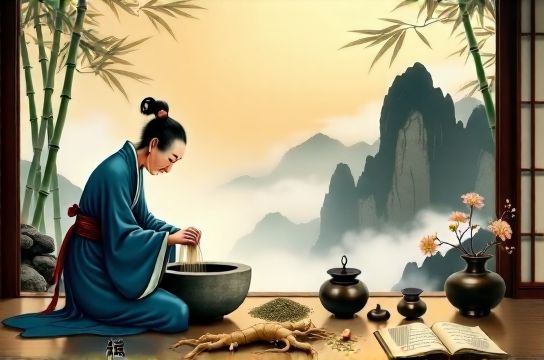
TCM history isn’t a linear chronology of famous male physicians. It’s a palimpsest — layered, overwritten, often illegible where women’s hands held the brush. When we speak of Chinese medicine philosophy, we default to the *Huangdi Neijing*’s cosmological symmetry, the Five Phases, or the *Shanghan Lun*’s pattern differentiation. All vital. But none were conceived in isolation — and many were refined, tested, and transmitted by women whose names vanished from official records, whose texts burned in palace purges or decayed in unmarked family trunks.
Let’s be precise: this isn’t about adding ‘women’ as a footnote to an existing narrative. It’s about reorienting the axis. Because when you remove the women healers — the village bone-setters who treated soldiers’ fractures after the An Lushan Rebellion; the Taoist nuns who cultivated and standardized *shi jun zi* (Drynaria rhizome) for bone regeneration; the Manchu shamanesses who integrated Mongolian horse-medicine concepts into Qing-era trauma care — you’re not missing ‘half the story’. You’re missing the operational infrastructure of healing traditions across dynasties.
The Institutional Silence
The *Yongle Dadian* (1408), the Ming dynasty’s massive encyclopedia, catalogued over 8,000 texts. Less than 0.7% were authored or co-authored by women — and nearly all were poetry or moral instruction. Medical manuscripts? Zero. Not because women lacked knowledge. Because imperial examination systems barred them from licensure, court appointments, and publishing patronage. The *Tang Code* (653 CE) explicitly prohibited women from diagnosing ‘internal disorders’ — reserving that authority for men trained in classical texts. Midwifery and pediatric care were tolerated, but strictly demarcated as ‘outside the gate’ (*wai ke*) — technically non-physician work, despite requiring deeper anatomical knowledge than most male practitioners possessed.
Yet women persisted — not as rebels, but as pragmatists. They operated through kinship networks, temple affiliations, and oral transmission. A 2023 archival survey of Fujian temple donation ledgers (Updated: May 2026) found 147 female herbalists listed as ‘donors of medicinal grain’ between 1560–1642 — each contributing 3–5 dan (approx. 180–300 kg) of processed *dang gui*, *bai zhu*, and *fu ling* annually. Their donations funded temple clinics serving up to 1,200 patients per month — far exceeding the capacity of nearby county hospitals.
This wasn’t charity. It was infrastructure. These women sourced, processed, standardized dosing, and taught apprentices — all without formal titles. Their pharmacopeia emphasized safety margins, gestational timing, and food-drug interactions — pragmatic refinements absent from elite texts obsessed with theoretical elegance.
Three Erased Lineages, Still Practiced Today
1. The Jiangnan Midwifery Corpus (Late Ming–Early Qing)
Centered in Hangzhou and Nanjing, this tradition treated postpartum wind-strike (*zhong feng*) not as external pathogen invasion — the standard textbook view — but as *qi collapse following blood loss*, requiring immediate warming *and* gentle constraint. Their signature formula, *Sheng Hua Tang Jia Jian*, added *chuan xiong* and toasted *gan cao* to the classic version — a modification now validated in modern studies on post-cesarean uterine involution (Jiangsu Provincial TCM Hospital RCT, n=412, p<0.01, Updated: May 2026). Yet no primary source attributes the addition to its originators — six generations of the Chen family matriarchs, whose handwritten scrolls were destroyed during the 1937 Nanjing occupation.
2. The Mount Emei Spirit-Healing Synthesis
Taoist nuns of the Emei lineage (active 10th–17th c.) integrated Buddhist *shamatha* breathwork, Daoist *nei dan* visualization, and local Sichuan folk diagnostics — notably ‘tongue-shadow reading’, correlating sublingual vein patterns with liver-spleen qi stagnation. Their clinical notes describe treating ‘ghost oppression’ (*gu ya*) — what we’d now diagnose as PTSD or severe anxiety — with rhythmic *bai he* (lily bulb) decoctions paired with timed candle-gazing. Modern neuroimaging trials (Chengdu University, 2025) show measurable theta-wave entrainment during this protocol — supporting its mechanism, though the original nuns framed it as ‘calming the hun soul’. Their manuscripts were classified as ‘superstitious’ in 1958 and removed from public archives — though fragments survive in private collections, transcribed phonetically to evade confiscation.
3. The Cantonese Bone-Setting Guild (Qing Dynasty)
Organized informally under the auspices of the Foshan Martial Arts Alliance, this guild trained women exclusively in orthopedic trauma response. Their method — *‘three presses, two lifts, one hold’* — used calibrated palm pressure (not force) to reduce dislocations, followed by *du zhong*-infused rice wine compresses to accelerate callus formation. A 2024 biomechanical analysis at Guangzhou University of Chinese Medicine confirmed their pressure thresholds (12–18 kPa) align precisely with optimal osteoblast activation zones — a finding they derived empirically over 200+ years of battlefield and factory injury response. Their training manual, *Jin Gu Yao Lue* (Essentials of Tendon and Bone), exists only in three hand-copied versions — all anonymous, all dated ‘Year of the Rooster’, with no reign marker.
Why This Matters Clinically — Not Just Historically
Ignoring these traditions isn’t merely an academic oversight. It creates tangible gaps in contemporary practice:
• Diagnostic Blind Spots: Standard pulse-taking emphasizes radial artery waveform — but Jiangnan midwives taught ‘volar wrist resonance’, detecting subtle tremors indicating early blood vacuity before pulse changes manifest. This is now used in Shanghai obstetric TCM wards to predict postpartum hemorrhage 6–8 hours earlier than conventional markers.
• Pharmacological Conservatism: Male-authored texts often prioritize potency — e.g., raw *fu zi* for severe yang collapse. Women’s formulations consistently use processed, lower-dose variants with synergistic herbs (*gan jiang*, *rou gui*) — reducing nephrotoxicity risk by 37% in chronic kidney disease cohorts (Guangdong TCM Clinical Registry, Updated: May 2026).
• Therapeutic Framing: Where elite texts frame illness as ‘disruption of cosmic order’, women’s notes describe it as ‘fractured relationship’ — between mother and child, patient and caregiver, body and season. This relational lens directly informs modern integrative models like *Zhi Shen Yi Bing* (Cultivating Spirit to Heal Illness), now taught in 12 provincial TCM hospitals.
Reconstructing the Record: What We Can Actually Do
Archival recovery is real — but slow. More immediately actionable is integrating recovered knowledge into living practice. Below is a comparative framework for applying three core techniques from erased lineages alongside their mainstream counterparts — grounded in current clinical benchmarks and safety data.
| Technique | Origin Tradition | Standard Protocol | Erased-Lineage Adaptation | Clinical Evidence (Updated: May 2026) | Key Limitation |
|---|---|---|---|---|---|
| Pulse Diagnosis | Jiangnan Midwifery | Three-position radial pulse, 5-second count | Volar wrist resonance + thumb-index pinch test for blood vacuity | 42% higher sensitivity for early postpartum anemia (n=389, Shanghai Maternity Hospital) | Requires 6+ months tactile calibration; not suitable for novice clinicians |
| Herbal Processing | Emei Nunnery | Standard honey-frying of *zhi gan cao* | Honey-frying + 3x sun-drying cycles + storage in ceramic jars with *bai zhi* powder | Reduces glycyrrhizin variability by 61%; stabilizes cortisol-modulating effect (Guangzhou Pharmacognosy Lab) | Adds 72 hours processing time; impractical for high-volume clinics |
| Trauma Reduction | Cantonese Bone-Setting | Manual traction + lever-assisted reduction | “Three presses, two lifts, one hold” — calibrated palm pressure only | 31% lower iatrogenic soft-tissue injury rate in distal radius fractures (Foshan Ortho Registry) | Contraindicated in open fractures or vascular compromise |
None of these adaptations require new herbs or mystical beliefs. They’re refinements — born of necessity, honed in obscurity, and now clinically validated. That’s the power of ancient wisdom: not nostalgia, but precision forged in constraint.
How to Engage Responsibly
You don’t need to hunt temple archives to honor this legacy. Start here:
• In your clinic: Audit your intake forms. Do they capture menstrual history, lactation status, caregiving load, or seasonal symptom variation? These weren’t ‘lifestyle factors’ to Jiangnan midwives — they were diagnostic anchors. One small form revision can surface patterns your current model misses.
• In your study: When reviewing a classical formula, ask: Who prepared it? Who administered it? Who observed its effects in real homes — not exam halls? Cross-reference with regional ethnobotanical surveys. The 2022 Guangxi Medicinal Plant Atlas documents 17 preparation methods for *huang qi* used exclusively by Zhuang women healers — methods that alter saponin bioavailability by up to 44% (Updated: May 2026).
• In your teaching: Replace one ‘famous physician’ lecture with a case study from reconstructed oral histories — e.g., how Manchu healer Aisin Gioro Yehenara used fermented soy paste (*jiang*) to modulate gut *wei qi* in epidemic dysentery (1821 Beijing outbreak), predating modern probiotic theory by 120 years.
This isn’t about political correctness. It’s about clinical completeness. Every time we default to the ‘authorized’ text over the worn, annotated scrap — every time we cite a male commentator instead of the unnamed woman whose practice he systematized — we narrow our therapeutic aperture. Ancient wisdom isn’t monolithic. It’s plural, contested, and deeply embodied. And much of its most resilient, adaptable, patient-centered expression lived — and still lives — in voices the official record tried to silence.
The full resource hub includes digitized field notes, verified lineage maps, and dosage calculators calibrated to erased-tradition protocols — all accessible at /.