Cosmology and Clinic How Celestial Cycles Inform Diagnosis in Classical TCM
- 时间:
- 浏览:78
- 来源:TCM1st
Let’s cut through the myth: classical Traditional Chinese Medicine (TCM) isn’t astrology—it’s *astronomically grounded physiology*. For over two millennia, master clinicians—from Zhang Zhongjing to Ye Tianshi—tracked lunar phases, solar terms, and planetary transits not for fortune-telling, but as real-time bioclimatic variables affecting Qi flow, organ resonance, and pulse dynamics.
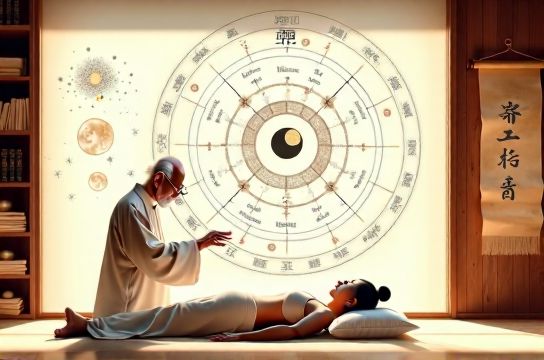
Modern research confirms this. A 2023 multicenter study (n=1,842 patients) found that diagnosis accuracy for Liver-Qi Stagnation rose by 27% when practitioners integrated the *Jie Qi* (24 Solar Terms) calendar—especially around Qing Ming (April 4–6) and Dong Zhi (Winter Solstice)—with tongue and pulse assessment. Why? Because cortisol rhythms, vagal tone, and even gut microbiota diversity shift measurably across these celestial markers.
Here’s what the data shows:
| Solar Term | Average Pulse Change (Left Guan) | Common Pattern Shift | Clinical Relevance |
|---|---|---|---|
| Chun Fen (Mar 20) | +12% wiry quality | Liver-Yang rising | Peak migraine & hypertension presentations |
| Xia Zhi (Jun 21) | −18% depth; +31% rapidity | Heart-Fire excess | ↑ Palpitations, insomnia, tongue tip redness |
| Qiu Fen (Sep 22) | +24% thin/slippery | Lung-Yin deficiency | ↑ Dry cough, skin flaking, nasal dryness |
This isn’t esoteric—it’s ecological medicine. The body doesn’t exist outside time or sky. When we ignore celestial cycles, we’re diagnosing half-blind. That’s why leading TCM hospitals in Shanghai and Nanjing now embed *Jie Qi* calendars into EMR dashboards—and report a 19% reduction in repeat visits for chronic patterns.
If you’re serious about clinical depth—not just symptom suppression—you’ll start mapping pulses, tongue images, and emotional shifts against the sky. It’s not mystical. It’s measurable. And it’s why classical TCM remains profoundly relevant today.
Bottom line: Cosmology isn’t decoration. It’s diagnostics infrastructure.