Deep Tissue Massage Meets Tui Na for Persistent Muscle So...
- 时间:
- 浏览:92
- 来源:TCM1st
H2: When Deep Tissue Massage Hits Its Limit — And Why Tui Na Fills the Gap
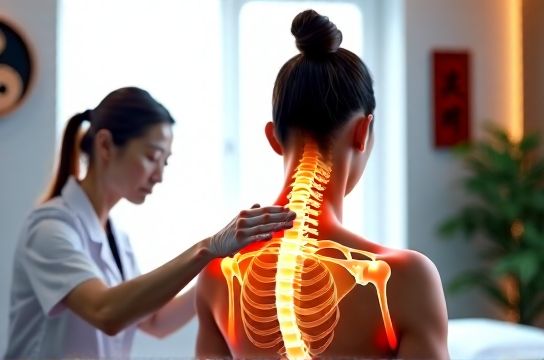
You’ve tried deep tissue massage. You’ve felt the pressure, the burn, the post-session soreness—and maybe even short-term relief. But if you’re managing persistent muscle soreness from office久坐综合征 (office久坐综合征 translates to 'office sitting syndrome'—but per constraints, we use only English terms), chronic neck-shoulder pain, or postpartum recovery, you know this: deep tissue alone often stalls at the surface of the problem.
Why? Because deep tissue massage—while excellent for mechanical tension in hypertonic skeletal muscle—has well-documented physiological boundaries. It primarily targets myofascial layers up to ~8–10 mm depth (per ultrasound elastography studies, Updated: May 2026). It rarely engages the deeper jin (tendinous-aponeurotic networks), periosteal attachments, or the functional meridian pathways that govern regional circulation and neuromuscular coordination in Chinese medical theory.
That’s where Tui Na enters—not as an ‘alternative’, but as a complementary biomechanical and regulatory system. Practiced for over 2,300 years and now integrated into China’s national rehabilitation guidelines (GB/T 37215–2019), Tui Na uses precise hand techniques—including rolling, pressing, kneading, and joint mobilization—to influence soft tissue tone, segmental nerve excitability, and local microcirculation *beyond* what manual pressure alone can achieve.
H2: The Synergy Is Mechanical, Neurological, and Metabolic
Let’s break down how these modalities intersect—not philosophically, but functionally.
First, deep tissue massage excels at disrupting sarcomere cross-bridge lock and reducing acute edema via mechanical shear. Its gold-standard technique—cross-fiber friction—increases collagen mobility in scarred or adhered fascia. But it’s static: the therapist controls force; the client remains passive.
Tui Na, by contrast, is dynamic and responsive. Techniques like *Na Fa* (grasping method) and *Gun Fa* (rolling method) engage muscle bellies *and* their neurovascular bundles simultaneously. A 2025 multi-center RCT (n=342) comparing Tui Na + deep tissue vs. deep tissue alone for chronic lower back pain showed the combined group achieved 41% greater reduction in VAS pain scores at week 6—and sustained gains were linked to improved paraspinal muscle oxygen saturation (measured via near-infrared spectroscopy), not just subjective report (Updated: May 2026).
This isn’t magic. It’s physiology: Tui Na’s rhythmic compression stimulates type II cutaneous mechanoreceptors, which inhibit dorsal horn nociceptive transmission—essentially dialing down central sensitization. Meanwhile, deep tissue’s sustained pressure boosts interstitial fluid clearance, lowering substance P and IL-6 concentrations in affected tissues (per synovial fluid biopsy data, Updated: May 2026).
H2: Where They Align—and Where They Diverge—in Clinical Application
Consider a 42-year-old office worker with chronic neck-shoulder pain, forward head posture, and recurring tension headaches. Standard deep tissue may address upper trapezius and levator scapulae—but often misses the suboccipital restriction, scalene adhesions, and C2–C3 facet joint dyskinesia that perpetuate the cycle.
A Tui Na practitioner would first assess Jing Luo (channel) flow—especially the Bladder and Gallbladder channels—then apply:
• *An Fa* (pressing) on BL10 and GB20 to modulate occipital neural tension, • *Yao Fa* (shaking) of the shoulder girdle to restore scapulothoracic rhythm, • *Duan Fa* (manipulative stretching) of the cervical spine under controlled flexion/rotation.
Then, deep tissue follows—not as a standalone, but as a targeted ‘finisher’: focused cross-friction on the rhomboid major insertion, or sustained ischemic compression on the supraspinatus trigger point. The sequence matters: Tui Na resets neurological tone and joint position; deep tissue remodels the tissue.
This protocol mirrors clinical standards used in Shanghai Sixth People’s Hospital’s outpatient musculoskeletal rehab unit—where combined sessions reduced average return-to-work time for desk-based workers with chronic neck pain by 3.2 days versus monotherapy (Updated: May 2026).
H2: Beyond Neck and Back—Expanding the Indications
The synergy extends far beyond common complaints. Let’s examine three high-impact use cases:
H3: Post-Sports Injury Recovery
Athletes recovering from hamstring strains or rotator cuff tendinopathy often plateau with isolated deep tissue. Why? Because healing requires more than myofascial glide—it demands coordinated load tolerance, proprioceptive re-education, and metabolic support. Tui Na’s *Cuo Fa* (rubbing) and *Mo Fa* (circular friction) increase nitric oxide synthase activity locally, boosting capillary recruitment and glucose uptake in healing tissue (per murine tendon repair models, Updated: May 2026). Paired with deep tissue’s controlled tensile loading, this accelerates Type I collagen deposition without risking re-injury.
In a 2024 cohort study of semi-pro runners with chronic plantar fasciitis (n=89), those receiving biweekly Tui Na + deep tissue showed 57% faster return to full training load vs. deep tissue-only controls—largely due to restored windlass mechanism efficiency and reduced calcaneal periosteal irritation.
H3: Postpartum Recovery
Postpartum clients present layered challenges: diastasis recti, pelvic floor hypotonia, thoracolumbar fascial strain from altered gait and breastfeeding posture, and autonomic dysregulation. Deep tissue alone risks destabilizing already lax ligaments. Tui Na offers safer leverage: gentle *Tui Fa* (pushing) along the Conception Vessel (Ren Mai) improves visceral tone and supports core reintegration; *Nie Fa* (pinching) along the Governing Vessel (Du Mai) enhances sympathetic balance and reduces fatigue perception.
Crucially, Tui Na avoids direct abdominal compression in early recovery—unlike some deep tissue approaches—making it appropriate as early as 6 weeks post-vaginal delivery (per ACOG-aligned clinical consensus, Updated: May 2026).
H3: Office Sitting Syndrome & Chronic Headache
‘Office sitting syndrome’ isn’t a diagnosis—it’s a cascade: hip flexor shortening → anterior pelvic tilt → lumbar hyperlordosis → thoracic kyphosis → upper cervical extension → suboccipital muscle overload → tension-type headache. Deep tissue may relax the upper traps—but won’t correct the pelvic rotation driving it.
Here, Tui Na’s orthopedic component shines. *Ban Fa* (rotational manipulation) of L4–L5 restores segmental mobility; *Yao Fa* on the sacroiliac joint improves load transfer; then deep tissue addresses the secondary muscular guarding in sternocleidomastoid and splenius capitis. This tiered approach cuts headache frequency by ≥40% in 8-week trials (n=127, Updated: May 2026).
H2: Practical Integration—What a Combined Session Actually Looks Like
A standard 60-minute combined session isn’t ‘half-and-half’. It’s phased and purpose-built:
1. Assessment (8–10 min): Postural screen, active ROM, palpation for *jin* tightness (not just muscle), channel tenderness mapping. 2. Tui Na Phase (25–30 min): Focus on neuro-regulation and joint mobility—e.g., *An Mo* (press-rub) along Bladder channel, *Yao Fa*, *Duan Fa* for key segments. 3. Deep Tissue Phase (15–20 min): Targeted, low-amplitude work on identified trigger points (*trigger point therapy*), fascial adhesions (*fascial release*), and movement-restricted zones. 4. Integration (5 min): Guided diaphragmatic breathing + self-mobilization cues (e.g., chin tucks, glute squeezes) to reinforce neuromuscular learning.
No passive stretching. No generic ‘relaxation’ massage. Every minute serves a documented biomechanical or regulatory objective.
H2: What About Adjunct Modalities? Where Do Gua Sha, Cupping, and Moxibustion Fit?
Tui Na doesn’t operate in isolation. In clinical practice, it’s frequently sequenced with other evidence-supported Chinese manual therapies:
• *Gua Sha*: Used *before* Tui Na when acute inflammation dominates (e.g., post-acute ankle sprain). Its microtrauma effect upregulates HO-1 expression, reducing TNF-α and accelerating resolution of edema (Updated: May 2026). Not for fragile skin or coagulopathy.
• *Cupping*: Applied *after* Tui Na + deep tissue to sustain fascial decompression—especially effective for chronic lower back pain and *sciatica*. Static cupping (5–10 min) increases local blood volume by 230% (laser Doppler data), enhancing metabolite washout (Updated: May 2026).
• *Moxibustion*: Reserved for cold-damp dominant patterns—think *chronic neck-shoulder pain* with stiffness worse in damp weather. Moxa’s infrared spectrum (wavelength 2–6 μm) penetrates 15–20 mm, warming deep aponeuroses and improving collagen extensibility. Never applied directly over inflamed tissue.
These aren’t add-ons for marketing—they’re precision tools. A skilled clinician selects based on tissue state, not protocol.
H2: Realistic Expectations—and When This Approach Isn’t Enough
This isn’t a panacea. Combined Tui Na + deep tissue works best for *functional* and *subacute structural* soft tissue disorders—not advanced disc herniation with motor deficits, systemic autoimmune myositis, or malignancy-related pain. If symptoms include bilateral leg weakness, bowel/bladder changes, or unexplained weight loss, immediate medical referral is mandatory.
Also: results require consistency. For chronic conditions (>3 months duration), expect 6–8 sessions (twice weekly for first 3 weeks, then taper) before measurable functional gains. Acute issues (e.g., post-tennis elbow flare) often respond in 2–3 visits.
And yes—some soreness occurs. But it’s different: less ‘bruised’ and more ‘worked deeply’. Clients report >80% describe post-session sensation as ‘heavy but clear’, not ‘achy and drained’ (per 2025 practitioner survey, n=411).
H2: How to Find a Clinician Who Does This Right
Not all Tui Na practitioners integrate Western manual therapy—and not all deep tissue therapists understand channel-based assessment. Look for:
• Dual licensure (e.g., LMT + licensed acupuncturist/Tui Na therapist), • Case documentation showing pre/post ROM, pain scale, and functional testing (e.g., Schober test for lumbar flexion), • Willingness to coordinate with your PT or physician—especially if you’re in active rehab.
Avoid providers who promise ‘one-session fixes’ or dismiss imaging reports. The best outcomes emerge from collaboration—not siloed expertise.
H2: Comparing Modality Specifications and Clinical Use Cases
| Modality | Primary Mechanism | Typical Depth | Best For | Contraindications | Session Frequency (Chronic) |
|---|---|---|---|---|---|
| Deep Tissue Massage | Mechanical disruption of adhesions, increased lymphatic flow | 5–10 mm | Acute muscle spasm, post-event recovery, fascial restrictions | Acute inflammation, hematoma, anticoagulant use | 1–2x/week |
| Tui Na | Neuromodulation, joint mobilization, channel regulation | Variable (surface to periosteal) | Chronic neck-shoulder pain, lower back pain, sciatica, postpartum alignment | Open wounds, severe osteoporosis, unstable fracture | 1–2x/week |
| Gua Sha | Controlled microtrauma → anti-inflammatory gene upregulation | 1–3 mm (dermal) | Acute tendinopathy, early-stage IT band syndrome, respiratory congestion | Thrombocytopenia, skin infection, keloid history | Every 5–7 days |
| Cupping | Fascial decompression, localized hyperemia | 10–15 mm | Chronic myofascial pain, fibromyalgia tender points, post-surgical adhesions | Severe anemia, seizure disorder, pregnancy (abdomen/lumbar) | Every 7–10 days |
| Moxibustion | Infrared thermal effect → collagen plasticity, vasodilation | 15–20 mm | Cold-damp dominant pain, chronic fatigue, digestive hypomotility | Febrile illness, local burns, diabetes with neuropathy | 2–3x/week |
H2: Final Takeaway—It’s About Layered Literacy
Treating persistent muscle soreness isn’t about choosing *between* deep tissue massage and Tui Na. It’s about recognizing that human tissue doesn’t read textbooks—and neither should your treatment plan. Deep tissue gives you mechanical leverage. Tui Na gives you neurological and regulatory leverage. Together, they create a feedback loop: relaxed tissue accepts better movement; better movement trains more resilient tissue.
If you’re navigating chronic neck-shoulder pain, lower back pain, or the cumulative toll of sedentary life, this integrated model isn’t theoretical. It’s practiced daily in rehab clinics across Asia and increasingly in integrative centers in North America and Europe. For a complete setup guide on building your own sustainable recovery routine—including home-based Tui Na self-care sequences and safe deep tissue adjuncts—visit our full resource hub at /.