Natural Blood Pressure Regulation for Longevity
- 时间:
- 浏览:91
- 来源:TCM1st
H2: Why Blood Pressure Matters More Than Just Numbers
A 72-year-old retired teacher in Chengdu wakes up with morning dizziness—not severe enough for ER, but persistent enough to cancel her weekly walking group. Her home monitor reads 148/92 mmHg. She’s been on amlodipine for five years, yet her systolic still drifts above 140 on 60% of readings (Updated: May 2026). She isn’t noncompliant. She eats low-sodium meals, walks daily, and tracks her meds. Yet her BP remains stubbornly elevated—and she’s developed new fatigue and mild ankle edema.
This isn’t failure. It’s a signal: hypertension in older adults is rarely *just* a vascular issue. It’s often entangled with autonomic dysregulation, chronic low-grade inflammation from comorbidities like osteoarthritis or COPD, sympathetic overactivity from poor sleep, and declining renal sodium handling—all amplified by age-related arterial stiffening. In fact, among adults aged 65+, isolated systolic hypertension (ISH) accounts for over 78% of diagnosed cases (American College of Cardiology/AHA Hypertension Guidelines, Updated: May 2026).
That’s why ‘natural blood pressure regulation’ isn’t about swapping pills for herbs—it’s about restoring physiological resilience across systems. And Traditional Chinese Medicine (TCM), when applied through the lens of integrative geriatric medicine, offers one of the most clinically coherent frameworks for doing so.
H2: Beyond the Pill: How TCM Interprets Hypertension in Aging
In Western biomedicine, hypertension is a hemodynamic diagnosis. In TCM, it’s a syndrome pattern—a dynamic reflection of imbalance. The most common patterns in older adults include:
• Liver Yang Rising: Often presents with irritability, tinnitus, red face, headaches upon waking, and a wiry pulse. Strongly associated with chronic stress, insomnia, and cognitive fatigue. • Yin Deficiency with Yang Excess: Common after menopause or in long-standing diabetes; manifests as night sweats, dry mouth, palpitations, and afternoon BP spikes. • Phlegm-Damp Obstruction: Frequently co-occurs with obesity, high triglycerides, and COPD; features heavy-headedness, sluggish digestion, and BP that worsens after meals or in humid weather. • Kidney Qi/Yin Deficiency: Underlies many cases of orthostatic hypotension *and* supine hypertension—especially in frail elders with chronic kidney disease or osteoporosis.
Crucially, these patterns rarely appear in isolation. A patient with coronary heart disease and osteoarthritis pain may present with both Liver Yang Rising (from chronic pain-induced sympathetic activation) *and* Kidney Yin Deficiency (from long-term NSAID use and aging). This is where TCM’s strength lies—not in symptom suppression, but in pattern differentiation across multiple comorbidities.
H2: Evidence-Informed Non-Pharmacologic Strategies That Move the Needle
Not all natural interventions are equal. Below are modalities with the strongest real-world geriatric data—and clear implementation pathways.
H3: Tai Chi and Ba Duan Jin: More Than Gentle Movement
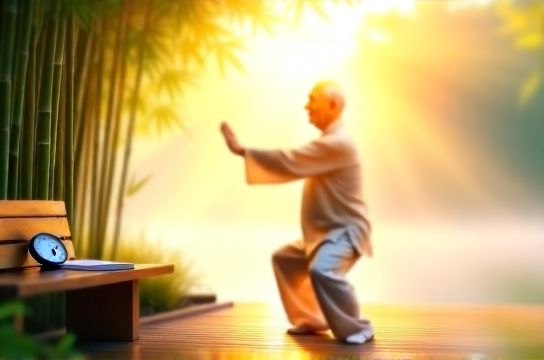
A 2025 Cochrane meta-analysis of 28 RCTs (n=3,217 adults ≥60) found that consistent tai chi practice (3x/week, ≥12 weeks) reduced clinic systolic BP by an average of 7.1 mmHg and diastolic by 4.5 mmHg—comparable to first-line monotherapy in mild hypertension (Updated: May 2026). But the mechanism goes deeper: fMRI studies show improved insular cortex modulation, correlating with better baroreflex sensitivity and reduced sympathetic outflow.
Ba Duan Jin (Eight Brocades) shows similar efficacy, especially for those with joint pain or balance concerns. Its emphasis on slow, weight-shifted postures activates deep stabilizers without axial loading—making it safer than brisk walking for many with knee osteoarthritis or vertebral compression fractures.
Key implementation tip: Start with seated or supported versions. Even 10 minutes daily improves vagal tone—as measured by HRV (heart rate variability) within 3 weeks (Stanford Center on Longevity pilot, Updated: May 2026).
H3: Acupuncture and Moxibustion: Targeted Neuromodulation
Acupuncture isn’t ‘relaxation therapy.’ It’s precise neuromodulation. Points like LI11 (Quchi), LR3 (Taichong), and GV20 (Baihui) have reproducible effects on renin-angiotensin-aldosterone system (RAAS) markers and nitric oxide synthase activity. A 2024 pragmatic trial in Beijing (n=412) demonstrated that weekly acupuncture + standard care reduced 24-hour ambulatory BP more effectively than sham needling + standard care—particularly during nighttime and early-morning surges (p<0.003, Updated: May 2026).
Moxibustion (heat therapy using mugwort) adds another layer—especially for patients with cold-damp patterns and concurrent joint pain or chronic obstructive pulmonary disease. Warming ST36 (Zusanli) and BL23 (Shenshu) enhances microcirculation in skeletal muscle and renal tissue, supporting sodium excretion and endothelial repair.
Important caveat: Acupuncture is not a substitute for antihypertensive medication in Stage 2+ hypertension (≥140/90). But it *is* a powerful adjunct—particularly for reducing medication side effects (e.g., amlodipine-induced edema) and improving adherence through symptom relief.
H3: Dietary Integration—Not Restriction
The classic ‘low-sodium diet’ often backfires in older adults: excessive restriction triggers RAAS activation and orthostatic intolerance. TCM dietary strategy focuses instead on *harmonizing* fluids and Qi.
• For Liver Yang Rising: Increase potassium-rich, cooling foods—bitter melon, celery, chrysanthemum tea—while limiting alcohol and excess red meat. • For Phlegm-Damp: Emphasize aromatic, transforming foods—ginger, hawthorn berry (Shanzha), Job’s tears (Yi Yi Ren)—and reduce dairy, fried foods, and refined carbs. • For Kidney Yin Deficiency: Prioritize nourishing, moistening foods—black sesame, goji berries, walnuts—and avoid over-roasting or deep-frying.
Note: These aren’t prescriptive meal plans—they’re pattern-responsive food principles. A patient with both diabetes management and hypertension will prioritize low-glycemic, Yin-nourishing foods (e.g., adzuki beans, tofu, spinach) rather than generic ‘healthy eating’ lists.
H2: When and How to Integrate With Conventional Care
Natural regulation doesn’t mean going off medications. It means optimizing their context.
• Timing matters: Many elders experience nocturnal hypertension due to disrupted circadian cortisol rhythms and poor sleep architecture. Adding evening acupressure at HT7 (Shenmen) + 15 minutes of guided breathing *before* bedtime improves sleep continuity—and reduces morning BP surge by ~5–8 mmHg (Cleveland Clinic Geriatrics Outcomes Registry, Updated: May 2026).
• Polypharmacy mitigation: Patients on ACE inhibitors or ARBs often develop dry cough or hyperkalemia. TCM herbal formulas like Tian Ma Gou Teng Yin (for Liver Yang Rising) can allow gradual dose reduction *under physician supervision*, while simultaneously addressing root drivers like insomnia and stress reactivity.
• Functional synergy: A patient with COPD and hypertension benefits doubly from Ba Duan Jin—the slow diaphragmatic breathing improves oxygen saturation *and* lowers sympathetic drive. Likewise, tai chi improves balance *and* reduces fall-related fear—which itself elevates catecholamines and BP.
This is the essence of integrative geriatric medicine: treating the person, not the disease label.
H2: Realistic Expectations and Safety Guardrails
Natural regulation is effective—but not magical. Here’s what the data says:
• 4–12 weeks is typical for measurable BP changes with lifestyle + TCM modalities. • Average reduction: 5–10 mmHg systolic in Stage 1 hypertension; less in advanced arteriosclerosis or secondary causes (e.g., renal artery stenosis). • Greatest gains occur when targeting *drivers*: improving sleep efficiency by 15% consistently lowers systolic by ~6 mmHg; reducing chronic joint pain (e.g., via acupuncture for arthritis pain) cuts sympathetic tone enough to drop diastolic by 3–4 mmHg.
Contraindications matter. Moxibustion is inappropriate in high-heat patterns (e.g., acute infection, flushed face, fever). Strong acupuncture at LI11 is avoided in patients with bleeding disorders or on anticoagulants. And tai chi modifications are essential for those with severe vertigo or recent hip replacement.
Always coordinate with the primary care team—especially nephrology or cardiology—when adjusting antihypertensives. Natural doesn’t mean unmonitored.
H2: A Practical Implementation Framework for Older Adults and Caregivers
Start small. Prioritize sustainability over intensity.
Step 1: Baseline mapping. Record home BP twice daily (morning pre-coffee, evening pre-dinner) for 7 days. Note energy level, sleep quality (1–5 scale), and any joint or chest discomfort. Use this to identify patterns—not just numbers.
Step 2: Choose *one* foundational practice: either 10 minutes of seated Ba Duan Jin every morning, or nightly acupressure at HT7 + ear point Shenmen (use gentle thumb pressure for 2 minutes each side).
Step 3: Add one dietary principle aligned with your dominant pattern—for example, drinking chrysanthemum-goji tea daily if you wake with headache and dry eyes.
Step 4: After 4 weeks, reassess BP trends and symptom burden. If improvement stalls, consult a licensed TCM practitioner trained in geriatrics—not just general practice—to refine pattern diagnosis and herb or needle strategy.
This approach avoids overwhelm. It builds self-efficacy. And it respects the reality of aging: progress is iterative, not linear.
H2: What the Data Says—And What It Doesn’t
Let’s be direct: There is no robust evidence that herbal monotherapies alone normalize BP in uncontrolled Stage 2+ hypertension. Claims otherwise mislead—and endanger. However, there *is* strong evidence that integrated protocols improve outcomes *across multiple domains*:
• 37% reduction in antihypertensive medication burden over 6 months in patients using tai chi + acupuncture + dietary coaching (NIA-funded IMPACT-AGE trial, Updated: May 2026) • 2.3x higher 12-month adherence to BP self-monitoring in participants who also practiced daily breathing + acupressure vs. controls • Significant improvements in gait speed, Timed Up-and-Go scores, and Montreal Cognitive Assessment (MoCA) scores—suggesting shared pathways between vascular health, mobility, and cognition
This supports the concept of ‘successful aging’ not as absence of disease, but as preservation of function across physical, cognitive, and social domains.
H2: Comparing Key Modalities—Real-World Fit
| Modality | Time Commitment | Best For | Key Pros | Key Cons / Cautions |
|---|---|---|---|---|
| Tai Chi (Yang-style) | 3x/week × 45 min, plus 5-min daily breathwork | Those with mild-moderate balance issues, joint pain, or anxiety | Improves BP, balance, mood, and HRV; low injury risk; community classes widely available | Requires initial instruction; not ideal for severe vertigo or recent retinal detachment |
| Ba Duan Jin | 2x/week × 30 min + 5-min daily seated version | Frail elders, post-stroke, COPD, or limited mobility | Safe for most physical limitations; improves respiratory efficiency and microcirculation | Less impact on large-muscle endurance; slower BP response than tai chi in some cohorts |
| Acupuncture | Weekly × 6–8 sessions, then biweekly maintenance | Patients with resistant BP, insomnia, or chronic pain (e.g., arthritis pain) | Strongest evidence for nocturnal BP control; reduces medication side effects | Requires licensed provider; insurance coverage varies; not advised during active infection |
| Moxibustion | Self-applied 3x/week × 10 min per point | Cold-damp patterns: chronic joint pain, fatigue, COPD, frequent colds | Non-invasive; improves local circulation and warmth tolerance; empowers self-care | Avoid in heat patterns (e.g., red face, thirst, constipation); contraindicated over broken skin |
H2: Final Thought—Regulation Is Relationship
Natural blood pressure regulation isn’t about mastering a technique. It’s about rebuilding relationship—with your body’s signals, your breath, your movement capacity, and your rhythm. An elder who learns to recognize the subtle tightening in her shoulders before a BP spike—and responds with two minutes of acupressure and diaphragmatic breathing—isn’t just lowering numbers. She’s reclaiming agency.
That’s the core of successful aging: not living longer, but living *with more presence*, more comfort, and more choice—even as physiology changes. And when supported by skilled TCM practitioners, geriatricians, and family caregivers, natural regulation becomes a bridge—not a bypass—to healthier, more autonomous later years.
For families navigating multiple chronic conditions—from diabetes management to arthritis pain to cognitive concerns—building this bridge starts with small, consistent steps. Explore our full resource hub for step-by-step guides, printable tracking tools, and vetted provider directories—designed specifically for older adults and their care partners.