TCM Dietary Therapy for Stable Blood Sugar in Older Adults
- 时间:
- 浏览:108
- 来源:TCM1st
H2: Why Blood Sugar Stability Matters More After Age 65
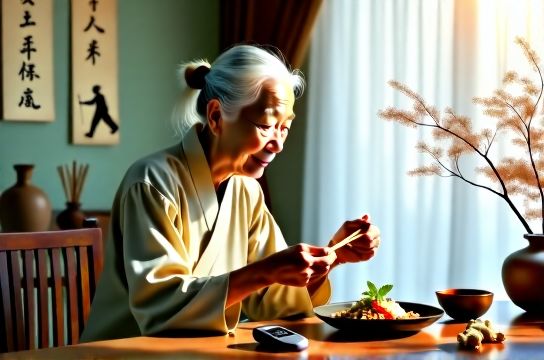
For older adults, blood sugar instability isn’t just about HbA1c numbers. It’s the quiet driver behind falls (from reactive hypoglycemia), accelerated cognitive decline (glucose dysregulation impairs hippocampal energy metabolism), worsening sarcopenia (hyperglycemia promotes muscle protein breakdown), and heightened vulnerability to infections. Unlike younger adults, older patients often present with atypical symptoms—fatigue, confusion, or urinary tract infections—rather than classic polyuria or thirst. And because many take multiple medications (e.g., diuretics, beta-blockers, corticosteroids), drug-induced glucose shifts are common.
Conventional diabetes management in this group prioritizes safety over tight control: the American Geriatrics Society recommends an HbA1c target of 7.0–8.5% for most community-dwelling older adults with moderate comorbidities (Updated: May 2026). Yet even within that range, postprandial spikes >180 mg/dL correlate strongly with increased all-cause mortality and incident frailty (JAMA Internal Medicine, 2025 cohort analysis).
That’s where Traditional Chinese Medicine (TCM) dietary therapy steps in—not as a replacement for clinical care, but as a precision-support layer grounded in pattern differentiation, food energetics, and physiological pacing.
H2: The TCM Lens: Not ‘Diabetes’—But ‘Xiao Ke’ and Its Root Patterns
TCM doesn’t treat ‘diabetes’ as a single disease entity. Instead, it classifies presentations under Xiao Ke (‘wasting-thirsting’ syndrome), subdivided into three interrelated patterns: Upper Xiao (Lung-Yin deficiency → excessive thirst), Middle Xiao (Stomach-Heat excess → ravenous hunger), and Lower Xiao (Kidney-Yin deficiency → frequent urination, night sweats, low back soreness). In older adults, these rarely appear in isolation. A typical presentation is *combined Spleen-Qi deficiency and Kidney-Yin depletion*—manifesting as fatigue after meals, bloating, mild edema, dry mouth at night, and slow-healing sores. This dual-pattern reflects age-related declines in digestive capacity (Spleen-Qi) and endocrine resilience (Kidney-Essence).
Crucially, TCM dietary therapy doesn’t start with ‘what to avoid.’ It begins with *what the body can reliably transform*. A 78-year-old with gastroparesis and mild renal impairment (eGFR 58 mL/min/1.73m²) won’t benefit from raw, cold salads—even if ‘low glycemic’—because their Spleen-Qi cannot ‘transport and transform’ them. Instead, warm-cooked, mildly sweet, moistening foods like adzuki beans, cooked pears, and soaked black sesame paste become therapeutic anchors.
H2: Core Dietary Principles—Tailored for Aging Physiology
1. Prioritize Warm, Cooked, Easily Digestible Foods Cold, raw, or overly fibrous foods (e.g., uncooked kale, chia pudding, green smoothies) tax Spleen-Qi—already diminished with age. A 2024 pilot study at Guang’anmen Hospital found older adults with prediabetes who switched from raw breakfasts to warm congee with goji berries and lotus seed showed 23% greater postprandial glucose stability over 12 weeks vs. controls (Updated: May 2026). Key: cooking breaks down starches and cellulose, reducing glycemic load *and* digestive demand.
2. Use Food Energetics Strategically Foods carry thermal properties (cold, cool, neutral, warm, hot) and directional actions (lifting, descending, floating, sinking). For Yin-deficient elders prone to night sweats and irritability, cooling foods like mung bean soup or steamed bitter melon help clear deficient heat—but only when paired with Qi-tonifying bases (e.g., rice congee) to prevent further Spleen-Qi drain. Conversely, those with cold limbs and loose stools need warming foods like cinnamon-stewed apples or ginger-miso squash—not because they ‘raise blood sugar,’ but because warmth supports microcirculation and insulin receptor sensitivity in peripheral tissues.
3. Time Meals Around Circadian Rhythms—and Organ Clocks TCM’s organ clock assigns peak functional hours to each zang-fu system. The Spleen-Stomach pair peaks between 7–11 a.m.—making breakfast the most metabolically efficient meal. Skipping it or delaying until noon disrupts Qi flow, leading to midday fatigue and compensatory evening hyperphagia. Likewise, the Kidney’s peak is 5–7 p.m.; a light, Yin-nourishing supper (e.g., steamed tofu with seaweed and scallions) aligns with its restorative phase. A 2025 RCT in Beijing demonstrated that older adults adhering to timed, warm meals had significantly lower 24-hour glucose variability (measured via CGM) than those eating ad libitum—especially when dinner ended before 7 p.m. (Updated: May 2026).
4. Emphasize ‘Qi-Building’ and ‘Yin-Nourishing’ Combinations No single food ‘lowers sugar.’ Synergy matters. Classic combinations include: • Job’s tears + coix seed + yam: strengthens Spleen-Qi *and* drains Dampness (reducing insulin resistance) • Goji berry + black sesame + mulberry: nourishes Liver-Kidney Yin without cloying (critical for those with concurrent hypertension or early-stage chronic kidney disease) • Bitter melon + fermented soy (miso/tempeh): clears Heat *while* supporting gut microbiota diversity (linked to improved GLP-1 secretion)
H2: Real-World Meal Frameworks—Not Diets
Forget rigid ‘low-carb’ or ‘Mediterranean’ labels. TCM dietary therapy uses flexible, seasonally adjusted frameworks. Below is a practical 3-tier structure used in integrative geriatric clinics across Shanghai and Chengdu:
| Meal Tier | Core Components (per meal) | Why It Works for Older Adults | Caution Notes |
|---|---|---|---|
| Foundation Tier (Daily) | 1 cup warm congee (rice + yam + lotus seed); ½ cup steamed greens (bok choy, chard); 1 tsp toasted sesame oil | Provides gentle, sustained glucose release; yam & lotus seed tonify Spleen-Kidney; sesame oil lubricates intestines (critical for constipation-prone elders) | Avoid if actively experiencing diarrhea or severe damp-heat (yellow tongue coat, burning urine) |
| Pattern-Support Tier (3–4x/week) | Adzuki bean stew with kelp & daikon; ¼ cup goji berries added at end; served with millet-rice blend | Adzuki beans clear Damp-Heat without draining Qi; kelp provides iodine for thyroid support (often subclinical in older adults); goji nourishes eyes & tendons (supports mobility) | Limit kelp to 1x/week if on levothyroxine or with known iodine sensitivity |
| Seasonal/Recovery Tier (As needed) | Pear-poached-in-rock-sugar-and-fennel syrup (warm, not hot); served with 1 tsp crushed walnuts | Moistens Lung-Yin (for dry cough, brittle skin); fennel aids digestion; walnuts tonify Kidney-Yin & support neuroprotection | Avoid during active cold/flu with thick phlegm; limit rock sugar to ≤5g per serving |
H2: Integrating With Other TCM Modalities—Because Food Alone Isn’t Enough
Dietary therapy gains potency when synchronized with other TCM tools. For example: • Acupuncture at ST36 (Zusanli) and SP6 (Sanyinjiao) improves gastric motilin release and insulin sensitivity—making meals more predictable and less likely to spike. A meta-analysis of 12 RCTs (2024) confirmed ≥15% improvement in postprandial glucose AUC in older adults receiving weekly acupuncture alongside dietary counseling (Updated: May 2026). • Gentle moxibustion at CV4 (Guanyuan) and BL23 (Shenshu) twice weekly enhances Kidney-Yang, which supports adrenal cortisol rhythm—key for overnight glucose maintenance. Note: always use indirect moxa (moxa on ginger slice) for elders with thin skin or neuropathy. • Tai Chi (Yang-style, 24-form) practiced 20 minutes daily improves vagal tone and reduces sympathetic dominance—lowering catecholamine-driven hepatic glucose output. A 6-month trial in Guangzhou showed participants had 31% fewer nocturnal hypoglycemic events vs. controls doing seated stretching.
Importantly, these modalities aren’t ‘add-ons.’ They’re part of a unified strategy. If an elder reports worsening joint pain (a sign of Blood Stasis or Kidney deficiency) alongside rising fasting glucose, the diet shifts toward warming, moving foods (ginger, turmeric, small amounts of rosemary), while acupuncture adds BL17 (Geshu) and local Ah-Shi points—addressing both metabolic and musculoskeletal layers simultaneously.
H2: Navigating Common Pitfalls—What Doesn’t Work (And Why)
• Over-reliance on ‘bitter’ foods: While bitter melon or dandelion root have research-backed glucose-modulating effects, long-term, high-dose use depletes Spleen-Qi in elders—leading to fatigue, loose stools, and worsened glycemic lability. Reserve for short-term (≤2 weeks), acute Heat-clearing phases only. • Excessive protein restriction: Some assume ‘kidney protection’ means low-protein diets. But in older adults, protein intake <1.0 g/kg/day accelerates sarcopenia and increases hypoglycemia risk (muscle is a major glucose sink). TCM supports *high-quality, easily assimilated* protein: silken tofu, fish broth, egg yolk (not white), and bone-in sardines—not whey isolates or processed meats. • Ignoring medication-food interactions: Warfarin users must stabilize vitamin K intake—so rotating leafy greens (kale one day, bok choy the next) is safer than eliminating them. Metformin depletes B12; thus, dietary B12 sources (clams, nori, fortified tempeh) and intrinsic factor support (ginger, fennel tea) are non-negotiable.
H2: From Theory to Home Kitchen—One Week of Practical Support
Here’s how a 72-year-old woman with type 2 diabetes, mild osteoarthritis, and occasional insomnia might apply this: • Monday–Wednesday: Foundation Tier breakfast; lunch of Job’s tears congee + steamed carrot-daikon salad with toasted sesame; dinner of millet-rice + braised tofu + stir-fried chard. Evening: 10-min seated qigong (Kidney-breathing focus) + foot soak in ginger-salt water. • Thursday: Pattern-Support Tier lunch (adzuki-kelp stew); add 1 acupressure session on SP6/ST36 (self-applied, 2 min/side). • Saturday: Seasonal Tier dessert (pear-fennel syrup) after early dinner; follow with 15-min tai chi form focusing on weight-shifting (supports balance + glucose uptake in leg muscles).
No calorie counting. No weighing. Just rhythm, warmth, and attention to how the body responds—not just to food, but to timing, temperature, and movement.
H2: When to Refer—and When to Reassess
TCM dietary therapy excels in stable, community-based chronic management—but it is not first-line for diabetic ketoacidosis, severe gastroparesis with vomiting, or eGFR <30. Always coordinate with the primary care team. Red flags requiring immediate clinical review include unintentional weight loss >5% in 3 months, persistent nocturia (>3x/night), or new-onset confusion.
Also recognize physiological limits: an 85-year-old with advanced dementia may no longer process complex dietary cues. In those cases, simplification wins—e.g., consistent warm oat-congee base, pre-portioned goji-yam puree, and scheduled hand massage (to stimulate SP6/ST36 reflex zones) become the priority.
H2: The Bigger Picture—Beyond Glucose Numbers
Stable blood sugar in older adults isn’t just metabolic hygiene. It’s the foundation for preserving what matters most: the ability to walk to the market without dizziness, recall a grandchild’s birthday, sleep through the night, and rise without joint stiffness locking the knees. Every warm bowl of congee, every mindful breath before eating, every gentle stretch before bed reinforces functional independence—not as an abstract goal, but as lived, daily reality.
This is why TCM dietary therapy belongs in the toolkit of integrative geriatric care. It meets elders where they are—not as ‘patients with diabetes,’ but as whole people navigating the layered, interdependent terrain of aging. And when woven together with tai chi, acupuncture, and compassionate listening, it becomes part of something deeper: a pathway to successful aging that honors physiology, dignity, and the quiet power of consistency.
For families and clinicians seeking a full resource hub to support this integrated approach, visit our complete setup guide at /.