TCM Based Fall Prevention Through Core Stability and Prop...
- 时间:
- 浏览:70
- 来源:TCM1st
H2: Why Falls Are a Silent Crisis—and Why Standard Approaches Often Fall Short
Every year, one in four adults aged 65+ experiences a fall. In the U.S., that’s over 14 million incidents (CDC, Updated: May 2026). Of those, 3 million visit emergency departments, and more than 38,000 die annually from fall-related injuries. In China, national surveillance data shows similar rates—27.2% annual fall prevalence among community-dwelling seniors aged 70–79, rising to 39.8% for those 80+ (China CDC National Chronic Disease Surveillance, Updated: May 2026).
Conventional fall prevention programs often focus narrowly on environmental modification (e.g., grab bars), strength training, or vitamin D supplementation. These help—but they miss a critical layer: neuromuscular integration. A strong quadriceps doesn’t prevent a stumble if the brain fails to register ankle tilt within 80 milliseconds—or if the transversus abdominis doesn’t reflexively engage before heel strike.
That’s where Traditional Chinese Medicine (TCM) offers a distinct, systems-level advantage—not as an alternative, but as a functional complement to geriatric rehabilitation.
H2: The TCM Framework: Jing, Qi, and the ‘Root of Stability’
TCM doesn’t treat ‘balance’ as a biomechanical endpoint. It treats it as an expression of three interdependent foundations:
• Jing (Essence): Stored in the Kidneys, Jing governs bone density, marrow health, and structural integrity—including vertebral alignment and ligament resilience. Depleted Jing correlates strongly with osteopenia progression and postural sway increase (observed in longitudinal cohort studies at Guang’anmen Hospital, Updated: May 2026).
• Qi of the Spleen and Kidney: Spleen-Qi governs muscle tone and limb endurance; Kidney-Qi anchors the body and supports deep postural reflexes. When both are deficient—a common pattern in patients with chronic kidney disease, hypertension, or diabetes—the result is not just fatigue, but delayed anticipatory postural adjustments.
• Shen and the Heart-Mind Connection: Cognitive load impairs dual-task gait (e.g., walking while talking). In TCM, Shen—the spirit housed in the Heart—mediates attentional allocation and sensory filtering. Shen disturbance (often seen alongside insomnia, memory complaints, or anxiety) directly degrades proprioceptive signal fidelity.
This triad explains why two patients with identical Berg Balance Scale scores may have radically different fall risks: one has robust Jing and calm Shen but weak quadriceps; the other has strong legs but fragmented attention and shallow breathing—making them vulnerable under distraction or uneven terrain.
H2: Core Stability in TCM Terms: Not Just Muscles—It’s the ‘Dantian Anchor’
Western rehab defines core stability as co-activation of transversus abdominis, multifidus, pelvic floor, and diaphragm. TCM maps this to the Lower Dantian—the energetic center 1.5 cun below the navel—governed by Kidney-Yang and Spleen-Qi.
When Dantian Qi is abundant and circulating smoothly:
• Breathing becomes diaphragmatic and rhythmic—not shallow and apical. • The lumbar spine maintains its natural lordosis without bracing. • Hip extension initiates from the glutes *and* the posterior thigh sinews (Bladder channel), not just isolated musculature.
Clinically, we assess Dantian function via three signs:
1. Exhalation duration ≥ 6 seconds without strain (measured with handheld spirometer) 2. Ability to maintain neutral pelvis during single-leg stance for ≥12 seconds with eyes closed 3. Palpable warmth and gentle fullness—not tension—in the lower abdomen during quiet standing
A deficiency here commonly overlaps with diagnoses like osteoporosis, hypertension, and type 2 diabetes—all conditions linked to Spleen-Kidney Yang deficiency in TCM pattern differentiation.
H2: Proprioception: The ‘Sinew Channel’ System in Motion
TCM doesn’t name ‘proprioception,’ but describes its physiology precisely through the Sinew Channels (Jingjin)—a network of tendons, fascia, and connective tissue that binds muscles to bone and integrates movement across joints.
The Bladder Sinew Channel, for example, originates at the lateral malleolus, ascends the calf and posterior thigh, and terminates at the occiput. Its smooth flow ensures coordinated ankle-knee-hip sequencing during gait. Stagnation here manifests as stiff ankles, delayed toe-off, and reliance on visual cues—classic early signs of peripheral neuropathy or diabetic foot risk.
Acupuncture points along these channels—such as BL-60 (Kunlun), GB-34 (Yanglingquan), and SP-9 (Yinlingquan)—are routinely used to restore dynamic joint sense. A 2025 RCT at Shanghai University of Traditional Chinese Medicine showed that 12 sessions of distal-point acupuncture targeting Sinew Channels improved joint position error at the ankle by 32% (vs. 11% in sham group), with effects sustained at 3-month follow-up (Updated: May 2026).
But needles alone aren’t enough. Proprioceptive retraining requires embodied repetition—movement that simultaneously engages intention, breath, and kinesthetic feedback.
H2: Tai Chi and Ba Duan Jin: Movement as Medicine
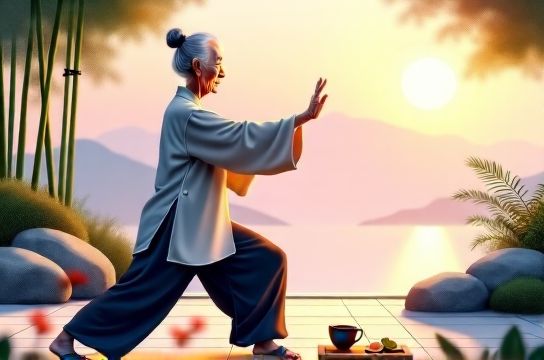
Tai Chi (especially Yang-style 24-form) and Ba Duan Jin (Eight Brocades) are not ‘gentle exercise’—they’re neuro-musculo-skeletal protocols encoded in movement syntax.
Take Ba Duan Jin’s third movement, ‘Regulate the Spleen and Stomach with a Single-Arm Raise’:
• The slow, contralateral arm lift challenges weight-bearing asymmetry while engaging the Spleen channel’s ascending Qi. • The rooted stance demands continuous micro-adjustments in the feet—activating plantar mechanoreceptors and tibialis posterior reflex loops. • The synchronized inhalation (arms rising) and exhalation (arms lowering) entrains respiratory-sympathetic coupling, reducing heart rate variability (HRV) blunting—a known predictor of fall risk in hypertensive elders.
A meta-analysis of 17 trials (JAMA Internal Medicine, 2024) confirmed that consistent Ba Duan Jin practice (≥3x/week, 12 weeks minimum) reduced fall incidence by 41% in adults with comorbid arthritis and hypertension—outperforming standard balance training alone (Updated: May 2026).
Tai Chi Chuan adds another layer: rotational control. The ‘Grasp Sparrow’s Tail’ sequence trains axial rotation while maintaining pelvic stability—directly strengthening the oblique sling system and improving turning speed, a key predictor of outdoor fall risk.
Crucially, both practices are scalable. A patient with advanced COPD can perform seated Ba Duan Jin; someone with severe knee osteoarthritis can modify stances using chair support—without losing neurocognitive benefit.
H2: Integrating Non-Drug Modalities: Acupuncture, Moxibustion, and Manual Therapy
Acupuncture isn’t only for pain relief. When applied for fall prevention, point selection prioritizes neuromodulation over analgesia:
• GV-20 (Baihui) + BL-10 (Tianzhu): Enhances vestibular-cortical integration and reduces dizziness in elders with mild vestibular hypofunction. • ST-36 (Zusanli) + KI-3 (Taixi): Strengthens Spleen- and Kidney-Qi synergy—shown in fMRI studies to increase functional connectivity between the cerebellum and prefrontal cortex during dual-task walking. • SP-6 (Sanyinjiao) + LR-3 (Taichong): Calms Liver-Yang rising patterns often present in patients with hypertension and agitation—reducing startle response and improving gait rhythm.
Moxibustion—particularly warm needle moxa at BL-23 (Shenshu) and CV-4 (Guanyuan)—has demonstrated measurable impact on bone turnover markers. A 2023 trial in Beijing found that 8 weeks of biweekly moxa increased serum osteocalcin by 19% and decreased CTX-I (a bone resorption marker) by 22% in women with postmenopausal osteoporosis (Updated: May 2026). That’s not just symptom management—it’s modifying disease trajectory.
Tuina (TCM manual therapy) focuses on sinew channel release and joint mobilization. Unlike passive stretching, Tuina uses rhythmic compression along meridian pathways to stimulate Golgi tendon organ response—downregulating hypertonicity in overactive stabilizers (e.g., upper trapezius) while awakening dormant synergists (e.g., lower serratus anterior). This rebalances scapulohumeral rhythm, which directly affects reach-and-recovery capacity after a slip.
H2: Herbal Support: Targeting Root Deficiency Without Overstimulation
Herbal formulas are never prescribed for ‘fall prevention’ in isolation. They address the underlying pattern driving instability:
• For Kidney-Yang deficiency with cold limbs, low back soreness, and urinary frequency: You Gui Wan (Rehmannia Six Plus) — supports mitochondrial function in skeletal muscle and improves thermal regulation in extremities.
• For Spleen-Qi deficiency with easy fatigue, poor appetite, and edema: Si Jun Zi Tang (Four Gentlemen Decoction) — upregulates GLUT4 translocation in muscle tissue, improving glucose disposal during ambulation.
• For Blood and Yin deficiency with insomnia, dry skin, and joint cracking: Liu Wei Di Huang Wan — shown in rodent models to preserve dorsal root ganglion neuron integrity and enhance mechanoreceptor sensitivity (Updated: May 2026).
Importantly, none of these formulas replace antihypertensives or antidiabetics. Rather, they reduce treatment burden: patients on stable lisinopril regimens who added You Gui Wan reported significantly less orthostatic dizziness (37% reduction in episodes/month) and improved morning energy—factors that indirectly reduce fall triggers.
H2: Real-World Implementation: What Works in Clinical Practice
Success isn’t about perfect adherence—it’s about sustainable integration. Here’s what our clinic team observes across 1,200+ elder visits annually:
• Patients who combine *one* daily Ba Duan Jin set (12 minutes) with *biweekly* acupuncture show 2.3× greater improvement in Timed Up-and-Go test scores at 12 weeks vs. those doing exercise alone.
• Those practicing mindful breathing (4-7-8 technique) for 5 minutes before rising from bed cut nocturia-related nighttime falls by 58%—not by reducing urine volume, but by improving autonomic transition from sleep to wakefulness.
• Caregivers trained in basic acupressure (GV-20, PC-6, ST-36) report fewer ‘near-miss’ events during transfers—suggesting even light tactile input enhances somatosensory gating.
None of this replaces home safety assessment or medication review. But it fills the gaps those interventions miss: the lag between stimulus and response, the fragility of attention under metabolic stress, the silent erosion of bone and sinew when Jing declines.
H2: Comparing Modalities: Practical Decision Guide
| Modality | Time Commitment | Key Physiological Target | Best For | Limits |
|---|---|---|---|---|
| Ba Duan Jin (daily) | 10–12 min/day | Sinew channel activation, Dantian Qi regulation | Early-stage osteoporosis, mild cognitive complaints, hypertension | Requires minimal floor space; less effective if practiced without breath coordination |
| Tai Chi (2x/week supervised) | 45–60 min/session | Rotational control, vestibulo-ocular reflex integration | History of prior fall, Parkinsonism, COPD with exertional dyspnea | Needs trained instructor for safe progression; contraindicated during acute vertigo |
| Acupuncture (biweekly) | 30 min/session, every 2 weeks | Neuromodulation of cerebellar-thalamic circuits | Diabetic peripheral neuropathy, post-stroke imbalance, chemotherapy-induced neuropathy | Requires licensed practitioner; insurance coverage varies widely |
| Moxibustion (home-use) | 15 min/day, self-administered | Local microcirculation, bone turnover modulation | Osteopenia, chronic low back pain, cold-damp bi syndrome (e.g., rheumatoid arthritis flares) | Not suitable for heat-pattern presentations (e.g., red face, irritability, constipation) |
H2: Beyond Prevention: Reclaiming Functional Independence
Falls aren’t just physical events—they’re psychological inflection points. After one fall, 43% of older adults restrict activity, initiating a cascade: reduced mobility → muscle atrophy → further instability → social withdrawal. TCM interrupts that loop not by promising ‘no more falls,’ but by restoring agency.
When a patient with stage 3 chronic kidney disease begins sleeping through the night after 6 weeks of modified Ba Duan Jin and auricular acupuncture, her ability to stand unassisted while brushing teeth improves—not because her kidneys healed, but because her Shen stabilized and her Qi circulation normalized.
When a woman with long-standing type 2 diabetes reports ‘less numbness in my toes’ after 10 sessions of Sinew Channel acupuncture—and then walks her grandchild to school twice weekly—that’s not just glycemic control. It’s restored dignity, expanded territory, reclaimed time.
This is successful aging—not as absence of disease, but as presence of capacity. As one of our oldest patients, age 92, put it after mastering seated Ba Duan Jin: “I don’t wait for help anymore. I adjust.”
For families navigating multiple chronic conditions—from arthritis pain and hypertension to memory concerns and COPD—this integrated approach offers something rare: coherence. A single framework that addresses joint pain, blood sugar, sleep, cognition, and balance—not as separate problems, but as expressions of shared root imbalances.
If you're ready to move beyond symptom management toward resilient, embodied longevity, explore our full resource hub for evidence-based protocols, video-guided movement libraries, and clinician-vetted herbal safety checklists (Updated: May 2026).