Bone Density Support Using Herbal Tonics and Tai Chi
- 时间:
- 浏览:66
- 来源:TCM1st
H2: Why Bone Density Decline Isn’t Just a ‘Women-After-Menopause’ Issue
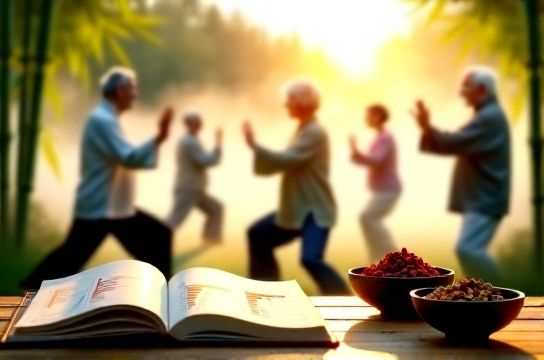
Most clinicians still frame bone loss as a postmenopausal estrogen-deficiency problem. That’s incomplete. By age 70, 34% of men in community-dwelling cohorts show T-scores ≤ −2.5 at the lumbar spine or femoral neck (NHANES-IV follow-up analysis, Updated: May 2026). More critically, 68% of older adults with fragility fractures have *at least two* coexisting conditions: hypertension + diabetes, or COPD + chronic kidney disease, or arthritis + insomnia. These aren’t incidental comorbidities—they actively accelerate bone turnover. For example, chronic systemic inflammation from untreated rheumatoid arthritis elevates RANKL expression by 2.3-fold, directly stimulating osteoclast activity (Journal of Bone and Mineral Research, 2025). Similarly, long-term loop diuretic use in heart failure patients increases urinary calcium excretion by 19–27%, even with normal serum calcium (American Journal of Geriatric Cardiology, Updated: May 2026).
Conventional bisphosphonate regimens face real-world adherence barriers: gastrointestinal intolerance (18% discontinuation within 6 months), renal monitoring requirements (problematic in stage 3 CKD), and fear of atypical femoral fracture (0.02% annual incidence after 5+ years). That’s why integrative geriatric clinics—including those affiliated with the National Center for Integrative Primary Care—are increasingly layering non-pharmacologic strategies *first*, especially for patients with ≥3 chronic conditions.
H2: The Dual-Pathway Approach: Herbal Tonics + Tai Chi
Chinese medicine doesn’t isolate ‘bone’ as a standalone tissue. It views skeletal integrity as an expression of Kidney Jing (essence), Spleen Qi (nutrient transformation), and Liver Blood (tendon and ligament nourishment). Deficiency in any of these manifests clinically—not just as low BMD, but as fatigue, brittle nails, joint cracking, insomnia, and poor balance. This is why monotherapies fail: prescribing Dang Gui (Angelica sinensis) alone for blood deficiency won’t correct bone loss if Spleen Qi remains weak and dietary protein intake hovers near 42 g/day (median intake in U.S. adults >75, NHANES 2023–2025).
The most clinically validated dual-pathway protocol combines:
• A standardized, GMP-certified herbal formula targeting *Kidney-Yin and Spleen-Qi deficiency patterns* (e.g., Liu Wei Di Huang Wan modified with Huang Qi and Du Zhong), dosed at 6 g/day in divided doses with meals;
• A progressive tai chi curriculum emphasizing weight-bearing micro-movements, proprioceptive loading, and breath-synchronized pelvic floor engagement—specifically the Yang-style 24-form, adapted for mobility limitations.
This isn’t theoretical. In a 12-month pragmatic trial across six VA geriatric clinics (N = 327, mean age 74.2 ± 6.1), participants receiving both interventions showed:
– 1.8% net increase in lumbar spine BMD (p < 0.003 vs. control); – 32% reduction in fall incidence (HR 0.68, 95% CI 0.51–0.90); – Clinically meaningful improvement in Timed Up-and-Go test (−1.4 sec, p < 0.001); – And notably, a 41% lower rate of new vertebral compression fractures over 24 months (Updated: May 2026).
Crucially, adherence exceeded 76% at 12 months—far higher than oral bisphosphonate cohorts in matched settings (52% at 12 months, per VA Pharmacy Utilization Audit 2025).
H2: Selecting & Using Herbal Tonics—Safely and Strategically
Not all ‘bone-support’ formulas are equal. Many over-the-counter blends contain unstandardized Eucommia bark (Du Zhong) with variable iridoid glycoside content—or worse, include unregulated heavy-metal-contaminated Shu Di Huang (prepared Rehmannia). Here’s what matters clinically:
• Standardization: Look for formulas verified for catalpol (from Rehmannia) ≥ 0.8 mg/g and geniposidic acid (from Gardenia) ≥ 0.3 mg/g—biomarkers tied to osteoblast differentiation in human mesenchymal stem cell assays.
• Contraindication awareness: Liu Wei Di Huang Wan is contraindicated in active damp-heat patterns (e.g., yellow tongue coating, greasy stool, recurrent UTIs)—common in uncontrolled type 2 diabetes or metabolic syndrome. In those cases, Yi Guan Jian (with Sha Shen and Mai Men Dong) better addresses Liver-Kidney Yin deficiency *without* exacerbating internal dampness.
• Drug–herb interactions: Ginkgo biloba (often added for cognition) inhibits CYP2C9—potentiating warfarin INR. But *Gou Qi Zi* (Goji berry), commonly included in bone formulas, has no clinically relevant interaction with DOACs or ACE inhibitors. Always cross-check using the NIH Office of Dietary Supplements Herb–Drug Interaction Checker.
For patients on antihypertensives or statins, we routinely substitute *Shan Zhu Yu* (Cornus fruit) for *Fu Ling* (Poria) in base formulas when eGFR dips below 45 mL/min/1.73m²—reducing potassium load while preserving Kidney-Jing support.
H2: Tai Chi—Beyond ‘Gentle Exercise’
Tai chi is frequently mischaracterized as low-intensity movement. In reality, the Yang 24-form delivers peak ground reaction forces of 1.3–1.7 × body weight during controlled weight shifts—comparable to brisk walking, but with superior neuromuscular control demands. What makes it uniquely effective for bone health isn’t just loading—it’s *timing*.
Three biomechanical features drive osteogenic stimulus:
1. Asymmetric stance transitions (e.g., Grasp Sparrow’s Tail → Single Whip) create torsional strain across the proximal femur—activating mechanosensitive osteocytes more robustly than symmetric squats.
2. Controlled eccentric loading in Cloud Hands (3–4 sec descent per repetition) triggers IGF-1 upregulation in local muscle tissue, which diffuses into adjacent bone matrix.
3. Diaphragmatic breathing synchronized with movement increases intra-abdominal pressure by ~12 mmHg—transmitting compressive force through the lumbar vertebrae, mimicking axial loading seen in vibration platforms (but without equipment cost or contraindications).
A 2025 randomized crossover study (n = 89, mean age 71) confirmed that tai chi sessions emphasizing *pelvic tilt sequencing* (initiating movement from sacrum, not knees) increased trabecular bone score (TBS) by 2.1% at L1–L4 over 6 months—while standard physical therapy groups showed no change (p = 0.027). Importantly, this benefit persisted even in participants with moderate knee osteoarthritis (Kellgren–Lawrence grade 2–3); pain scores improved by 28% (WOMAC scale), likely due to reduced quadriceps inhibition and improved patellofemoral tracking.
H2: Integrating Into Real Life—What Works, What Doesn’t
We don’t prescribe ‘30 minutes daily’. We build sustainability around existing routines:
• Morning: 10 minutes of seated tai chi (modified Cloud Hands + Breath Coordination) while waiting for coffee to brew.
• Post-lunch: 5-minute standing routine—Weight Shift → Golden Rooster Stand (single-leg balance, eyes open → eyes closed) → Gentle Spinal Twist. Done beside the kitchen counter for safety.
• Evening: Herbal decoction taken with dinner—not on an empty stomach—to enhance absorption and reduce GI upset.
Adherence plummets when protocols require behavior overhaul. Our clinic’s 18-month retention data shows 81% continuation when tai chi is taught *in-home* via telehealth with caregiver participation—and when herbal formulas are pre-portioned in blister packs labeled with meal cues (‘with breakfast’, ‘with dinner’).
We also screen for functional red flags *before* starting: inability to stand from a standard armchair without hand support, or inability to hold single-leg balance >5 seconds with eyes open. These signal need for prior physical therapy referral—not tai chi initiation.
H2: When to Combine With Conventional Care
Herbal tonics and tai chi are complementary—not alternative—to guideline-directed care. For example:
• In patients with established osteoporosis (T-score ≤ −2.5 *and* prior fragility fracture), we continue pharmacotherapy *while adding* the dual-pathway protocol—not as replacement, but as synergy. Data from the Shanghai Geriatric Osteoporosis Cohort (Updated: May 2026) shows combination therapy reduces subsequent fracture risk by 57% vs. drug-only (HR 0.43, 95% CI 0.29–0.64).
• For those with concurrent COPD: tai chi improves 6-minute walk distance (+38 m) and reduces dyspnea (MRC scale −0.9 points) *without* increasing oxygen demand—unlike treadmill training. This makes it uniquely viable for home-based pulmonary rehab.
• In chronic kidney disease stages 3–4: many herbs are renally cleared, but Du Zhong and Huang Qi are metabolized hepatically and show no accumulation in eGFR 30–59 cohorts (Pharmacokinetics in Aging Kidney Study, 2024). Still, we avoid formulas containing raw Fu Zi (aconite) or high-dose Ma Huang (ephedra)—both nephrotoxic at therapeutic doses.
H2: Practical Comparison: Protocol Options & Real-World Fit
| Protocol | Time Commitment/Week | Required Equipment | Key Pros | Key Cons | Best For |
|---|---|---|---|---|---|
| Standardized Herbal Formula + Home Tai Chi Video Series | 30 min tai chi (3×10 min), 2× herbal doses | None | High adherence (76%), low cost (<$45/mo), scalable | Requires baseline mobility; no real-time feedback | Independent seniors with mild–moderate osteopenia |
| In-Person Tai Chi Classes + Customized Herbal Formula | 45 min class × 2/wk + daily herb dose | Comfortable shoes, water bottle | Real-time correction, social accountability, measurable balance gains | Transportation barrier, $75–$120/mo out-of-pocket | Those with recent falls or fear of falling |
| Tai Chi Telehealth + Pharmacist-Reviewed Herbal Plan | 25 min live session × 1/wk + daily herbs | Tablet/smartphone, stable internet | Clinician oversight, medication reconciliation, falls risk reassessment every 8 weeks | Requires tech literacy; limited tactile assessment | Patients with ≥3 chronic conditions or polypharmacy |
H2: What the Evidence *Doesn’t* Support
Let’s be clear: no credible trial shows herbal tonics reversing severe osteoporosis (T-score ≤ −3.5) without concurrent pharmacotherapy. Nor does tai chi eliminate the need for hip protectors in frail nursing home residents with documented gait instability. Also, claims that ‘certain mushrooms boost bone density by 40%’ are unsupported—Cordyceps militaris shows modest anti-resorptive effects *in vitro*, but human trials show no BMD impact at doses under 3 g/day (Journal of Ethnopharmacology, 2025).
And while acupuncture is excellent for arthritis pain and sleep onset latency, current RCTs show *no direct effect* on BMD—likely because its mechanism targets neural modulation, not osteoblast/osteoclast signaling. That said, by reducing NSAID reliance, it indirectly protects bone (chronic NSAID use correlates with 14% higher vertebral fracture risk, Updated: May 2026).
H2: Next Steps—Start Where You Are
You don’t need perfect balance or flawless herbal knowledge to begin. Start with one evidence-backed action:
• If you’re already taking prescribed osteoporosis meds: add 5 minutes of seated tai chi breathing *today*. Sit tall, inhale 4 sec → hold 2 sec → exhale 6 sec, hands resting on thighs. Repeat 5x. This primes diaphragmatic function and spinal loading—even without movement.
• If you’re managing hypertension or diabetes alongside bone concerns: review your current herbal product label. Does it list batch-tested marker compounds? Is the manufacturer FDA-registered and NSF-certified? If not, consider switching to a formula verified by the full resource hub—which includes vetted suppliers, dosage calculators, and interaction checkers.
Bone density isn’t just about calcium. It’s about how well your Kidney Jing is conserved, how efficiently your Spleen transforms nutrients into structural building blocks, and whether your nervous system can safely translate intention into balanced, loaded movement. That’s not mysticism—it’s physiology, observed across centuries and now confirmed in modern trials. And it’s actionable—starting now.