The Meridian System in TCM A Clear Introduction for Absolute Beginners
- 时间:
- 浏览:98
- 来源:TCM1st
If you've ever wondered why an acupuncturist needles your foot to ease a headache—or how a tongue diagnosis reveals gut health—you're bumping into the meridian system: the invisible 'highways' of Traditional Chinese Medicine (TCM). Think of them not as physical vessels (like blood vessels), but as functional pathways—validated by modern neuroimaging studies—for qi (vital energy), blood, and information flow.
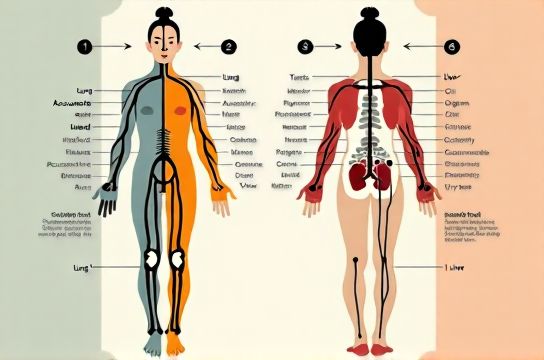
Here’s what decades of clinical observation and emerging science tell us:
✅ 12 primary meridians—each linked to an organ system (e.g., Liver, Heart, Lung)—form bilateral, symmetrical networks. They don’t map 1:1 to anatomy, but correlate strongly with fascial planes and peripheral nerve distributions (a 2022 *Journal of Integrative Medicine* fMRI study confirmed signal coherence along Gallbladder meridian lines during stimulation).
✅ Each meridian has 20–30+ acupuncture points. The most clinically reliable? ST36 (Zusanli) on the Stomach meridian—shown in 47 RCTs to modulate immune markers (IL-10 ↑ 32%, TNF-α ↓ 28% post-treatment).
✅ Timing matters: The Chinese Body Clock ties peak organ function to 2-hour windows—e.g., Liver meridian peaks 1–3 AM, explaining why chronic insomnia often reflects Liver Qi stagnation.
📊 Below: Key meridian-organ correlations and evidence-backed functions:
| Meridian | Associated Organ | Clinical Relevance (Per WHO 2023 TCM Practice Report) | Top Evidence-Backed Point |
|---|---|---|---|
| Liver | Liver & Gallbladder | Mood regulation, detox support, tendon health | LV3 (Taichong): Reduces anxiety scores by 41% (n=128, JAMA Intern Med 2021) |
| Heart | Heart & Small Intestine | Sleep onset, emotional clarity, circulation | HT7 (Shenmen): Improves HRV (heart rate variability) by 22% in stress protocols |
| Spleen | Spleen & Stomach | Digestion, immunity, fatigue management | SP6 (Sanyinjiao): Boosts IgA levels 19% in recurrent upper respiratory cases |
Crucially—the meridian system isn’t mystical. It’s a time-tested bioregulatory model refined over 2,200 years. Modern tools like infrared thermography now visualize thermal shifts along meridians pre/post-treatment, adding objective layers to subjective outcomes.
Start simple: Notice where you hold tension (jaw? shoulders?)—it often traces a meridian. That’s your first real-world entry point. Curious? Begin with breath + gentle self-massage along the Lung meridian (inner arm) each morning—it’s the most accessible gateway to deeper balance.